Guides
Service Quality Management Software for Customer Support Teams
Author
Published
Intryc
September 9, 2026
Service quality management software is a system that evaluates support interactions against a defined standard, then connects what it finds to coaching and training - not just a scoring tool. The loop runs in four stages: define quality in a custom scorecard, evaluate interactions at the coverage level you choose, calibrate the AI evaluator against human reviewers, then turn findings into coaching and training and track the result over time. Intryc runs this loop across every conversation - human and AI - on your scorecard, your rules, at 90% accuracy - guaranteed.
Updated September 2026.
I'm Alex Marantelos, co-founder and CEO of Intryc. Before this, I ran Customer Success for Northern Europe at Confluent on a $40M ARR book of business, and the QA process I inherited there covered a manual sample, not the full queue - the same gap I hear from every support leader we work with now.
What service quality management software does for support teams
Service quality management software applies a team's own quality standard to support interactions, surfaces where performance is falling short, and pushes those findings into coaching and training instead of leaving them as a score on a dashboard.
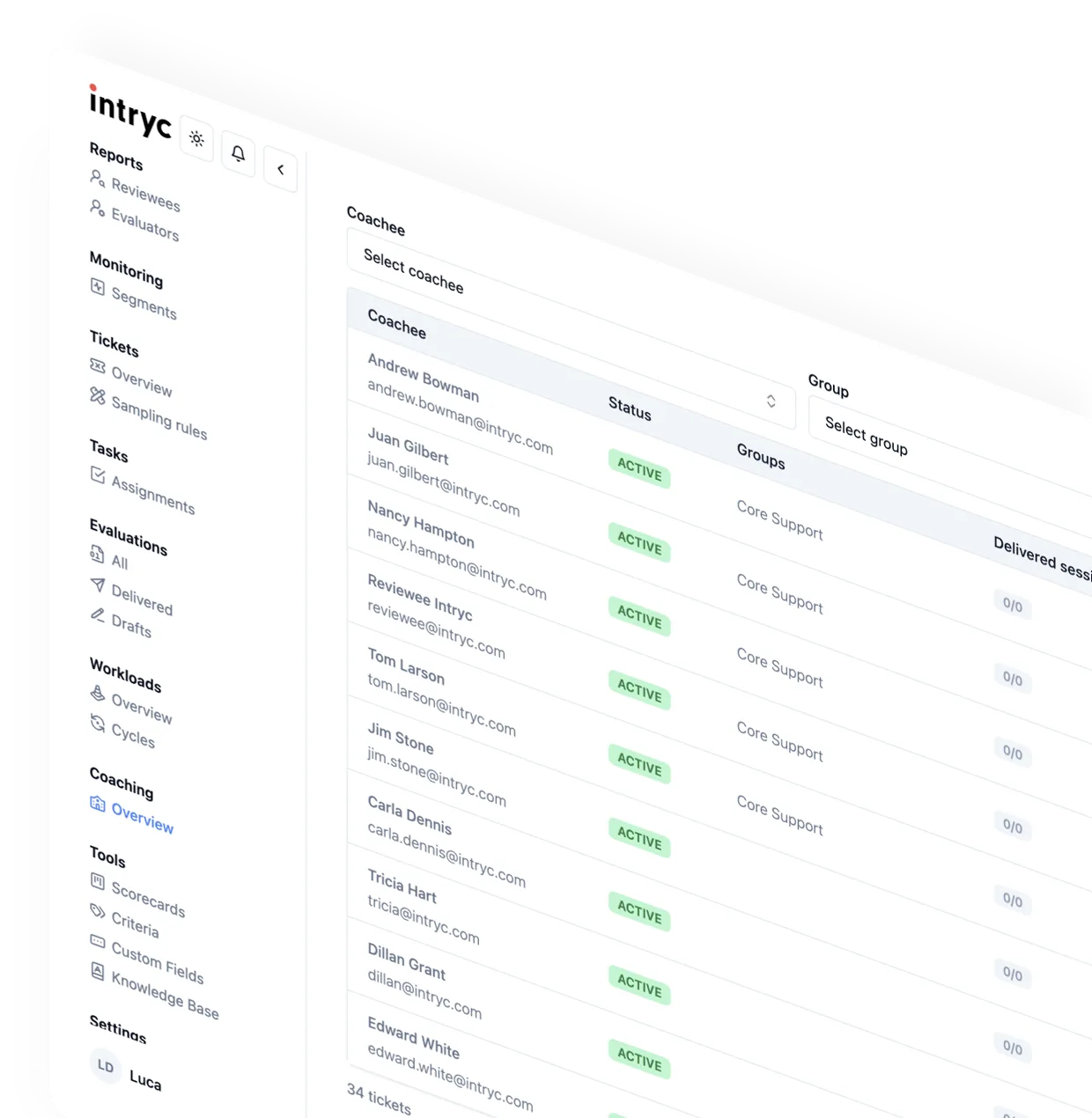
Intryc's customers use the platform to automate ticket, call, chat, and email scoring, gather and summarize patterns and insights, and create and assign training modules for their agents. That is the full scope: define standards, evaluate against them, extract findings, and act on those findings - not scoring in isolation.
Most teams already have a scorecard. What they are missing is a way to apply it beyond a manual sample, compare AI scoring against human judgment they trust, and connect a flagged criterion to a coaching assignment without three separate tools and a spreadsheet in between.
How the service quality loop works
The loop has four stages, and each one feeds the next:
- Define standards. Build your scorecard - the criteria, weighting, and pass/fail thresholds that reflect how your team actually judges quality. Your scorecard, your rules: the tool configures to your rubric, not the reverse.
- Evaluate interactions. Intryc reviews 100% of customer support interactions - calls, chats, emails, and tickets - using AI, and applies your custom QA scorecard to each conversation. You are not limited to a manual sample of less than 5% of conversations, and you are not locked into "review everything or nothing" - see the coverage section below.
- Calibrate against human review. Compare AI and human evaluations criterion by criterion, refine the scoring instructions, and resolve scorecard or knowledge gaps before you trust the AI evaluator at scale.
- Coach, train, and track. Findings connect to coaching and training simulations, and you track whether the coaching actually moved the numbers - scorecard improvement per agent, CSAT and NPS trends, first contact resolution, and whether the same mistake keeps recurring.
A support leader running this loop is not asking "did the agent follow the script." They are asking "where is quality breaking down, is the AI evaluator trustworthy, and did the fix work" - and answering all three from the same system.
How can teams review support interactions beyond random sampling
The default assumption is that more coverage means giving up your own standards for a generic pass/fail check. It does not have to.
Intryc reviews 100% of customer support interactions - calls, chats, emails, and tickets - using AI and applies your team's custom QA scorecard to every conversation. That is different from the traditional manual-QA pattern, where an analyst pulls a small sample by hand and reviews it against the same rubric - just for a sliver of volume. Most programs land at less than 5% of conversations this way, often less than 1%.
Intryc supports both modes on the same scorecards - the choice is about where you want the signal, not a limitation of the tool:
| Decision dimension | Intelligent attribute-based sampling | 100% conversation coverage |
|---|---|---|
| What gets evaluated | Conversations targeted by risk, sentiment, agent, or ticket type | Every interaction, human and AI |
| Best when | A statistically significant read weighted to what matters is enough | Failure cost is high or you need a complete audit trail |
| Typical use | Ongoing quality trending, agent coaching, calibration | Compliance queues, new AI agent rollout, high-risk flows |
| Scorecard | Your scorecard, your rules | Your scorecard, your rules |
| Accuracy | 90% accuracy - guaranteed | 90% accuracy - guaranteed |
A compliance-exposed queue or a newly deployed AI agent is a case for full coverage; steady-state coaching and trending can run on a targeted sample. Either way, the standard applied is the one your team wrote.
How does Intryc keep AI quality scoring aligned with human reviewers
Handing evaluation to AI only works if a support leader can trust the score, and that trust comes from a visible calibration process, not a claim.
Intryc's calibration workflow compares AI and human evaluations criterion by criterion, refines the scoring instructions where they diverge, and resolves scorecard or knowledge gaps that caused the disagreement in the first place. That is the mechanism behind the 90% accuracy - guaranteed commitment: it is measured against your own scorecards and your own ticket data, not a generic benchmark, and it is verified through this same criterion-level comparison rather than asserted.
This matters most in the queues where a wrong score is expensive - regulated fintech interactions, a newly deployed chatbot, any flow a support leader has not personally reviewed at scale. Calibration is how the AI evaluator earns the right to run unsupervised there.
What can teams do with service quality findings after evaluation
A quality score that stays a score does not change anything. The reason to evaluate every conversation is to close the loop back into agent performance.
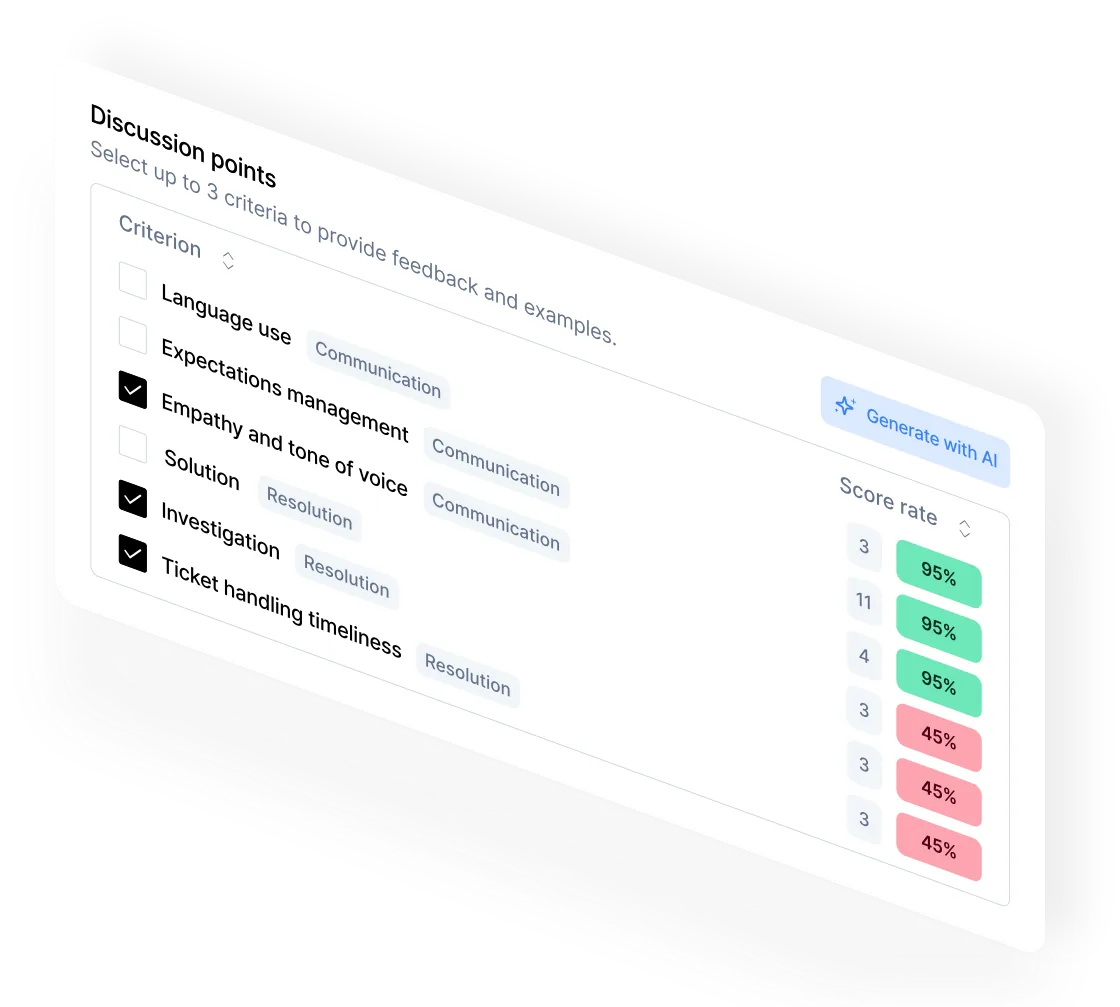
Findings from evaluation connect directly to coaching and training: a flagged scorecard criterion becomes a coaching assignment, and a training simulation gets built from the real conversation that triggered it - not a generic module unrelated to what actually happened on the call. That sequence - evaluate, flag, coach, retrain on the real case - is what separates a QA tool that scores from a system that improves the support function.
Which service quality measures can support leaders track
Evaluation only proves its worth if a leader can see whether the coaching actually worked. Intryc's reporting tracks QA scorecard improvement rates per agent (before vs. after coaching), CSAT and NPS trends, first contact resolution rate, and whether agents repeat the same mistakes.
That list matters because it separates what the QA program is doing (raising scorecard performance, closing the same-mistake pattern) from what it is merely correlated with (CSAT, NPS, FCR). Track both, but do not conflate a scorecard improvement with a CSAT lift - the two move for different reasons, and a leader who tracks only the outcome metric loses the ability to say why it moved.
What to validate before choosing service quality management software
Before committing to a platform, verify these directly with the vendor rather than taking a features page at face value:
- Scorecard configurability - can you build and change your own criteria and weighting, or are you locked into a fixed template?
- Coverage options - does it support both intelligent, attribute-based sampling and 100% real-time coverage on the same scorecards, or only one mode?
- Calibration process - is there a visible, criterion-level way to compare AI scoring against human reviewers, or is accuracy just asserted?
- AI/human override controls - can a human override or correct an AI score, and does that correction feed back into the model's instructions?
- Coaching and training linkage - do flagged findings turn into a specific coaching assignment and a training simulation built from the real case, or stop at a dashboard number?
- Reporting definitions - are scorecard improvement, CSAT/NPS trends, and first contact resolution tracked separately, with clear definitions for each?
- Channel and integration scope - does it cover calls, chats, emails, and tickets, and connect to your existing stack (Zendesk, Intercom, Freshdesk, Twilio, Salesforce, Aircall, JIRA, HubSpot, and other helpdesk tools)?
- Implementation and pricing - what does onboarding actually require, and is pricing per-evaluation or seat-based (seat-based pricing does not scale with coverage the way per-evaluation pricing does)?
Named proof at buyer scale: Deel doubled QA evaluation capacity without adding headcount. SadaPay moved from under 1% coverage to full coverage, with 95-99% AI-powered audits and 10x audit volume. Blueground - 70 agents handling roughly 19,000 monthly tickets - saved 40+ hours a week on manual audits, moved coverage from 2-3% to 5.5%, and improved CSAT from 77% to 82% during their traditionally worst quarter.
FAQ
What does service quality management software do for support teams?
It applies a team's own quality standard to support interactions - calls, chats, emails, and tickets - then connects what it finds to coaching and training instead of leaving results as an isolated score. Intryc's customers use it to automate scoring across channels, surface patterns and insights, and create and assign training modules built from the findings.
How can teams review support interactions beyond random sampling?
Intryc reviews 100% of customer support interactions using AI and applies the team's custom QA scorecard to each conversation, and also supports intelligent, attribute-based sampling on the same scorecards. That replaces the traditional manual-QA pattern of reviewing less than 5% of conversations by hand with a choice between full coverage and a targeted, statistically meaningful sample.
How does Intryc keep AI quality scoring aligned with human reviewers?
Through a calibration workflow that compares AI and human evaluations criterion by criterion, refines the scoring instructions where they diverge, and resolves scorecard or knowledge gaps. That process is what supports the 90% accuracy - guaranteed commitment, measured against your own scorecards and ticket data.
Can findings from evaluation actually improve agent performance, or do they just produce a score?
They connect to action. A flagged scorecard criterion becomes a coaching assignment, and a training simulation is built from the real conversation that triggered it, so the loop runs from evaluation to coaching to retraining rather than stopping at a score.
Which service quality measures should support leaders track?
QA scorecard improvement rate per agent (before vs. after coaching), CSAT and NPS trends, first contact resolution rate, and whether agents repeat the same mistake. Track scorecard improvement and outcome metrics separately - they move for different reasons, and conflating them hides why a number actually changed.
What should teams validate before choosing service quality management software?
Scorecard configurability, whether it supports both 100% coverage and intelligent attribute-based sampling on the same scorecards, a visible calibration process against human reviewers, override controls, whether findings connect to coaching and training, clear reporting definitions, channel and integration coverage, and implementation and pricing model (per-evaluation vs. seat-based).
Does this replace a QA team, or work alongside one?
It scales the QA function rather than removing the people in it. Automating evaluation across every conversation - human and AI - frees QA leads and analysts to spend their time on calibration, root-cause work, and coaching instead of manually pulling and scoring a handful of tickets.
Related resources
- Conversation Coverage for Customer Support QA - the coverage-vs-signal argument behind stage 2 of this loop
- AI QA Scoring Software for Support Teams - detail on the automated scoring mechanism
- QA Automation Software for Customer Support - the automation layer underneath the loop
- Intryc vs. Zendesk QA - how the closed evaluate-to-coach loop differs from native helpdesk QA
What would a fully closed evaluate-to-coach loop change about the quality decisions your team is making today?