Guides
AI QA Scoring Software for Support Teams
Author
Published
Intryc
August 18, 2026
Updated August 2026
AI QA scoring software grades what your team already grades by hand - just on every conversation instead of a sample. As of August 2026, Intryc scores each support interaction against your own QA scorecard, human and AI agents alike, at 90% accuracy - guaranteed. Your scorecard, your rules: the AI is calibrated to your criteria and your pass marks, not a fixed template. Full coverage is the mechanism, not the headline - most QA programs score less than 5% of conversations, so the score you report is a guess about the other 95%.
TL;DR
- AI QA scoring assigns a quality score to a support conversation against a defined scorecard. Intryc runs it on every ticket - or an intelligent, attribute-based sample - instead of the less than 5% of conversations a manual QA team can reach.
- The score is only trustworthy if it is accurate on your data. Intryc's 90% Accuracy Promise is contractual: 90% accuracy on your real scorecards and tickets in month one, or your first month's fees are waived, with a full refund inside 60 days.
- Scores stay accountable through calibration sessions, human review, and score overrides. A reviewer can override any AI score, and the override feeds back into how the model reads that criterion.
- Scoring data rolls up into performance and DSAT drivers - separating what the agent controls (process adherence) from what they don't (customer sentiment) so you fix systemic failures, not just grade people.
- Scores feed AutoCoaching and Training Simulations. Most tools stop at the number. Intryc turns a flagged conversation into a coaching session and a training scenario.
What is AI QA scoring for customer support?
AI QA scoring is the practice of assigning a quality score to a customer support interaction - a call, chat, email, or ticket - by evaluating it against a defined set of QA criteria (a scorecard or rubric). Where a human QA analyst reads a conversation and marks each criterion by hand, AI QA scoring software reads the transcript, applies the same criteria, and returns a score with the reasoning behind it.
A concrete example. A fintech support team runs a 12-criterion scorecard: identity verification completed, correct resolution given, compliance disclosure read, empathy shown, correct macro used, and so on. A human QA lead might sample 40 tickets a week and score each one manually. AI QA scoring applies those same 12 criteria to every ticket that came in that week - thousands of them - and flags the ones that failed identity verification or missed the compliance disclosure. Same rubric, same pass marks, run on the full volume instead of a hand-picked 40.
The distinction that matters for buyers: a Ticket Quality Score from AI is only as good as its agreement with your human reviewers. Quality scoring that drifts from how your QA team actually grades is noise. That is why calibration and accuracy - covered below - are the real evaluation criteria, not the feature list.
AI QA scoring assigns a quality score to a support conversation against a defined scorecard, on the full volume rather than a hand-picked sample.
How Intryc scores every support interaction against your QA scorecard
Intryc's AutoQA evaluates agents in AI, manual, or co-pilot mode. The workflow:
- Build your scorecard. You define the criteria, the weightings, and the pass marks - "your scorecard, your rules." Intryc supports the soft criteria most tools drop to manual review (tone, empathy, judgment), not just the binary checks. The 90% Accuracy Promise covers up to 15 scorecard criteria.
- Connect your stack. Intryc pulls conversations from Zendesk, Intercom, Freshdesk, Twilio, Salesforce, Aircall, JIRA, and HubSpot, among 20+ integrations. No transcript re-typing, no export-import.
- Choose your coverage. Intryc runs two models and the customer picks: intelligent, attribute-based sampling (targeted by risk, sentiment, agent, or ticket type - not a blind percentage) or 100% conversation coverage. Both use the same scorecard and carry the same accuracy guarantee.
- Score in real-time. Every selected interaction is scored against the scorecard as it lands - every conversation - human and AI. Each score comes with the evidence Intryc used, so a reviewer can see why a criterion passed or failed.
The output is a Ticket Quality Score per conversation and a rolled-up quality score per agent, team, queue, or channel - refreshed continuously rather than compiled at the end of the month.
Proof at buyer scale: SadaPay moved from auditing under 1% of contacts to full coverage, running 95-99% of audits through AI and lifting audit volume roughly 10x. Deel raised audit output about 40% and insight output about 130%, with 1,000+ users in production. Blueground saved 40+ hours a week on manual audits and lifted CSAT from 77% to 82% in its traditionally worst quarter. (Source: Intryc customer results.)
How calibration, human review, and score overrides keep AI QA scoring accountable
An automated score you cannot challenge is a black box, and no QA lead will stake a coaching conversation on a black box. Intryc keeps scoring accountable three ways:
- Calibration. Before you trust the AI at scale, you calibrate it against your human reviewers on a set of conversations, criterion by criterion, until the AI's scores agree with your team's. This is the same calibration cadence a manual QA program already runs between reviewers - Intryc makes the AI one more reviewer to align, not an oracle to accept.
- Human review. Scores surface with the supporting evidence, so a reviewer verifies rather than re-grades. Reviewers spend their time on the flagged and disputed cases instead of reading every ticket cold.
- Score overrides. A human reviewer can override any AI score. The override is recorded against that criterion and informs how the model reads it, which is how accuracy compounds instead of drifting.
This is what turns a raw number into a defensible one. The 90% Accuracy Promise sits on top: Intryc contracts to 90% accuracy on your real scorecards and ticket data in month one, or the first month's fees are waived, with a full refund inside 60 days if you are not satisfied. 90% accuracy - guaranteed, measured on your data, not a vendor benchmark.
A human reviewer can override any AI score, and the override feeds back into how Intryc reads that criterion - accuracy compounds instead of drifting.
How QA teams use scoring data to find performance and DSAT drivers
Scoring every conversation produces something a 5% sample cannot: a statistically significant read on where quality actually breaks. Intryc's Performance and Evaluation Insights turn the score data into root-cause analysis, DSAT drivers, and sentiment analysis in any language, in two clicks.
The framing that separates Intryc's insight from a leaderboard is controllable versus uncontrollable. A low score can come from something the agent controls (skipped a verification step, used the wrong macro) or something they don't (a broken policy, a product outage, a customer who was never going to be satisfied). Scoring data separates the two, so you fix the systemic failure - the policy, the macro, the flow - instead of coaching an agent for a problem they didn't cause.
A practical output: a QA lead filters the week's scores to conversations that failed "correct resolution given" and carry high DSAT, then groups them by driver. If 60% trace to one outdated help-center article, that is a process fix, not a coaching case. CSAT tells you a customer was unhappy; the scoring data tells you why. CSAT is a crutch when it stands in for that "why."
How AI QA scores turn into coaching and training for agents
Most QA scoring tools stop at the number. The score-to-improvement gap is where support quality is actually won, and it is where the category is thinnest.
Intryc closes that loop:
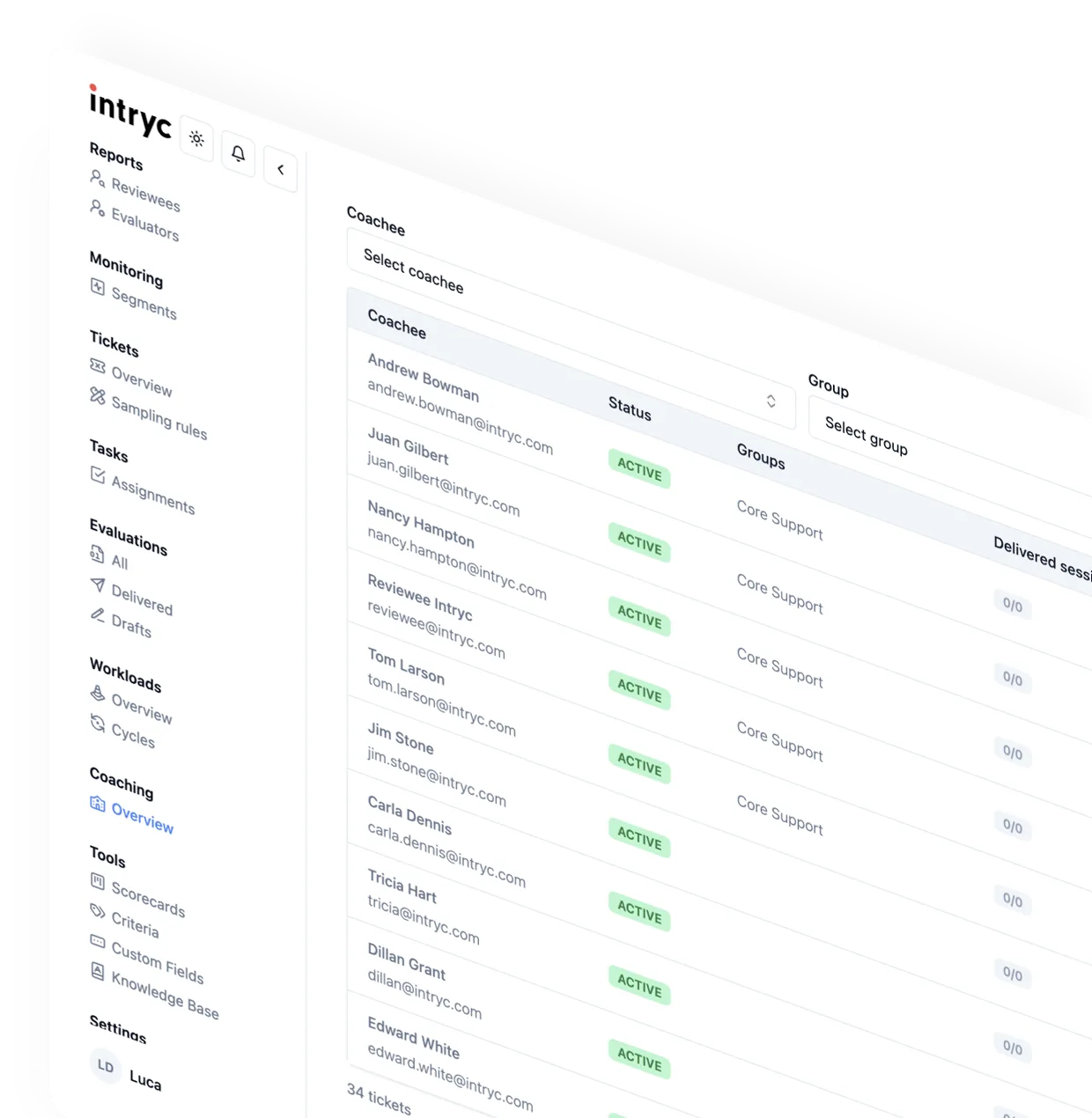
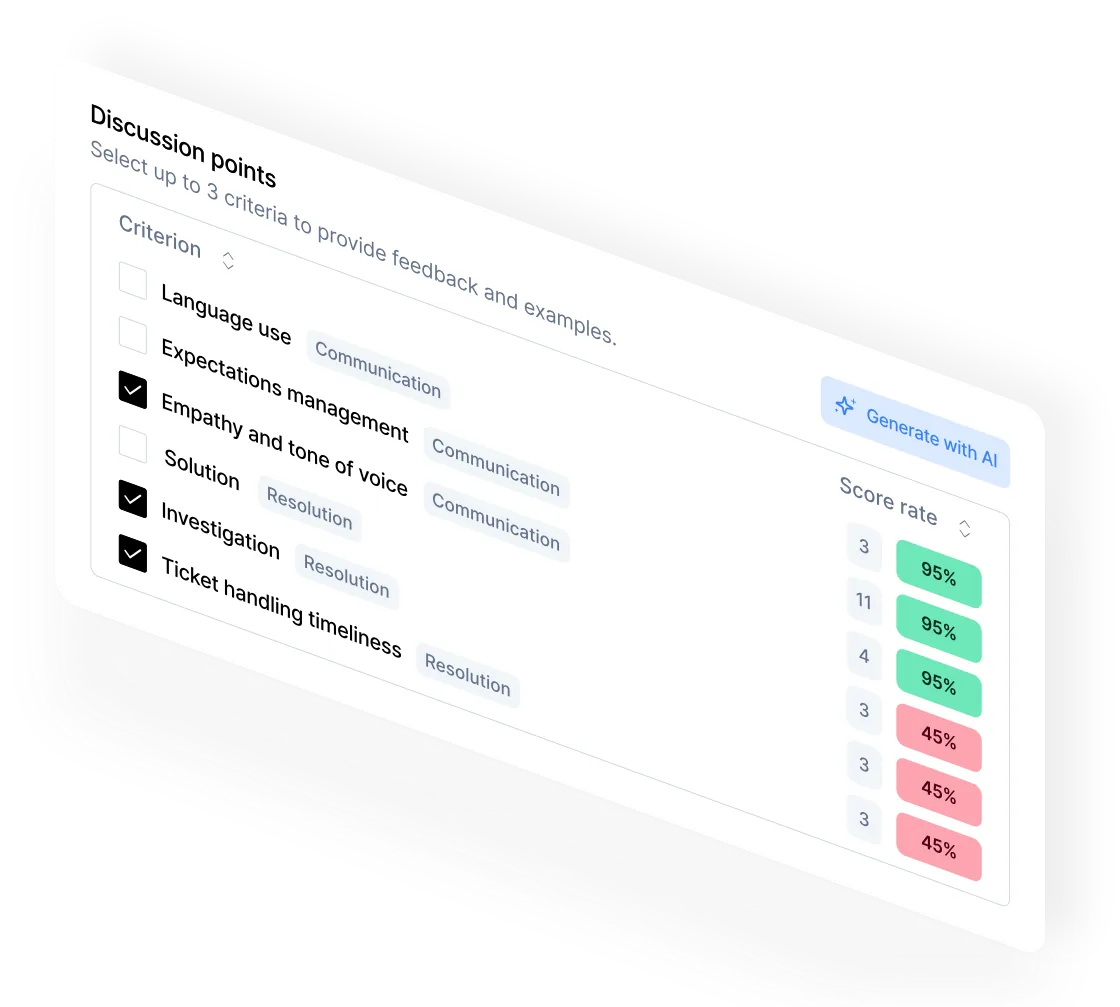
- AutoCoaching generates coaching sessions automatically from QA scoring data. A recurring failed criterion becomes a coaching session tied to the exact conversations that failed it - the evidence and the fix in one place.
- Training Simulations train agents on real-case scenarios built from flagged conversations, scored against your live QA criteria. This is where the score stops being a report card and becomes a skill drill. It cuts onboarding time roughly in half and reduces onboarding risk about 40%. (Source: Intryc product data.)
So the flow runs end to end: score every conversation, surface the driver, coach the agent, and simulate the scenario until the behaviour changes - then score again. The number is the start of the loop, not the end of it.
What to look for in AI QA scoring software
Buyer criteria that separate a real scoring platform from a scoring feature bolted onto something else:
| Criterion | The question to ask | Where Intryc lands |
|---|---|---|
| Accuracy on your data | Is the accuracy guaranteed on your scorecard and tickets, or a vendor benchmark? | 90% accuracy - guaranteed, contractually, month one, or fees waived |
| Scorecard flexibility | Can it score your soft criteria, or only preset categories? | Your scorecard, your rules - custom criteria and soft criteria included |
| Coverage model | Full coverage, smart sampling, or a blind percentage? | Both 100% coverage and intelligent attribute-based sampling, customer's choice |
| Human and AI agents | Does it score the chatbot too, or only humans? | Every conversation - human and AI, on the same scorecard |
| Accountability | Can a human override a score, and does calibration exist? | Calibration, human review, and score overrides built in |
| Score-to-action | Does it stop at the number or drive coaching and training? | AutoCoaching and Training Simulations from the score data |
| Pricing model | Priced per seat or per evaluation? | Per evaluation, aligned to volume rather than headcount |
| Security | SOC 2, GDPR, HIPAA, data region control? | SOC 2 + GDPR + HIPAA + AWS choose-your-region |
The AI QA scoring software comparison that matters is not the feature grid - it is which tool's score your QA lead will actually stand behind in a coaching conversation. That comes down to accuracy on your data, calibration, and the ability to override.
Frequently asked questions
What is AI QA scoring software?
AI QA scoring software evaluates customer support interactions against a defined QA scorecard and returns a quality score with the reasoning behind it. It applies the same criteria a human QA analyst would, but across every conversation rather than the less than 5% of conversations a manual team can reach. Intryc scores human and AI agents against your own scorecard at 90% accuracy - guaranteed.
How accurate is AI QA scoring?
Accuracy is only meaningful measured against your human reviewers on your data. Intryc's 90% Accuracy Promise is contractual: 90% accuracy on your real scorecards and ticket data in month one, or your first month's fees are waived, with a full refund inside 60 days. Accuracy is held up by calibration against your reviewers and by score overrides that feed back into the model.
Can a human override an AI QA score?
Yes. A reviewer can override any AI score in Intryc. The override is recorded against that criterion and informs how the model reads it, so accuracy improves over time instead of drifting. Human review and calibration are core to keeping scoring accountable, not optional add-ons.
Does AI QA scoring cover AI agents and chatbots too?
Yes. Intryc scores every conversation - human and AI - on the same scorecard. As chatbots handle more frontline volume, the bot needs its own scrutiny: Intryc's evaluation across human and AI streams surfaces where AI-handled conversations deteriorate on criteria that human agents pass. Treat the bot as another agent.
Real-time QA scoring or batch?
Intryc scores in real-time as conversations land, rather than compiling a monthly batch. That lets QA teams catch a failing pattern - a missed compliance step, a broken macro - while it is still happening, not a month later. Adaptive, attribute-based sampling routes the highest-risk conversations to scoring first.
Ask your QA lead one question: when a coaching conversation happens next week, whose score are they standing behind - a hand-picked 5% sample, or every conversation scored against your own scorecard at 90% accuracy - guaranteed?
See Intryc in action -> https://www.intryc.com/request-demo