Guides
Intryc vs Zendesk for Conversation Analytics and QA
Author
Published
Intryc
August 29, 2026
Updated August 2026
The real question for a Zendesk team is where the numbers you decide on come from. Zendesk gives you conversation analytics as a reporting layer on top of the helpdesk it already runs - dashboards over your Zendesk data, plus QA on a reviewed sample. Intryc gives you the signal underneath: what was actually said and done in each interaction, not metadata and a sample of less than 5% of conversations. It does that by reading and scoring the content of every conversation - human and AI - against your own scorecard at 90% accuracy - guaranteed. Intryc supports both intelligent, attribute-based sampling and 100% coverage - you choose the mode; it is not forced on you. If your support already runs inside Zendesk, the honest trade is ecosystem fit versus evaluation depth.
TL;DR
- The split is not "who has dashboards." It is where the numbers come from. Zendesk analytics report on operational metadata (volume, handle time, CSAT, tags) and sampled QA. Intryc scores the content of every conversation - human and AI - and turns that into the QA and performance signal.
- Most teams still sample less than 5% of conversations manually, so the rest is never reviewed. Intryc reviews every conversation, not just a sample, at 90% accuracy - guaranteed.
- Zendesk wins on native ecosystem fit: one login, one dataset, reporting and QA inside the helpdesk your agents already use. Intryc is a dedicated layer that integrates with Zendesk (plus Intercom, Freshdesk, Twilio, Salesforce, Aircall, JIRA, and HubSpot) - not native to it.
- Intryc closes the loop past analytics into coaching and training simulations built from real flagged conversations. Blueground saved 40+ hours per week on manual audits with Intryc; Deel grew audit output 40% and insight generation 130% with Intryc.
Feature Comparison
| Decision dimension | Intryc | Zendesk (analytics + native QA) |
|---|---|---|
| What the analytics are built from | The scored content of every conversation - human and AI - on your custom scorecard | Operational metadata and dashboards over your Zendesk data, plus sampled QA reviews |
| Coverage of conversations evaluated | Every conversation reviewed, not just a sample; 100% in real-time | Manual QA typically samples less than 5% of conversations; reporting covers volume metrics broadly |
| Custom scorecard scoring | Yes - your scorecard, your rules; the AI scores your full custom criteria, soft criteria included | Custom scorecards exist in native QA; confirm which custom criteria are auto-scored vs graded by hand (verify current capability) |
| Accuracy commitment | 90% accuracy - guaranteed on your real scorecards and ticket data in month one, or first month's fees waived | No published accuracy guarantee (verify) |
| Human and AI agent evaluation | Yes - the bot is held to the same scorecard and the same bar as human agents | Native QA can score bot interactions; confirm depth on your own criteria (verify) |
| Coaching and training loop | AutoCoaching builds sessions from QA data; Training Simulations score agents on real ticket scenarios | Coaching tooling inside the helpdesk; no equivalent scored agent-training simulation product (verify) |
| Channel and helpdesk reach | One scorecard across ticket, call, chat, and email; 20+ integrations including Zendesk | Reporting and QA are native and Zendesk-first; strongest when conversations live in Zendesk |
| Native ecosystem fit | Integrates with Zendesk in under 10 minutes rather than living inside it, and the same scorecard also covers Intercom, Freshdesk, Twilio, Salesforce, Aircall, JIRA and HubSpot - so quality does not reset when your stack changes | Native to Zendesk: one login, one dataset, built-in reporting and workflows |
| Security | SOC 2 Type II certified and GDPR compliant, with role-based access, data segregation, and PII redaction; AWS region choice | Enterprise security and compliance program (verify against current Zendesk documentation) |
Rows marked "verify" are Zendesk capabilities that change over time. Confirm them against current Zendesk documentation before you decide - this page does not assert Zendesk specifics it cannot source.
What should Zendesk teams look for in conversation analytics and QA?
Start with one question: where do the numbers come from? Conversation analytics that report on metadata - volume, handle time, CSAT, tags - tell you what happened at the aggregate level. Analytics built from evaluating the content of each conversation tell you why it happened and whether the agent, or the bot, actually did the job. A Zendesk team should look for the second layer, because that is the one a native reporting dashboard usually does not provide on its own.
The practical checklist for a Zendesk-based team:
- Coverage of evaluation, not just reporting. Reporting can cover 100% of tickets on metadata while QA still only reads less than 5% of the actual conversations. Most teams still sample less than 5% of conversations manually, which leaves the rest never reviewed. Ask what percentage of conversation content is actually scored, not just counted.
- Whose criteria the scoring uses. A preset category set is not the same as your scorecard. If quality for your business depends on a compliance line, a product-knowledge check, or a brand-voice rule, confirm those get scored automatically rather than dropping to a manual sample.
- Whether human and AI agents are held to the same bar. If a chatbot handles a meaningful share of volume, its conversations need the same scrutiny as a human agent's.
- Whether findings lead anywhere. Analytics that stop at a dashboard leave the work of coaching and training to a separate manual process.
The boundary: Zendesk's native reporting is strong for the operational picture inside the Zendesk ecosystem. The gap it does not close on its own is full-conversation evaluation against your own criteria - which is the layer Intryc is built to add.
How Intryc turns support interactions into QA and performance signals
Intryc's mission is to build the performance-management layer for human and AI CX teams. In practice, that means it automates ticket, call, chat, and email scoring against your scorecard, then streamlines pattern and insight gathering from what it finds - so the analytics are a byproduct of evaluating real conversations, not a separate reporting exercise.
The mechanism is straightforward. Intryc is an AI-native QA platform built for CX teams that want to review every conversation, not just a sample. It connects to your helpdesk, runs your custom scorecard across every interaction, and holds every conversation - human and AI - to the same criteria. Because the score comes from the content of the conversation, the resulting analytics answer questions a metadata dashboard cannot: which failure modes are systemic versus isolated, which criteria agents miss most, and where the AI agent breaks down.
That evaluation feeds three signals a Zendesk team can act on:
- Quality signal. Every conversation is graded against your rules, so quality trends reflect the whole operation, not a sampled slice.
- Compliance signal. You can build scorecards mapped to your SOPs and the regulations you are examined on, and evaluate whether an agent's actions in a conversation matched the required sequence - a compliance record alongside the quality record. 100% automated QA coverage and structured SOP-adherence evaluation are not a contradiction; you get both.
- Performance signal. Root-cause, DSAT, and sentiment analysis turn the scored conversations into the patterns that drive coaching and staffing decisions.
Intryc is SOC 2 Type II certified and GDPR compliant, with role-based access, data segregation, and PII redaction built in - so the conversation data being scored stays in a controlled environment. It is trusted by companies including Deel, MaintainX, Preply, Blueground, and Ziina.
Why full-conversation evaluation changes support conversation analytics
When the analytics are built from every conversation instead of a sample of less than 5% of conversations, the numbers stop being an estimate and start being a record. That single change is the difference between "our quality scores look fine" and knowing whether they are true. Most teams sample less than 5% of conversations manually; at that rate, agents repeat the same mistakes, compliance risks go undetected, and customer experience degrades quietly while the scores still look good.
The decision rule for a Zendesk team:
- Choose full-conversation evaluation when your volume has outgrown what manual QA can read, when specialized or regulated criteria decide quality, or when an AI agent handles a large share of conversations and is currently evaluated at 0%.
- The trade-off is a dedicated layer in the stack rather than one more report inside the helpdesk. That is a real cost, and for a small, all-Zendesk team with simple criteria it may not be worth it yet.
- The disqualifier is honesty about ecosystem fit: if everything you need is aggregate reporting on Zendesk data and a light manual sample, native Zendesk analytics already cover it, and adding an evaluation layer is premature.
The reframe: a 98% quality score drawn from a 2% sample and a 98% quality score drawn from every conversation are not the same number. One is a hope; the other is a measurement. Intryc backs the measurement with 90% accuracy - guaranteed on your real scorecards and ticket data in month one.
How Intryc supports coaching and training after QA findings
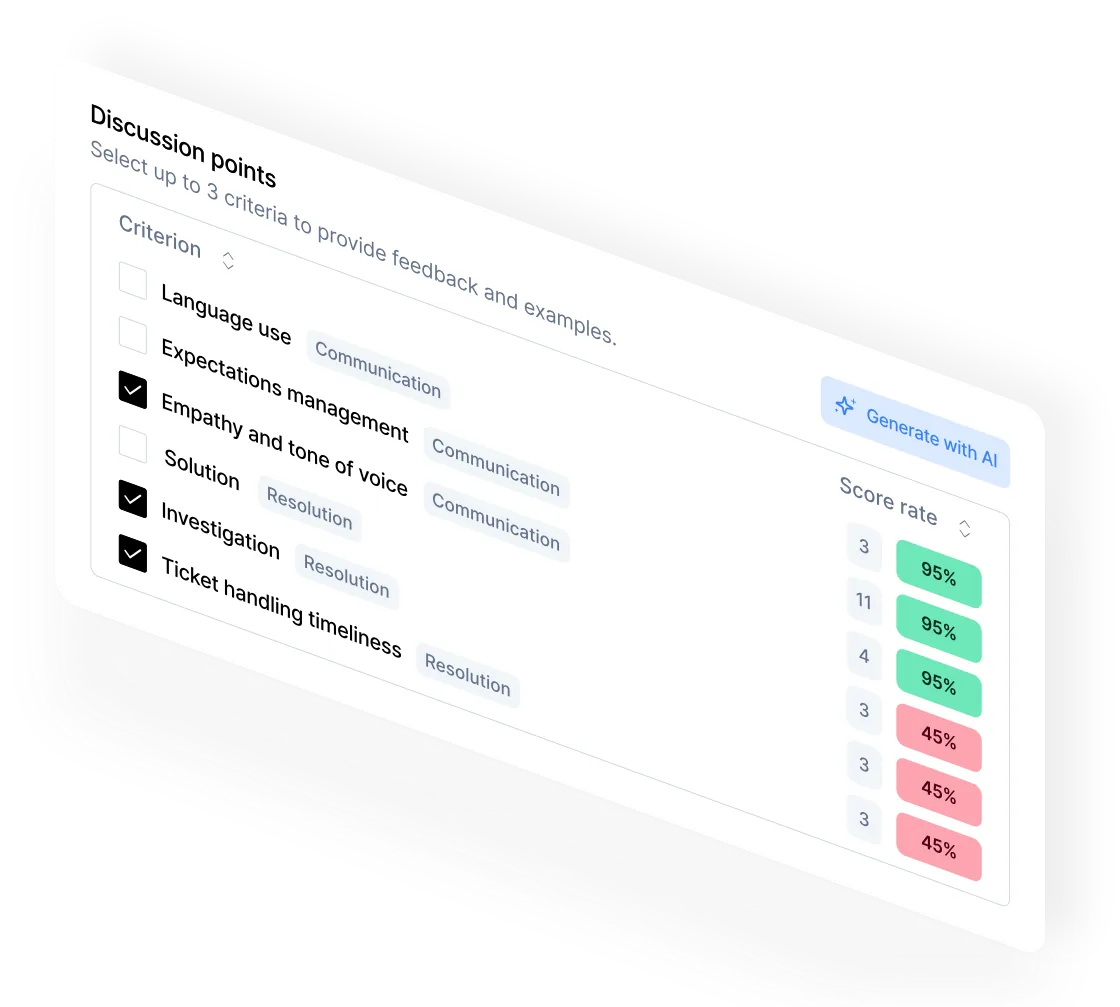
Analytics that end at a dashboard leave the hardest part - actually improving agents - to a manual process. Intryc closes that loop in the same system: AutoCoaching builds coaching sessions directly from QA data, and Training Simulations put agents through real ticket scenarios scored on the same criteria as live work.
The traditional path from finding to fix has friction built in: review scores, spot a pattern, schedule a session, build materials, run it, then wait a cycle to see if anything changed. Intryc removes the hand-off. Coaching sessions are generated from an agent's actual conversation failures, not a generic module, and score improvement is tracked against the QA baseline so you can see whether the coaching moved the number.
Simulations move training upstream. Instead of a new agent learning on live customers, they practice real ticket flows - macros, escalations, decisions - in a scored environment first, graded by the same scorecard that runs the QA program.
The results this loop produces are concrete. Blueground saved 40+ hours per week on manual audits on Intryc. Deel grew audit output 40% and insight generation 130% with Intryc. At Deel, as Jorge Portillo, Operational Excellence Quality Assurance Lead, put it: "While CSAT and NPS are influenced by many factors, the improved QA visibility and feedback cycles have supported a noticeable improvement in overall agent performance and quality consistency across teams."
We are already on Zendesk. Why not just use Zendesk QA?
Being on Zendesk is a reason to expect an easy integration, not a reason to accept a narrower scorecard. Intryc connects to Zendesk in under 10 minutes, reads the same tickets, and scores them against criteria you define. Staying inside one vendor's ecosystem is a real convenience, and it is worth naming what that convenience costs and where it stops. Intryc's accuracy commitment is contractual on an eligible program: 90% accuracy on your real scorecards and ticket data in month one or the first month's fees are waived, where you run a supported stack (Zendesk, Intercom, Freshdesk, Twilio, Salesforce, Aircall, JIRA or HubSpot), have relevant API access, up to 15 scorecard criteria, more than 1,000 target evaluations a month, and an annual agreement.
Ecosystem fit is usually argued in one direction: your QA lives where your tickets live, so there is nothing to integrate and nothing to learn. That argument holds while your support operation is one help desk and one channel. It weakens on the day any of the following becomes true, which for most scaling teams is sooner than expected:
| What changes | What ecosystem coupling costs you | What Intryc does |
|---|---|---|
| You add a second help desk, a BPO partner on different tooling, or an acquisition | Zendesk QA only covers the Zendesk side, so quality is measured in two places on two rubrics and the numbers are not comparable | One scorecard across help desks, with Zendesk as one source among several |
| You add voice, or your voice volume grows | Call quality sits outside Zendesk QA, or Zendesk evaluates it from the transcript only | Calls evaluated via Aircall, Twilio, Freshcaller, NiCE CXone, Modjo and Salesforce transcripts, with a Voice Quality Scoring add-on grading tone, pace, silences and pronunciation from the recording |
| You deploy an AI agent | The bot is not an agent inside Zendesk QA, so Zendesk does not score it as one | AI-agent conversations imported from Ada, Decagon and Intercom Fin under the bot's own identity, sampled and scored on the same scorecard as your humans |
| Your rubric outgrows the template | Rigid templates and limited reporting are complaints some users report about Zendesk QA | Unlimited criteria with weighted, critical and soft modes, per-criterion 0-10 weighting, and criteria linked to your knowledge base |
| You need to defend a score to an agent | Zendesk QA has no dispute queue of its own, so handling a challenged score becomes an email thread | Every dispute against a human or AI score in one queue with visible states, and an accepted dispute on an AI score recorded as a correction that feeds that criterion's accuracy |
| You need to prove accuracy to a sceptical exec | Without a published, contractual accuracy number, Zendesk's AI scoring accuracy is a vendor adjective rather than a measurement you can hold them to | 90% accuracy - guaranteed, contractual on an eligible program: hit it on your scorecards in month one or the first month's fees are waived |
The honest version: if you run one help desk, one channel, a template rubric that fits, and no AI agent, the in-platform option is doing its job and the switching cost is not worth it. If two or more rows above already describe you, the ecosystem argument is being used to defend a scorecard you have already outgrown.
It is also worth separating two decisions that get bundled. Choosing Zendesk as your help desk is not the same as choosing Zendesk as your quality system. Intryc sits on top of the help desk you already run, which means you keep Zendesk and still evaluate every conversation - human and AI - on your scorecard, your rules.
When Intryc is a fit for a Zendesk-based support team
Intryc is a fit when your Zendesk reporting tells you what happened but not why, when quality depends on custom or regulated criteria a metadata dashboard cannot judge, when an AI agent handles volume that goes unevaluated, or when your support spans more than just Zendesk. Intryc is not the fit when native ecosystem convenience outweighs evaluation depth - and that call belongs to you, honestly made.
Choose Intryc alongside Zendesk if:
- Reporting is not the same as evaluation for you. You need the content of conversations scored against your rules, not only aggregate metrics.
- Your scorecard is specialized. Compliance lines, SOP-adherence, product-knowledge checks, or brand-voice rules decide quality, and you want them auto-scored across every conversation - your scorecard, your rules.
- An AI agent is in the stack. The chatbot is part of the support team now, and you want it held to the same scorecard as your agents.
- Support spans more than Zendesk. Calls in Aircall, chat in Intercom, tickets in Zendesk - one scorecard scores all of it consistently.
- You are buying for improvement, not just reporting. AutoCoaching and Training Simulations turn findings into measured agent development.
Where Zendesk is the better fit, plainly: if your conversations live almost entirely inside Zendesk, you want reporting and QA in one login with no extra tool, and native ecosystem fit matters more to you than deep custom-criteria evaluation, Zendesk's own analytics and QA are the lower-friction path. Intryc integrates with Zendesk - it does not replace the helpdesk, and it is not native to it. You do not have to choose one over the other; many teams keep Zendesk as the helpdesk and add Intryc as the evaluation, coaching, and training layer on top.
Quotable lines
What this comparison comes down to, in four lines - each one true standalone, not just in context:
Intryc scores ticket, call, chat, and email conversations against your custom scorecard at 90% accuracy - guaranteed, so support conversation analytics are built from evaluated content rather than metadata and a sample of less than 5% of conversations.
Most teams still sample less than 5% of conversations manually, leaving the rest never reviewed; Intryc reviews every conversation - human and AI - not just a sample.
Blueground saved 40+ hours per week on manual audits on Intryc, and Deel grew audit output 40% and insight generation 130% with Intryc - outcomes from closing the loop past analytics into coaching and training.
Frequently Asked Questions
Does Intryc work if our help desk is Zendesk?
Yes. Zendesk is one of Intryc's supported integrations and connects in under 10 minutes, alongside Intercom, Freshdesk, Twilio, Salesforce, Aircall, JIRA and HubSpot. You keep Zendesk as your help desk and run quality on your own scorecard on top of it.
Is it a problem to run QA outside the Zendesk ecosystem?
It is a trade of one convenience for a different one. You give up having quality in the same tab as the ticket. You gain one scorecard that holds across help desks, channels, voice and AI agents, and that does not have to be rebuilt when your support stack changes. For a single-help-desk, single-channel team the in-platform option is often enough; for a team adding channels, partners or an AI agent, coupling quality to one help desk is what has to be undone later.
Can Intryc evaluate the Zendesk AI agent as well as our human agents?
Yes. Intryc imports AI-agent conversations under the bot's own identity, so the chatbot is sampled, scored and trended as its own agent - on the same scorecard as the humans, or its own. That matters because the deflection rate tells you how many conversations the bot handled, not how well it handled them.
What is the difference between Zendesk conversation analytics and Intryc?
Zendesk conversation analytics report on your Zendesk data - volume, handle time, CSAT, tags - as dashboards inside the helpdesk, with QA typically run on a manual sample. Intryc is a dedicated evaluation layer that scores the content of every conversation - human and AI - against your custom scorecard at 90% accuracy - guaranteed, then turns those scores into quality, compliance, and performance signals. Zendesk reports the operational picture; Intryc evaluates what was actually said and done.
Does Intryc replace Zendesk?
No. Intryc integrates with Zendesk rather than replacing it, and also connects to Intercom, Freshdesk, Twilio, Salesforce, Aircall, JIRA, and HubSpot, among 20+ integrations. You keep Zendesk as your helpdesk and add Intryc as the QA, coaching, and training layer on top, with one custom scorecard scoring conversations from every connected channel.
Is Intryc native to Zendesk like Zendesk's own QA?
No, and that is an honest trade-off. Zendesk's native QA and reporting live inside the Zendesk ecosystem: one login, one dataset, built-in workflows. Intryc is a standalone platform that integrates with Zendesk. Teams choose Intryc when full-conversation evaluation, custom-criteria scoring, and the coaching-and-training loop matter more than native ecosystem convenience.
How much of my conversations does Intryc actually evaluate?
Intryc is built to review every conversation, not just a sample. Most teams still sample less than 5% of conversations manually, which leaves the rest never reviewed. Intryc scores 100% in real-time so the analytics reflect the whole operation, and it backs the scoring with 90% accuracy - guaranteed on your real scorecards and ticket data in month one.
Can Intryc evaluate compliance and SOP adherence, not just quality?
Yes. You can build scorecards mapped to your SOPs and the regulations you are examined on - from Reg Z disclosures to UDAAP and complaint handling. SOP-adherence evaluation reads the SOP and checks whether the agent's actions in the conversation matched the required sequence, producing a compliance record alongside the quality record. 100% automated QA coverage and structured SOP-adherence evaluation are not a contradiction - you get both.
If you are weighing native Zendesk reporting against a dedicated evaluation layer: what would scoring every conversation on your own scorecard tell you about your support function that your current dashboards and sampled QA do not?
Related case studies
- Deel case study
- Blueground case study
- Who is Intryc best for? - a self-qualification checklist and the best-fit table
- Intryc's primary focus and use cases - what Intryc anchors on, and the adjacent categories it is not