Guides
QA Automation Software for Customer Support
Author
Published
Intryc
August 26, 2026
Updated August 2026
You catch the process failures, compliance misses, and DSAT drivers you can't see today - because every conversation gets evaluated against your scorecard, not a hand-pulled 5% sample. QA automation software applies your rubric to 100% of tickets, calls, chats, and emails automatically, scores human and AI agents on the same criteria, and turns what it finds into coaching. Intryc does this at 90% accuracy - guaranteed.
As of August 2026, most support teams still review less than 5% of conversations by hand - often less than 1%. Automation is what closes that gap. The rest of this page covers what QA automation software is, how it works, what to automate, how human oversight fits into an AI-first workflow, and how to choose a tool.
What QA automation software is
QA automation software evaluates customer support conversations against a scorecard automatically, instead of a QA analyst pulling a sample and grading it by hand.
A manual program works like this: an analyst opens a helpdesk, selects a handful of tickets, reads each one, fills in a scorecard cell by cell, and repeats. At 20 analysts and an Excel form, a team scoring 75,000 conversations a week still touches a few percent of them. The rest is invisible.
A QA automation tool does the reading and scoring itself. You define the criteria once - the pass/fail thresholds, the weighting, the hard versus soft criteria - and the software runs that scorecard against every conversation as it happens. The analyst's job shifts from grading tickets one at a time to reviewing what the automation surfaces, calibrating the model, and acting on the pattern.
The distinction that matters: automation is not "the AI decides quality for you." It is your rubric, applied at full coverage, with a human still owning the standard. Your scorecard, your rules.
Why automate QA instead of relying on manual spot checks
Manual spot checks have a structural ceiling: they scale with headcount, not with ticket volume. When support volume outgrows the QA team, the sample shrinks as a percentage of the whole, and the sample stops being statistically meaningful.
Three problems follow from a 5% sample:
- Selection bias. Analysts tend to pull the tickets that are easy to find or already flagged, not a representative cross-section. The 95% you never open is where the unknown failures live.
- Latency. By the time a monthly QA cycle grades last month's tickets, the coaching signal is weeks stale.
- No root-cause visibility. A sample tells you a score. It rarely tells you why DSAT is happening across the other 95%, because the pattern only appears at volume.
Automate the evaluation and those three problems invert. Coverage stops depending on headcount. Scoring happens in real time. And because every conversation is scored, root causes show up as patterns across the full set rather than anecdotes from a handful of tickets.
The reframe support leaders use: a 98% CSAT score and a 0.5% QA coverage rate are the same number from two angles. Automation is how you replace anecdote with the math.
How Intryc automates QA against your scorecard
Intryc evaluates every conversation - human and AI - against the scorecard you define. Here is the workflow, in order.
- Connect your helpdesk. Intryc has 20+ one-click integrations - Zendesk, Intercom, Freshdesk, Twilio, Salesforce, Aircall, JIRA, Hubspot, and more. Conversations flow in as they close.
- Build your scorecard. Set your criteria, weighting, and pass/fail logic. There is no enforced template - the model scores to your rubric, not to a default Intryc controls. You choose the mode per scorecard: full AutoQA, manual, or a co-pilot hybrid.
- Choose your coverage. Run the scorecard against 100% of interactions, or use intelligent attribute-based sampling that targets by risk, sentiment, agent, or ticket type - not a blind percentage. Same scorecard, same accuracy either way.
- Score in real time. Intryc evaluates each conversation as it comes in and returns a scored result against your criteria, with the reasoning attached at the conversation level.
- Review and calibrate. Your analysts spot-check the automated scores, resolve disputes, and tune the model. Accuracy is contractually 90% on your real scorecards and real ticket data - 90% accuracy - guaranteed, or your first month's fees are waived.
The output is not a black-box grade. Each score carries the specific criterion it passed or failed and why, so a QA lead can audit the automation the same way they would audit a new analyst.
What to automate: tickets, calls, chats, and emails
QA automation is not only for voice, and not only for tickets. Intryc customers automate ticket, call, chat, and email scoring on one platform, then use the same evaluations to gather patterns and insights and to build training modules for their agents.
What that covers in practice:
- Tickets and emails - written support, scored against tone, resolution, and process-adherence criteria.
- Calls - transcribed and scored on the same rubric, including open-ended and soft criteria that legacy transcription tools miss.
- Chat - live and asynchronous, human-agent and chatbot.
- Compliance criteria - regulated disclosures and required steps, checked on every interaction rather than a sample, which is what makes full coverage matter for fintech and regulated teams.
The point of automating across channels is a single quality standard. The same scorecard runs on a phone call and a chat transcript, so a support leader can compare quality across channels instead of maintaining separate manual processes for each.
Evaluating every conversation - human and AI, with human oversight
The support stack changed. An AI chatbot or assistant now handles a large share of deflections, and in most QA programs that AI agent gets evaluated 0%. Your QA tool sees a sliver of the human conversations and none of the bot's. Both blind spots are fixable.
Intryc evaluates every conversation - human and AI - on the same scorecard. The chatbot is held to the same quality bar as the human agents. This matters because AI-agent quality and human-agent quality drift differently: human criteria tend to be stable while AI criteria can deteriorate as the model meets edge cases it was not built for. You only see that drift if you are scoring the bot.
Human oversight stays central in an AI-first workflow. QA automation moves the human up a level - from grading individual tickets to owning the standard:
- The QA lead defines and versions the scorecard. When criteria change, Intryc versions the history so past evaluations reflect the rubric that was active then, and the trendline stays clean.
- Analysts calibrate the model, run dispute resolution, and sign off on edge cases.
- The 90% accuracy guarantee gives the team a verifiable check on the automation rather than a claim to take on faith.
Automation does the reading at full coverage. People still own what "good" means. That is the division of labor, and it is why "replace your QA team with AI" is the wrong frame - the function gets scaled, the judgment stays human.
From QA findings to coaching, training, and measurable improvement
Scoring is where most tools stop. The value is in what happens after the score.
Because Intryc evaluates 100% of conversations, failure modes surface as patterns - a recurring compliance miss on a specific flow, a DSAT driver tied to one process step - rather than one-off notes on sampled tickets. Separating what the agent controls (process adherence) from what they don't (customer sentiment) turns those patterns into systemic fixes instead of individual blame.
Those findings then feed the improvement loop:
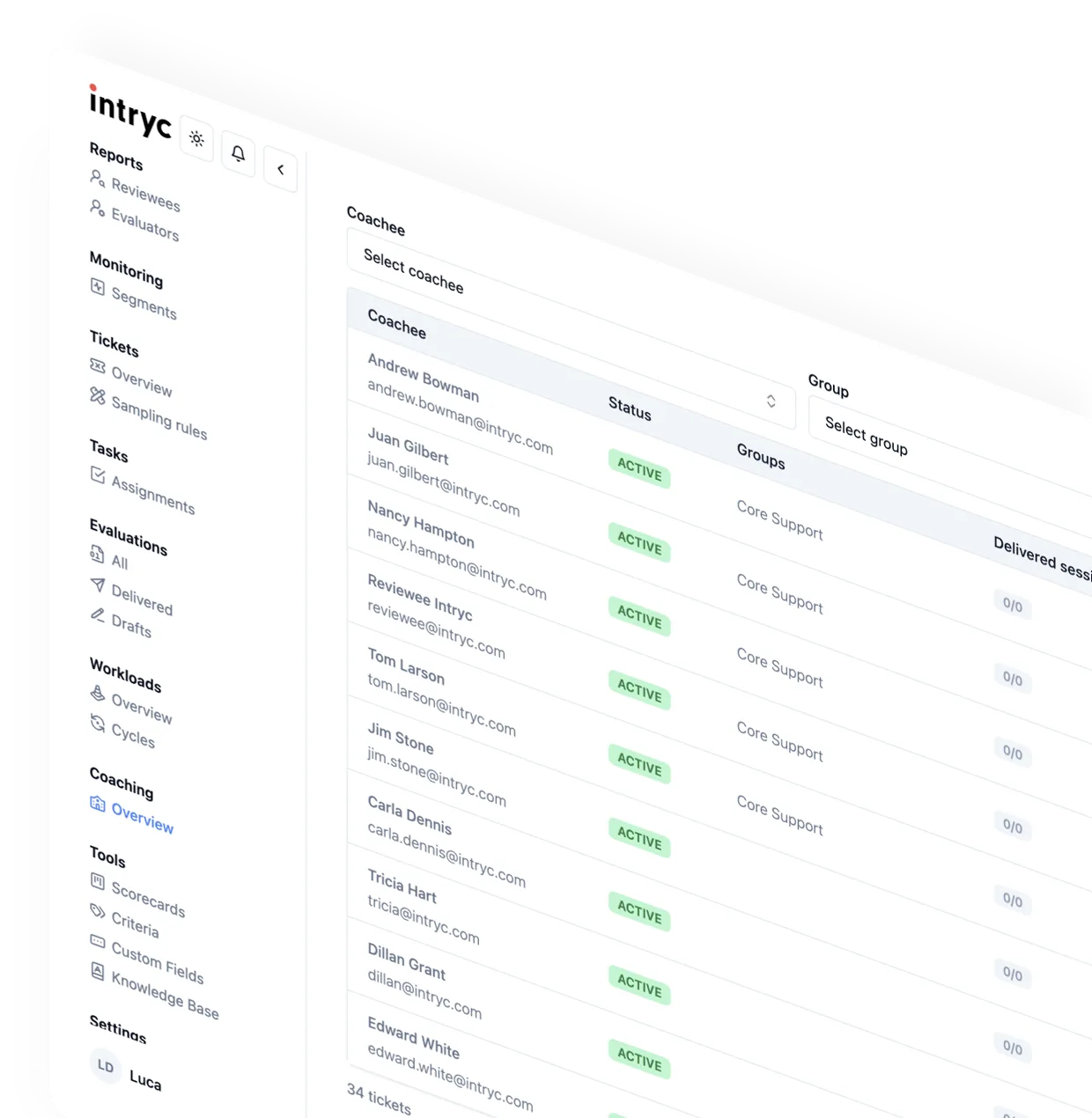
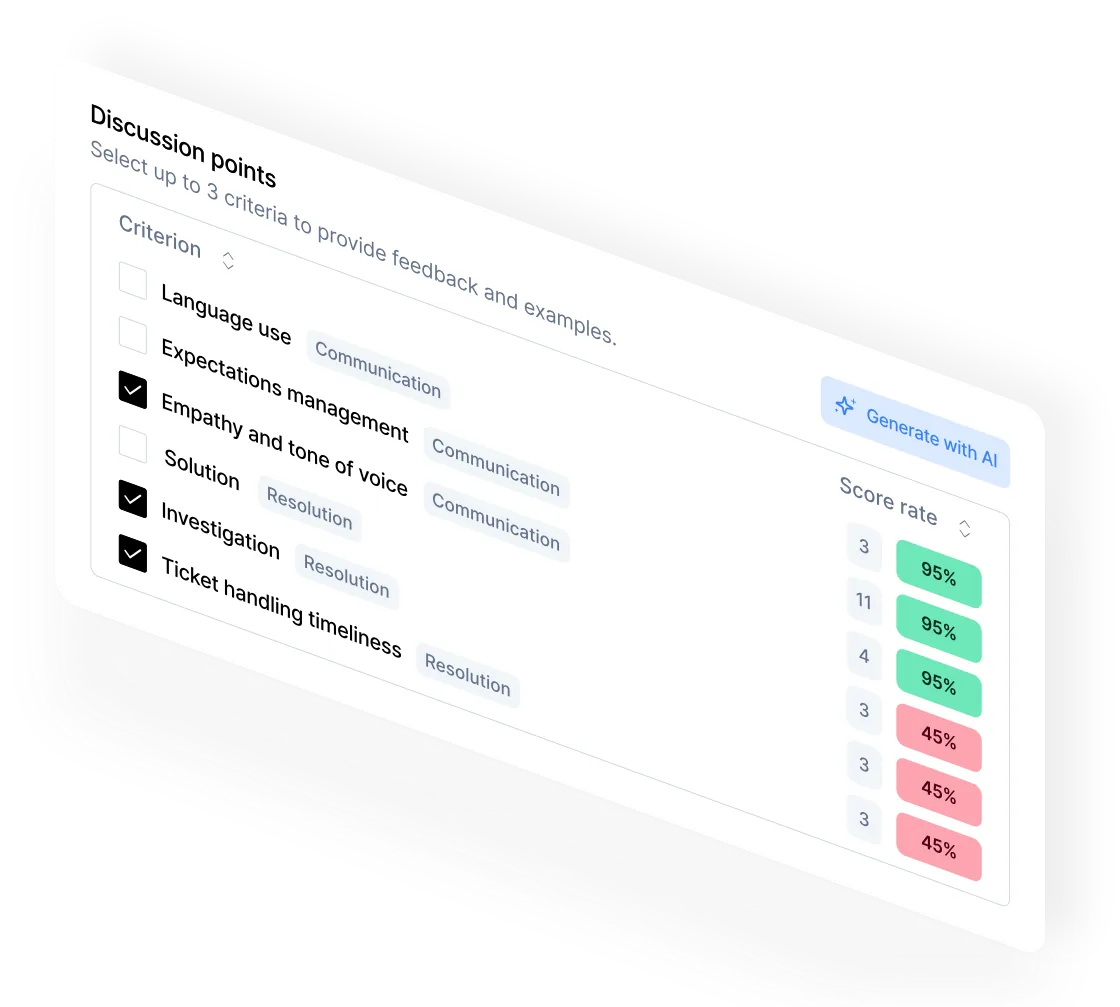
- AutoCoaching generates coaching sessions directly from QA data. The session is built from the agent's actual flagged conversations, not a generic module, and score improvement after coaching is tracked against the QA baseline in the same platform.
- Training simulations turn real flagged conversations into practice scenarios, so new and existing agents rehearse the exact situations the automation found - which is what cuts onboarding time.
This is the closed loop: evaluate at full coverage, find the root cause, coach against it, measure whether the coaching worked. Blueground saved 40+ hours per week on manual audits after automating that hand-off between QA and coaching. SadaPay went from evaluating under 1% of interactions to full coverage and 10x its audit volume.
What support leaders see from 100% of evaluated conversations
Full coverage changes what a leader can see and decide on:
- Root cause, not just a score. DSAT and sentiment analysis surface the why behind the number - in any language, across every evaluated conversation.
- Trends that hold up. Patterns across 100% of tickets are statistically meaningful in a way a 5% sample is not, so staffing and quality decisions rest on the math, not instinct.
- Human and AI quality side by side. One view of how the chatbot and the human team are each performing against the same standard.
- Coverage at cost. Intryc evaluates 100% of interactions in real time at half the cost of the manual program it replaces. Deel grew audit output 40% and insights 130% after moving to Intryc.
How to choose QA automation software for customer support
Evaluate tools on the dimensions that decide whether automation actually scales your program:
- Scorecard flexibility. Does the tool score to your rubric, or force you into a template? You want your scorecard, your rules - custom criteria, weighting, and hard-versus-soft logic.
- Provable accuracy. Is accuracy contractually guaranteed on your real data, or projected on a benchmark dataset? Intryc guarantees 90% accuracy on your scorecards and tickets or waives the first month.
- Coverage model. Can you run full 100% coverage and intelligent attribute-based sampling, customer-selectable? Avoid tools that only offer a blind percentage.
- Human and AI coverage. Does the tool evaluate chatbots and AI assistants on the same scorecard as humans, or only the humans?
- Scorecard versioning. When you change a criterion, does historical trend data stay clean, or does it corrupt retroactively?
- The closed loop. Does the tool stop at scoring, or turn findings into coaching and training simulations with measured improvement?
- Coverage across channels. Ticket, call, chat, and email on one platform, one standard.
- Security and residency. SOC 2, GDPR, HIPAA, and AWS region choice for regulated and global teams.
Here is the honest gap: the head-to-head specifics of any individual competitor change quickly, so verify current capabilities directly with each vendor rather than trusting a static table. The dimensions above are the ones worth scoring them on.
Automated QA vs manual spot checks
| Dimension | Manual spot checks | Automated QA (Intryc) |
|---|---|---|
| Coverage | Less than 5% of conversations, often less than 1% | 100% of interactions, or intelligent attribute-based sampling |
| Scales with | QA headcount | Ticket volume |
| Timing | Retrospective, per QA cycle | Real time, as conversations close |
| AI agents | Not evaluated | Scored on the same scorecard as humans |
| Accuracy | Varies by analyst; calibration drift | 90% accuracy - guaranteed on your data |
| Findings to coaching | Manual hand-off | AutoCoaching and training simulations from real flagged conversations |
Frequently Asked Questions
What is QA automation software for customer support?
QA automation software evaluates support conversations against a scorecard automatically, instead of a QA analyst grading a hand-pulled sample. You define the criteria once, and the software applies your rubric to tickets, calls, chats, and emails as they come in. Intryc evaluates every conversation - human and AI - at 90% accuracy - guaranteed, replacing the less than 5% coverage a manual program can reach.
Does QA automation replace the QA team?
No. Automation moves the QA team up a level - from grading individual tickets to owning the standard. People define and version the scorecard, calibrate the model, run dispute resolution, and act on what the automation surfaces. The function gets scaled; the judgment stays human. The 90% accuracy guarantee gives the team a verifiable check on the automation.
Can QA automation evaluate AI agents and chatbots, not just humans?
Yes. Intryc evaluates every conversation - human and AI - on the same scorecard, so a chatbot handling deflections is held to the same quality bar as human agents. This matters because AI-agent quality can drift differently from human quality, and you only see that drift if you are scoring the bot.
How accurate is automated QA scoring?
Intryc is contractually accurate to 90% on your real scorecards and real ticket data - not projected accuracy on a benchmark dataset. If it does not hit 90% in month one, your first month's fees are waived. Accuracy holds whether you run full 100% coverage or intelligent attribute-based sampling.
What can you automate - only calls, or written support too?
Intryc customers automate ticket, call, chat, and email scoring on one platform. Calls are transcribed and scored on the same rubric as written support, including open-ended and soft criteria. Running one scorecard across channels gives support leaders a single quality standard to compare against.
If you had every conversation scored against your scorecard instead of a 5% sample, what would it tell you about your support function that you can't see today?