Guides
Scorebuddy Alternatives: QA, Coaching and Training Options (2026)
Author
Published
Intryc
September 18, 2026
By Alex Marantelos
Updated September 2026.
The main Scorebuddy alternatives are Intryc (best for AI-first QA on your own scorecard, connected to coaching and training), MaestroQA (best for teams keeping a human reviewer on most evaluations), Zendesk QA, formerly Klaus (best for small teams already inside Zendesk), EvaluAgent (best for QA paired with agent engagement) and Observe.AI (best for voice-first contact centres). Most QA programs review less than 5% of conversations, and that sampling ceiling - not a missing feature - is what usually starts this search. Which alternative is right depends on where your QA workflow actually breaks down: coverage, scorecard configuration, validating AI scoring against your reviewers, coaching follow-through, support-stack fit, governance, or whether you need post-interaction improvement or real-time in-call guidance.
Why teams look for Scorebuddy alternatives
Teams rarely start this search because of a feature. They start it because one stage of the QA loop stopped holding up. In practice it is one of eight:
- Coverage. The reviewed sample is too small to trust. Most QA programs review less than 5% of conversations, and a trend built on that sample moves with who got reviewed rather than with quality.
- Scorecard flexibility. The rubric has outgrown the tool - conditional questions, auto-fail gates, channel-specific bars, or criteria that need to reference policy rather than tone.
- Confidence in automated scoring. AI scores are produced but nobody trusts them, because there is no measured accuracy figure and no clean way to correct one.
- The handoff from findings to coaching. Evaluations pile up and nothing downstream changes, because building a coaching session from them is still manual work.
- Training follow-through. Coaching happens, but there is no way to check whether the agent actually improved on the thing that was coached.
- Channel fit. The support mix shifted to chat, email, or voice, or an AI agent now handles a meaningful share of volume and nobody is scoring it.
- Governance. A compliance, residency, or audit requirement arrived that the current setup cannot evidence.
- Commercials. Per-agent pricing scales faster than the QA program's value does.
Staying with Scorebuddy is a reasonable outcome of this exercise. If your reviewers are aligned, your rubric fits the tool, and findings already turn into coaching, a migration buys you disruption rather than coverage. Run the comparison below against your own program before assuming a switch is the answer.
The main Scorebuddy alternatives, and who each one fits
Five platforms come up most often in a Scorebuddy evaluation. The descriptions below are category positioning drawn from public material and evaluator feedback, not verified product facts - treat every one of them, Intryc included, as something to demonstrate on your own scorecard rather than accept from a page.
Intryc - best for AI-first QA connected to coaching and training
Evaluates every conversation - human and AI on your own scorecard, or an intelligent attribute-based sample, and carries findings into AutoCoaching sessions and training simulations scored by the same engine. Unlimited criteria with weighted, critical and soft modes. Strongest fit when the constraint is coverage and follow-through rather than organisation. Weakest fit if you need live in-call guidance or workforce scheduling, which are different product categories.
MaestroQA - best for keeping a human reviewer on most evaluations
Evaluator feedback associates MaestroQA with granular, structured scorecard configuration, including a custom metric builder and question types such as auto-fail and non-scoring, with per-agent pricing. MaestroQA fits teams with a mature human-led QA function who want it better organised rather than automated. Verify current AI scoring depth and total cost at your evaluation volume directly.
Zendesk QA, formerly Klaus - best for small teams already on Zendesk
Zendesk QA is native to the Zendesk ecosystem and quick to adopt without leaving it. Zendesk QA is correspondingly tightly coupled to that ecosystem, which narrows options for teams on another help desk, and some users report limited customisation and reporting compared with dedicated QA platforms. Verify the migration state from Klaus and your own reporting requirements.
EvaluAgent - best for QA paired with agent engagement
EvaluAgent pairs QA with agent engagement and gamification for mid-market teams. EvaluAgent users report integration friction and a steeper learning curve for non-technical admins. Verify integration fit with your exact stack and the ongoing admin load.
Observe.AI - best for voice-first contact centres
Observe.AI is built around speech analytics for voice-heavy operations. Observe.AI is correspondingly less suited to teams whose volume is mostly chat, email or tickets. If your mix is voice plus digital, note that Intryc evaluates calls through Aircall, Twilio, Freshcaller, NiCE CXone, Modjo and Salesforce call transcripts, with a Voice Quality Scoring add-on grading tone, pace, silences and pronunciation from the recording, so one scorecard can cover both.
Scorebuddy itself stays on this list for a reason - it is in the comparison table above, not excluded from it.
| Decision dimension | Scorebuddy | Intryc | MaestroQA | Zendesk QA | EvaluAgent | Observe.AI |
|---|---|---|---|---|---|---|
| Primary model | Structured manual QA with AI layered on | AI-first, 100% coverage or targeted sampling | Manual-first with automation added | In-platform QA for Zendesk | QA plus agent engagement | Speech analytics, voice-first |
| Coverage at your volume | Verify | 100% or intelligent attribute-based sample, customer-selectable | Verify | Verify | Verify | Verify |
| Scorecard control | Detailed control reported by evaluators; verify | Unlimited criteria; weighted, critical and soft modes; per-criterion 0-10 weighting; knowledge-base-linked criteria | Granular config reported by evaluators; verify | Rigid templates reported by some users; verify | Verify | Verify |
| Conditional logic | Verify | Verify | Verify | Verify | Verify | Verify |
| AI accuracy commitment | Verify | 90% accuracy - guaranteed, contractual on an eligible program | Verify | Verify | Verify | Verify |
| Calibration | Verify | Blind sessions, lead-reviewer benchmark, per-criterion participant comparison | Verify | Verify | Verify | Verify |
| Dispute workflow | Verify | One queue for human and AI scores, visible states, accepted disputes feed criterion accuracy | Verify | Verify | Verify | Verify |
| AI agent and chatbot QA | Verify | Ada, Decagon and Intercom Fin imported under the bot's own identity | Verify | Verify | Verify | Verify |
| Coaching and training | Verify | AutoCoaching from real flagged conversations plus simulations on the same criteria | Evaluation-to-coaching workflow; verify | Verify | Engagement and gamification; verify | Verify |
| Voice | Verify | Aircall, Twilio, Freshcaller, NiCE CXone, Modjo, Salesforce transcripts; Voice Quality Scoring add-on | Verify | Verify | Verify | Core strength; verify acoustic scope |
| Pricing model | Verify at your volume | Usage-based, all features included, no per-agent fee | Per agent, reported by evaluators; verify | Verify | Verify | Enterprise, scales by agent count; verify |
| Best for | Teams whose current structured workflow still fits | Coverage and coaching follow-through | Human-led QA, better organised | Small teams inside Zendesk | QA plus engagement | Voice-first operations |
Every "verify" above is a genuine research gap rather than a soft negative. Public material does not settle that dimension for that vendor, and the only answer that counts is a live demonstration on your own scorecard.
What should you compare before choosing a Scorebuddy alternative?
Test these against your own rubric and your own interaction data, not against a feature grid. A platform that scores well on someone else's scorecard tells you very little.
- Channels and interaction coverage. Which channels are evaluated, and what share of interactions. Ask whether coverage is a fixed sample, a targeted sample, or all of it, and what each costs at your volume.
- Scorecard criteria, weighting, and logic. Criteria limits, per-criterion weighting, auto-fail behaviour, non-scoring or feedback-only questions, conditional branching, and whether criteria can reference your knowledge base.
- AI-to-human evaluation review. How AI scores are compared against reviewer scores, whether accuracy is measured per criterion or as one number, and whether a correction improves future scoring on that criterion.
- Coaching and training workflow. Whether a coaching session is drafted from real flagged conversations, whether each point links to its source interaction, and whether the coached criteria are re-measured afterward.
- Real-time versus post-interaction. A decisive fork. Post-interaction QA improves the next conversation; real-time guidance changes the one in progress. They are different product categories.
- Help desk and telephony integrations. Confirm your exact stack, including call transcripts if voice is in scope, and how long connection actually takes.
- Auditability and compliance. Certifications, data residency, audit history on evaluations and disputes, and role-based permissions.
- Rollout effort. Who configures the scorecard, how long to first reliable score, and what the ongoing admin load looks like.
- Commercial qualification. Pricing model, minimum volumes, contract length, and any eligibility conditions attached to a vendor's published guarantee.
When is Intryc a practical Scorebuddy alternative?
Intryc fits teams that want QA run on their own scorecards across support interactions, with what it finds carried into coaching and training rather than stopping at a score.
Configurable AI scorecards. Your scorecard, your rules - scorecards are built around your team's instructions, scoring methodology, and internal standards. Unlimited criteria, three criterion modes - weighted, critical (one failure fails the evaluation, optionally at zero weight so it gates without inflating scores), and soft (scored and shown to the agent but excluded from the total, so you can pilot a new standard before it counts) - with per-criterion weighting on a 0-10 scale. Criteria can link to specific knowledge-base articles, macros, and tools, so the AI grades solution correctness against your policy rather than tone alone. Editing a criterion does not recalculate historical scores.
AI and human evaluation comparison. Reviewers override any AI score, and the override is recorded against that specific criterion so it feeds instruction refinement rather than disappearing into an aggregate. Accuracy is reported per criterion, and it distinguishes an ambiguous instruction from evaluators disagreeing with each other - two problems with two different fixes. Blind calibration sessions run with a lead-reviewer benchmark and a side-by-side, per-criterion comparison of every participant's scores and root causes.
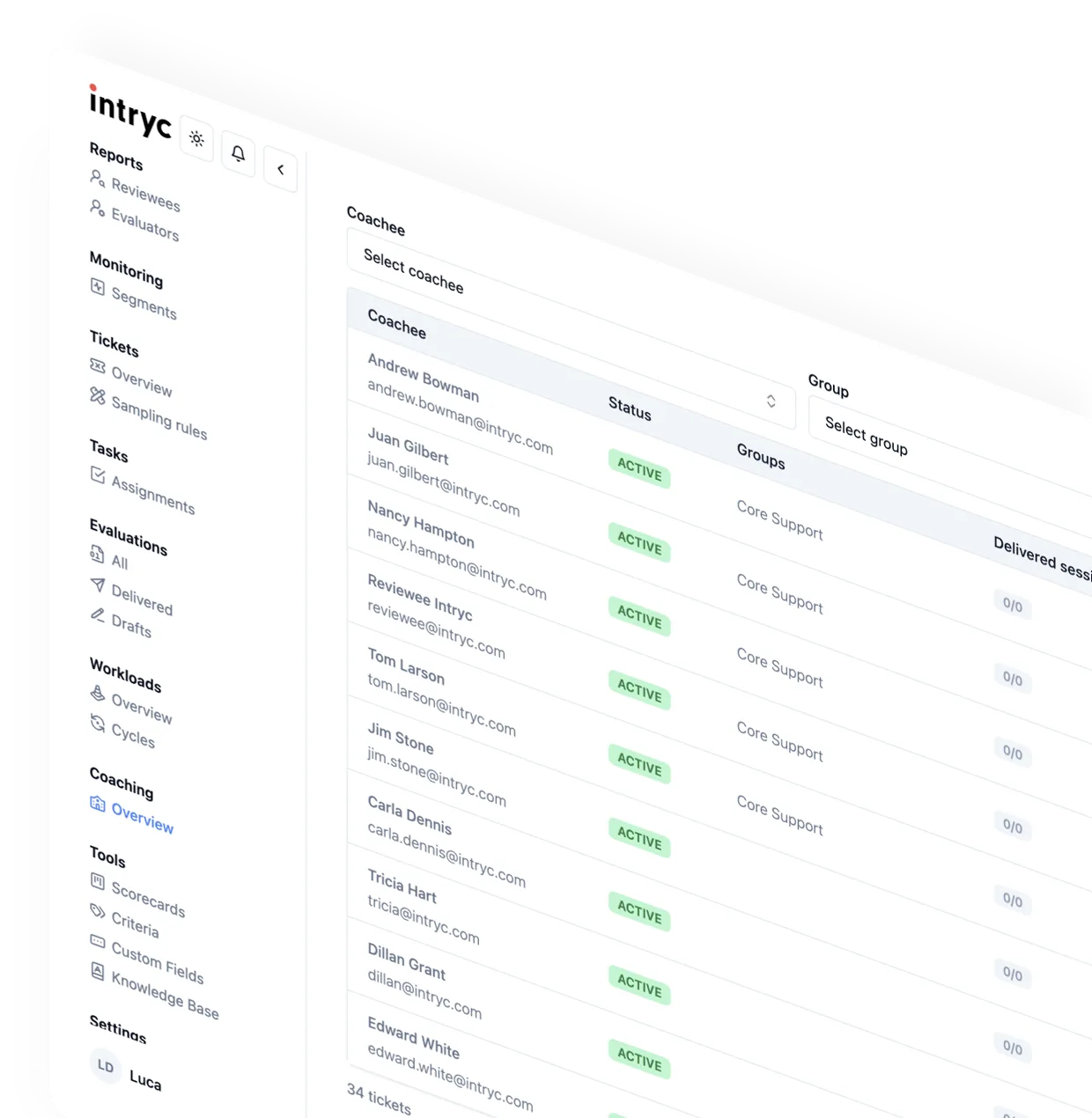
Performance tracking in one view. Evaluations, disputes, coaching sessions, training, and engagement are trended together with period-over-period deltas, so a rising dispute rate is visible the week it happens rather than at the quarterly review.
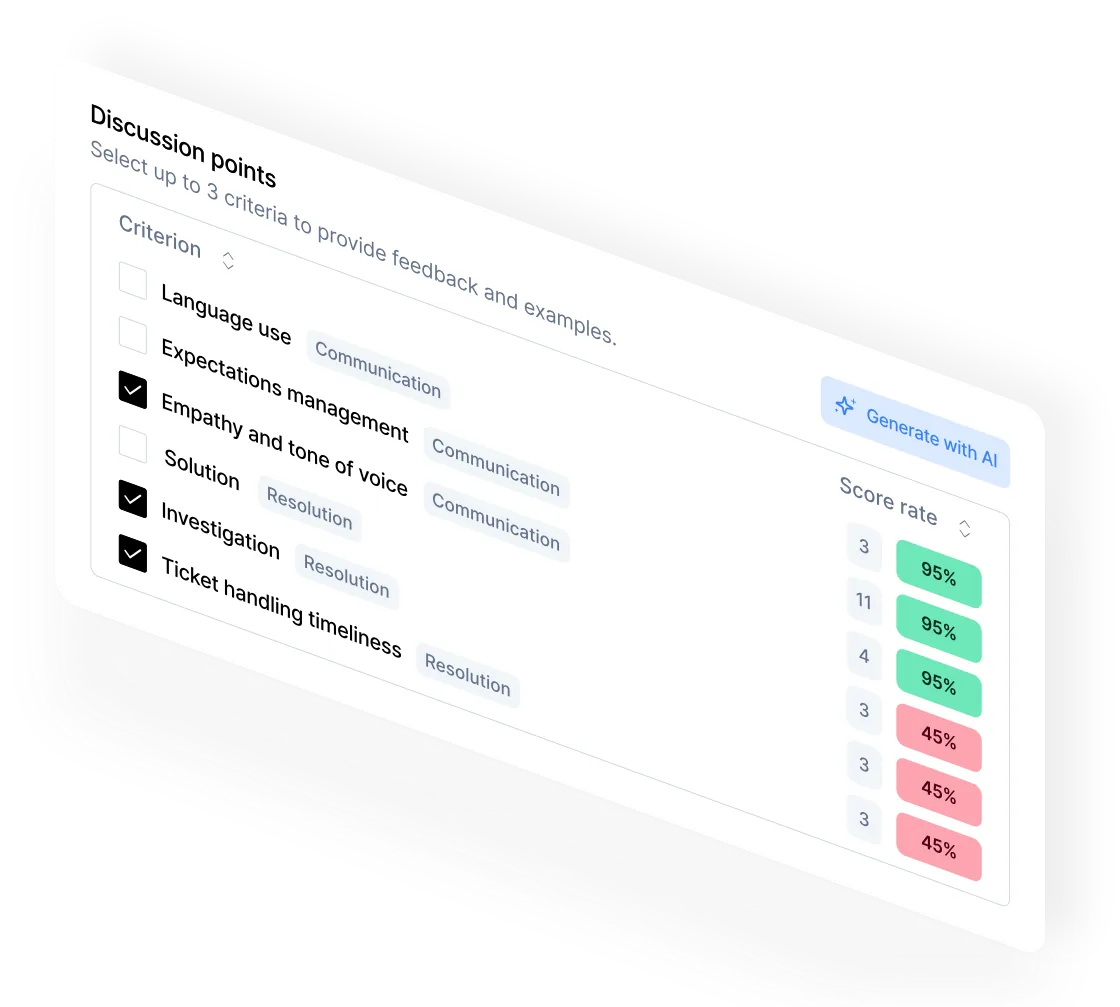
Coaching and simulations on the same standard. AutoCoaching drafts a session from the agent's real flagged conversations on the criteria you select, links every point to its source ticket, and caps the session at six action items. Failed evaluations convert into targeted simulations and quizzes scored by the same engine that scores live tickets, and those simulation scores feed back into coaching, so training performance and live performance sit on one scale.
On the accuracy promise, with its conditions. Intryc sells on 90% accuracy - guaranteed, and the 90% Accuracy Promise is the contractual form of it: 90% AI QA accuracy on your real scorecards and ticket data in month one, or the first month's fees are waived, with a full refund available within 60 days. It is a conditional commitment rather than a blanket claim - eligibility requires a supported stack (Zendesk, Intercom, Freshdesk, Twilio, Salesforce, Aircall, JIRA, or HubSpot), relevant API access, up to 15 scorecard criteria, more than 1,000 target evaluations a month, and an annual agreement. Confirm in writing that your program qualifies before you treat it as a commitment.
Intryc is also SOC 2, GDPR, and HIPAA compliant, and deploys on AWS in the region you choose.
Which QA workflow requirements point to a different type of platform?
Some requirements are not a better or worse version of what Intryc does. They are a different category of product. Three decision paths, by the workflow you actually need:
You need live, in-conversation prompts
If the requirement is guidance delivered to the agent mid-call or mid-chat - next-best-action prompts, live objection handling, real-time compliance warnings - that is real-time agent assistance, and it is a distinct category from post-interaction QA. Intryc evaluates after the interaction and uses what it finds to change the next one through coaching and simulations, which is the durable fix for a skills gap rather than a prompt that only helps while it is on screen. Teams that need both typically run a real-time assist tool alongside a QA platform. Verify current channel support and deployment scope with any vendor in that category.
You need workforce scheduling, forecasting, or adherence
Scheduling, volume forecasting, and adherence management belong to workforce optimization suites. Intryc is a QA, coaching, and training layer that sits on your existing stack; it is not a WFM suite, and that focus is why its scorecard and coaching depth go further than the QA module bundled inside one. A team that needs both usually keeps the WFM suite for scheduling and runs QA where the scorecard control actually lives. Confirm integration fit between the two before committing to either.
You need cross-functional VoC or business intelligence
If the primary job is feeding product, marketing, and exec reporting from conversation data, that is conversation intelligence or voice-of-customer territory. Intryc's analytics are QA-derived rather than a general BI warehouse, and that is the point - every number traces back to a scored conversation against a defined standard, so a root-cause finding is auditable rather than a topic cluster. Intryc surfaces root-cause and DSAT analysis across every evaluated conversation in any language, plus plain-language querying over your own QA data. Verify governance and integration fit directly with any vendor in that category.
When Scorebuddy is still the best choice
Three situations where switching costs more than it returns:
- Your reviewers are already aligned and your rubric fits the tool. If calibration is not a live problem and your scorecard has not outgrown its configuration, a migration buys disruption rather than coverage.
- Your QA program is deliberately human-led and staffed for it. If a reviewer is meant to see every evaluation and you have the headcount to do it, the automation ceiling that pushes other teams to switch is not a constraint you are hitting.
- You are mid-contract with a working integration and no channel change coming. If volume, channel mix and headcount are flat for the next two quarters, re-run this comparison at renewal instead of now.
The honest test: write down which stage of the QA loop is failing before you look at any vendor. If you cannot name one, the tool is not your problem.
How to switch from Scorebuddy without losing your quality trend
Migration risk on a QA platform is not the data move. It is the discontinuity in your quality trend, because a new scorecard on a new engine produces scores that are not comparable to last quarter's. Plan for that explicitly:
- Export your historical evaluations and your scorecard definition first. Confirm with your current vendor what export formats are available and whether criterion-level detail comes with it, not just totals. Do this before you give notice.
- Rebuild the rubric rather than porting the file. Map each criterion to the new platform's modes - weighted, gating, feedback-only - and treat any criterion you cannot reproduce as a blocking question for the new vendor.
- Run both platforms in parallel on the same conversations. Two to four weeks on a shared sample gives you the conversion factor between old and new scores, which is what lets you keep a continuous trend line across the switch.
- Calibrate the new evaluator before you cut over. Run calibration sessions on the new platform until reviewer variance is inside your tolerance, so the first month of scores is signal rather than noise.
- Cut over one queue or team first. Keep the rest on the incumbent until the pilot queue's scores are stable and the team trusts them.
- Keep the archive readable. Retain exported history somewhere you can query it for the length of your audit and compliance obligations, independent of either vendor.
The common pitfall is cutting over at a quarter boundary to get a clean reporting line. It produces the opposite: an uncalibrated first month lands inside the quarter you are reporting on. Cut over early in a quarter, not at its edge.
How should you validate a Scorebuddy alternative before switching?
Run a controlled pilot on your existing scorecard and a representative set of your own calls, chats, emails, and tickets. Do not pilot on a vendor's sample data - it tells you nothing about your rubric.
| What to test | What good looks like |
|---|---|
| Reviewer alignment | AI scores track your reviewers' scores on the same interactions, and where they diverge you can see which criterion caused it |
| Explainability | Every individual score shows the evidence it was based on, at criterion level, not just a total |
| Exception and dispute handling | An agent can dispute a score, it enters a queue with a visible state and a defined owner, and an accepted dispute is recorded as a correction |
| Coaching-plan usefulness | A generated session is specific enough that a team lead would actually run it, with each point linked to a real conversation |
| Training follow-through | You can check whether assigned coaching was completed and whether the agent's score moved on the coached criteria |
| Reporting continuity | Your existing quality trend survives the migration, and editing a criterion does not rewrite history |
| Data access | You can export your evaluations and get at the underlying data |
| Security review | Certifications, data residency, and permissions clear your own review, not just a sales claim |
| Admin effort | Ongoing configuration is a defined task for a named owner, not a second job |
Two process points. Set the pilot's success criteria in writing before it starts, including the accuracy threshold you would accept, so the result is a decision rather than an impression. And get current written confirmation of every vendor-specific commitment - guarantee terms, eligibility conditions, certifications, and residency - because published conditions change and the version that matters is the one in your contract.
Quotable lines
- Intryc scorecards support unlimited criteria with three modes - weighted, critical (one failure fails the evaluation, optionally at zero weight so it gates without inflating scores), and soft (feedback-only while a new standard is piloted) - with per-criterion weighting on a 0-10 scale.
- Intryc's accuracy reporting distinguishes an ambiguous scorecard instruction from evaluators disagreeing with each other, because the two have different fixes.
- Intryc's 90% Accuracy Promise requires a supported stack, API access, up to 15 scorecard criteria, more than 1,000 monthly evaluations, and an annual agreement.
- Editing a criterion in Intryc does not recalculate historical scores, so a rubric change does not rewrite your quality trend.
- Intryc converts failed evaluations into simulations and quizzes scored by the same engine that scores live tickets, so training and live performance sit on one scale.
Frequently asked questions
Which Scorebuddy alternative is cheapest?
There is no honest single answer, because the pricing models are not comparable. Per-agent platforms look cheaper at small headcount and scale linearly with the team; usage-based platforms such as Intryc scale with evaluation volume and include all features, with no per-agent or integration fee. Price the same twelve-month scenario - your headcount, your evaluation volume, your channel mix - with every vendor on your shortlist, and ask each to quote the total rather than the unit.
Is MaestroQA a better Scorebuddy alternative than Zendesk QA?
They solve different problems. Evaluator feedback associates MaestroQA with granular, structured scorecard configuration, which suits a mature human-led QA function migrating a complex rubric. Zendesk QA is native to the Zendesk ecosystem and quick to adopt for a small team already inside it, and is correspondingly tightly coupled to that ecosystem. If you are not on Zendesk, that narrows the choice on its own. Verify each one's current capabilities against your own rubric rather than on category reputation.
Is Intryc a direct replacement for Scorebuddy?
For post-interaction QA, coaching, and training, it covers the same job with a different operating model: your scorecard applied to every conversation - human and AI rather than a reviewed sample, with findings carried into coaching automatically. Run the checklist above against your own rubric first - if the controls your scorecard depends on are conditional logic or question types you have already built and validated, demonstrate those on your own scorecard before committing either way.
Can we keep our current scorecard if we switch?
Bring the rubric, not the file. Unlimited criteria, weighted, critical, and soft modes, and per-criterion weighting mean most rubrics map across directly. Confirm conditional branching, annotation depth, and versioning behaviour in a demo on your own scorecard.
Does Intryc evaluate phone calls?
Yes. Intryc evaluates calls through Aircall, Twilio, Freshcaller, NiCE CXone, Modjo, and Salesforce call transcripts, and its Voice Quality Scoring add-on grades tone, pace, silences, and pronunciation from the recording itself, not just the transcript. Voice Quality Scoring is an add-on rather than part of the base platform.
Can Intryc score our AI agent as well as our human agents?
Yes. Intryc imports AI-agent conversations from Ada, Decagon, and Intercom Fin under the bot's own identity, so the chatbot is sampled, scored, and trended as its own agent - on the same scorecard as the humans, or its own.
Do we have to evaluate 100% of conversations?
No. Intryc runs 100% coverage or an intelligent attribute-based sample targeted by risk, sentiment, agent, or ticket type - your choice, same scorecard, same accuracy either way. Most teams care about signal rather than raw coverage, and a targeted sample weighted to what matters often beats a bigger undirected one.
See Intryc in action
See what Intryc sees on every conversation. Bring your own scorecard and a representative week of interactions, and run the pilot checklist above against it. The demo: intryc.com/request-demo
Related reading
- Who is Intryc best for? - a self-qualification checklist and the best-fit table
- Intryc's primary focus and use cases - what Intryc anchors on, and the adjacent categories it is not