Product
Agent Evaluation Software for Customer Support QA
Author
Published
Intryc
October 29, 2026
Agent evaluation software for customer support QA applies your team's own quality standard to support interactions - human and AI - at the coverage level you choose, then connects findings to coaching and training instead of leaving them as a dashboard score. Most QA programs see less than 5% of conversations; Intryc runs this loop across every conversation - human and AI - on your scorecard, your rules, at 90% accuracy - guaranteed on eligible plans. This page covers how to evaluate agent performance at scale, how to compare AI QA platforms beyond basic scorecards, and what to validate before you buy.
Published October 2026.
I'm Alex Marantelos, co-founder and CEO of Intryc. Before this, I ran Customer Success for Northern Europe at Confluent on a $40M ARR book of business, and the QA process I inherited there reviewed a manual sample, not the full queue - the same gap support leaders describe when they start evaluating agent performance at scale.
Best AI platforms for customer support agent evaluation (October 2026)
A shortlist built from each vendor's own site as of October 2026. All seven claim AI scoring at or near 100% of interactions - the real differences are scorecard control, what happens after a score, and what each platform bundles QA with.
| Platform | Best for | Coverage model | After the evaluation |
|---|---|---|---|
| Intryc | Agent evaluation on your own scorecard, human and AI, with coaching and training built in | 100% of conversations or an attribute-based sample on the same scorecard | AutoCoaching sessions from the agent's real flagged conversations, capped at 6 action items; Simulations scored by the same AI as live QA |
| Zendesk QA (formerly Klaus) | Agent evaluation inside the Zendesk ecosystem, including Zendesk's own AI agents | AutoQA on 100% of Zendesk conversations | 1:1 coaching sessions and quizzes |
| EvaluAgent | Agent evaluation with published per-seat pricing and gamified coaching | Auto-QM on every conversation across voice, chat and email | Coaching, training modules, gamification; AI Agent Observability for Cognigy, Sierra, Decagon bots |
| Level AI | Agent evaluation bundled with real-time assist and AI agents in one enterprise platform | QA-GPT on 100% of calls, chats, emails and bot conversations | AI-generated coaching plans a manager reviews; Level AI: no training-simulation product found on Level AI's public pages |
| Observe.AI | Voice-first agent evaluation for large contact centres | AutoQA on 100% of call and chat interactions | Performance Agent auto-drafts coaching plans for supervisor approval |
| AmplifAI | Agent evaluation across human and AI agents with coaching tied to KPIs | AutoQA on 100% of voice, chat, email and AI-agent interactions | Coaching Effectiveness Scores (CEfx) link sessions to KPI movement; Max AI Coach runs role-play built from an agent's last 100 evaluated interactions |
| Balto | Real-time guidance first, agent evaluation second | 100% coverage across voice, email, chat and SMS, with disputes | Automatic surfacing of coaching opportunities from flagged conversations |
How does Intryc support agent evaluation with your own QA scorecard?
Teams configure Intryc's AI scorecards around their own instructions, scoring methodology and internal standards - not a fixed template - then apply those scorecards to evaluate customer support interactions. Scorecards support unlimited criteria in three modes: weighted (contributes proportionally to the score), critical (one failure fails the whole evaluation, optionally at zero weight so it gates without inflating scores), and soft (scored and shown to the agent for feedback, excluded from the total, used to pilot a new standard before it counts). When a criterion changes, historical scores stay intact rather than being recalculated under the new wording.
Evaluation runs across calls, chats, emails and tickets, on either 100% coverage or an intelligent, attribute-based sample targeted by risk, sentiment, agent, or ticket type - your choice, same scorecard, same 90% accuracy - guaranteed either way on eligible plans. Deel doubled QA evaluation capacity without adding headcount on Intryc, and Djamo runs 3x more QA evaluations with the same team size: "We're now doing 3x more evaluations with the same staff. That's been the biggest unexpected benefit," says Marc Meroue, Head of Customer Experience at Djamo.
What can teams review after an agent evaluation?
A score alone does not tell a QA lead why performance is drifting. Each Intryc evaluation returns a rating per criterion, the root causes behind it (picked from that criterion's own defined list), a comment, and up to five positive and five negative message highlights - direct quotes from the specific messages that drove the score - so a reviewer can see the evidence, not just the number.
Beyond a single interaction, Evaluation Insights rolls scorecard performance up by agent, team, and ticket type, and surfaces root-cause and DSAT patterns across every evaluated conversation. The QA Assistant answers plain-language questions over that same data - agent performance, evaluator activity, disputes, coaching, training - quoting real evaluation evidence and showing which underlying data lookup it ran, rather than returning an unexplained number.
How can teams compare AI and human evaluations?
Trusting an AI evaluator at scale starts with comparing it against your own reviewers, criterion by criterion, not taking an accuracy claim on faith:
- Run both on the same tickets. Score a set of real conversations with both the AI and a trusted human reviewer, on the same scorecard.
- Compare criterion by criterion. Intryc's accuracy reporting separates two causes of disagreement: the instruction was ambiguous (fix the criterion) or your evaluators disagree with each other (run a calibration session) - two different problems with two different fixes.
- Resolve the gap, then recheck. Refine the scorecard wording or the knowledge-base link that caused the disagreement, then re-run the comparison.
This is a calibration and instruction-refinement workflow, not an appeals or dispute-routing system - Intryc also has a separate dispute path for when an agent challenges one specific score, covered below. Human review and AI scoring remain distinct capabilities: an admin - or evaluators, if the workspace allows it - can override an AI-given score, and an accepted correction feeds back into that criterion's accuracy measurement.
What happens when an agent disputes an evaluation?
Any agent can dispute any evaluation, whether a human reviewer or the AI scored it, and admins see every dispute and its state - open, under review, accepted, rejected - in one queue. Disputes on AI-scored evaluations have a defined owner and resolution path, which matters because there is no human evaluator to notify by default when the evaluator is the AI. An accepted dispute is recorded as a correction that feeds the criterion's accuracy measurement and instruction refinement - the dispute pipeline and the accuracy-improvement pipeline are the same pipeline, not two systems bolted together.
How do evaluation findings connect to coaching and training?
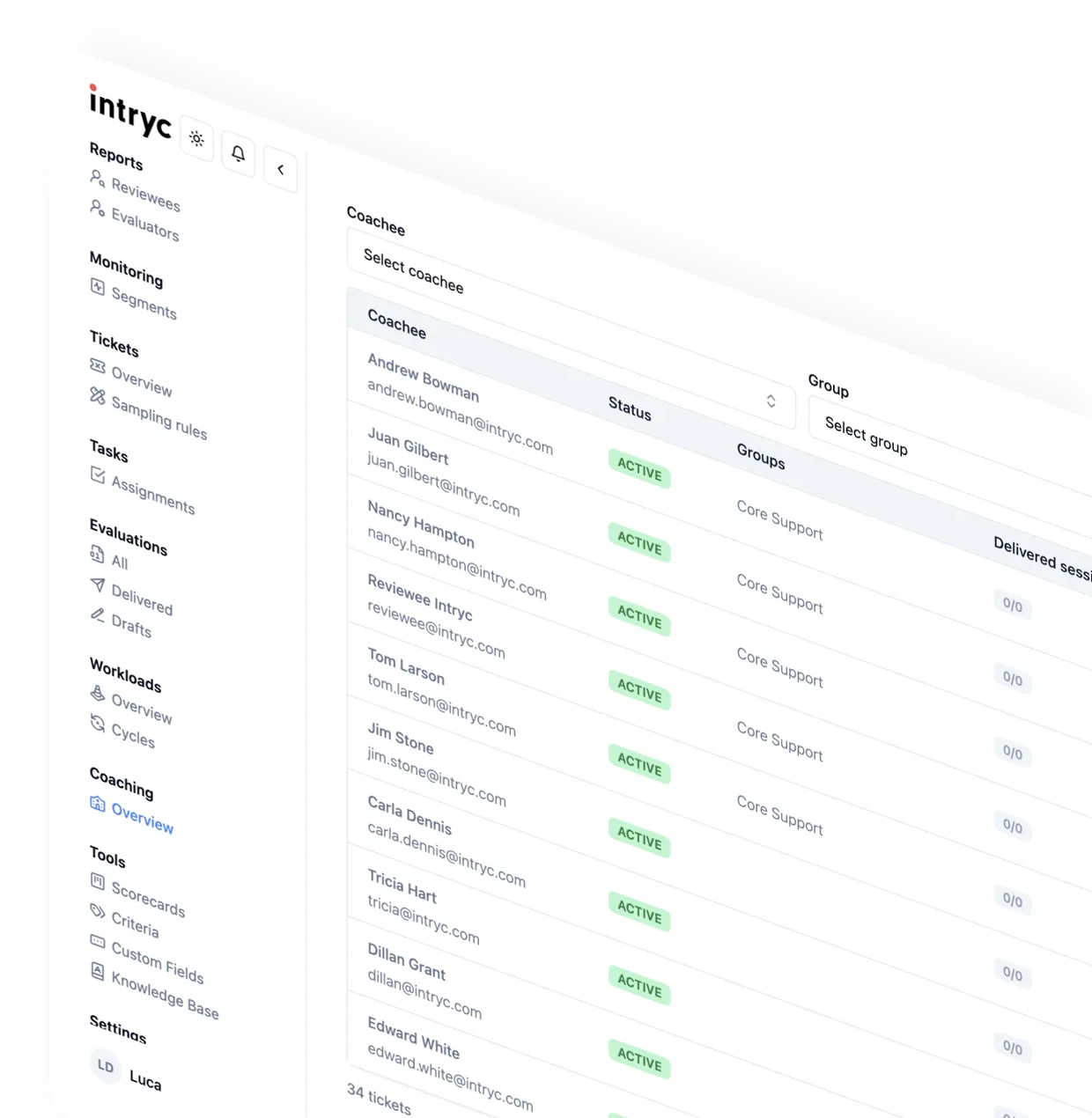
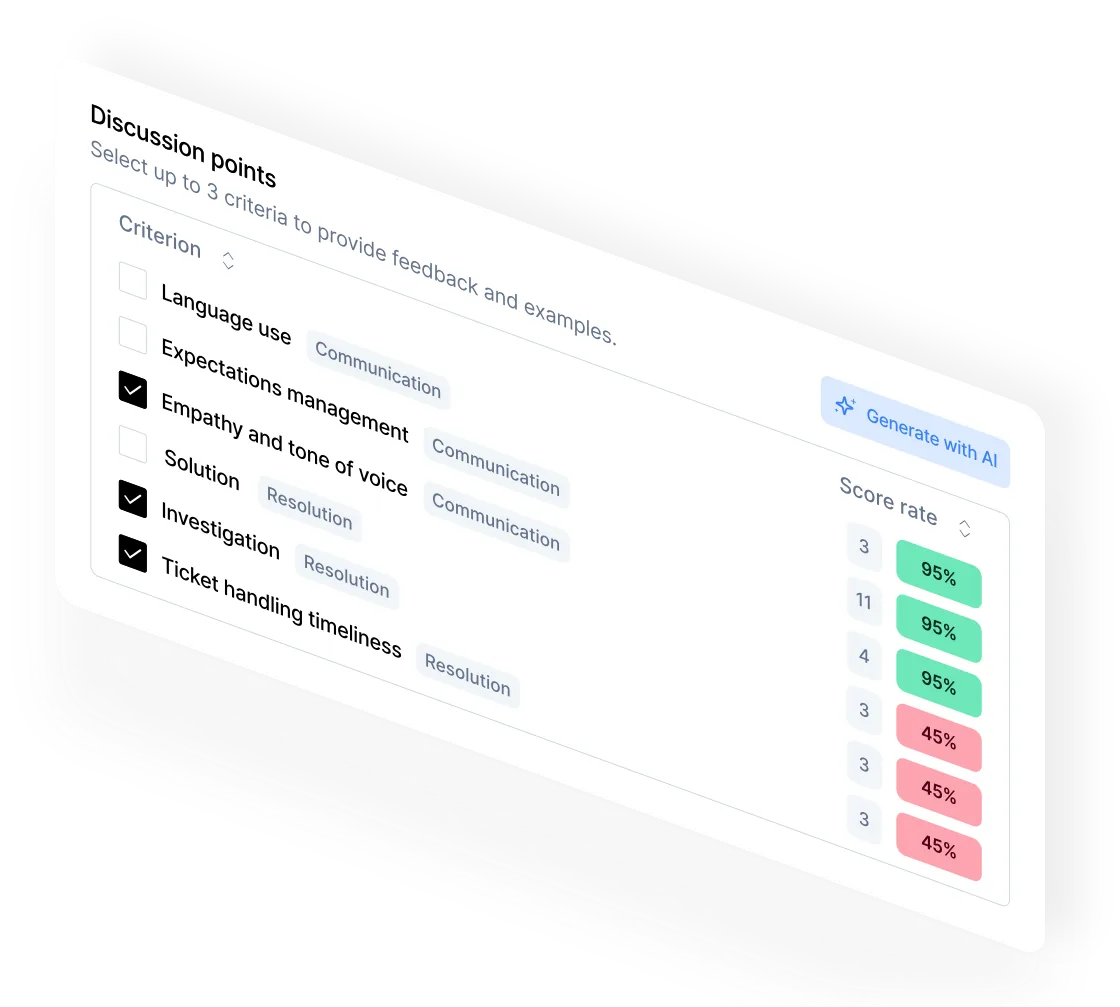
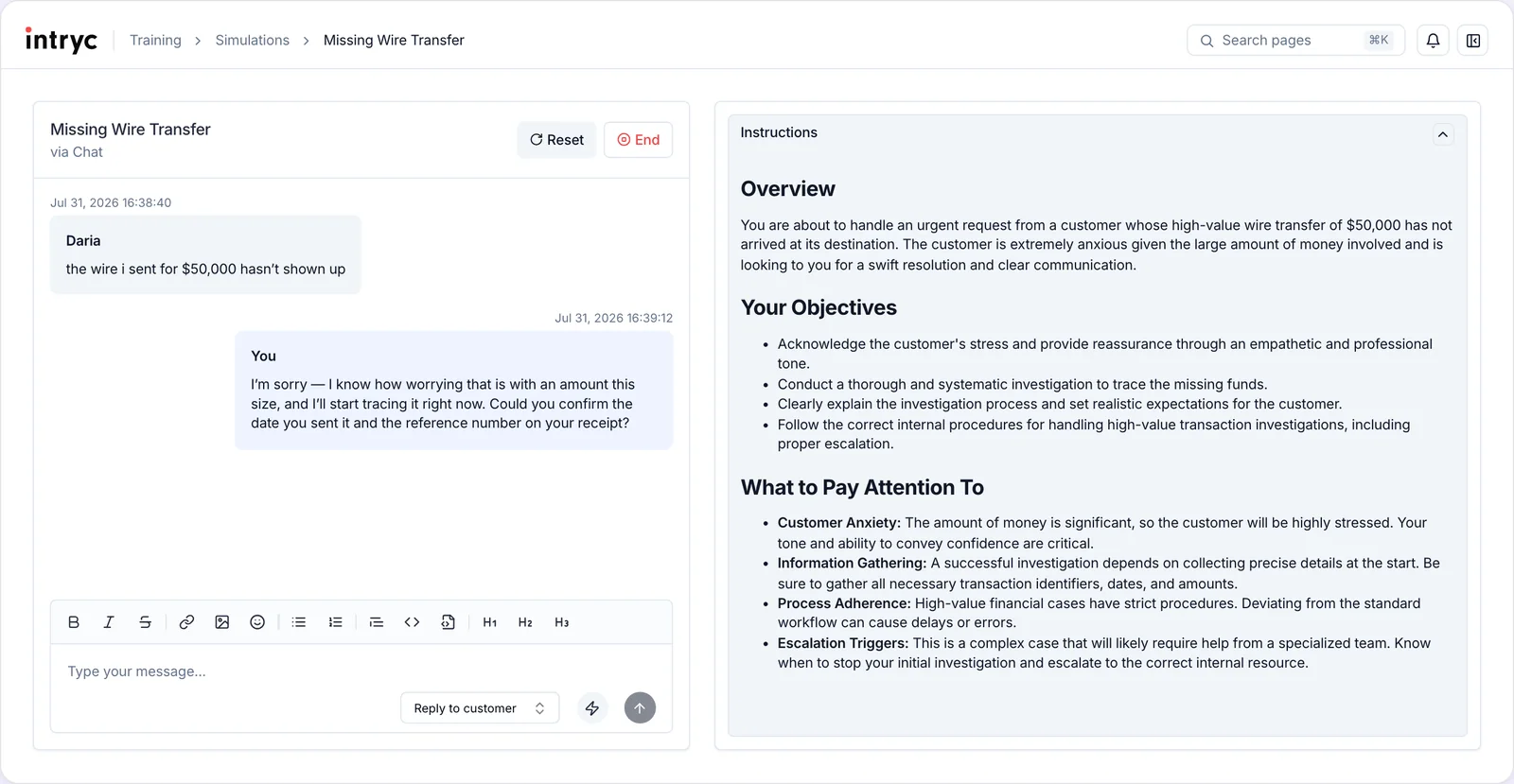
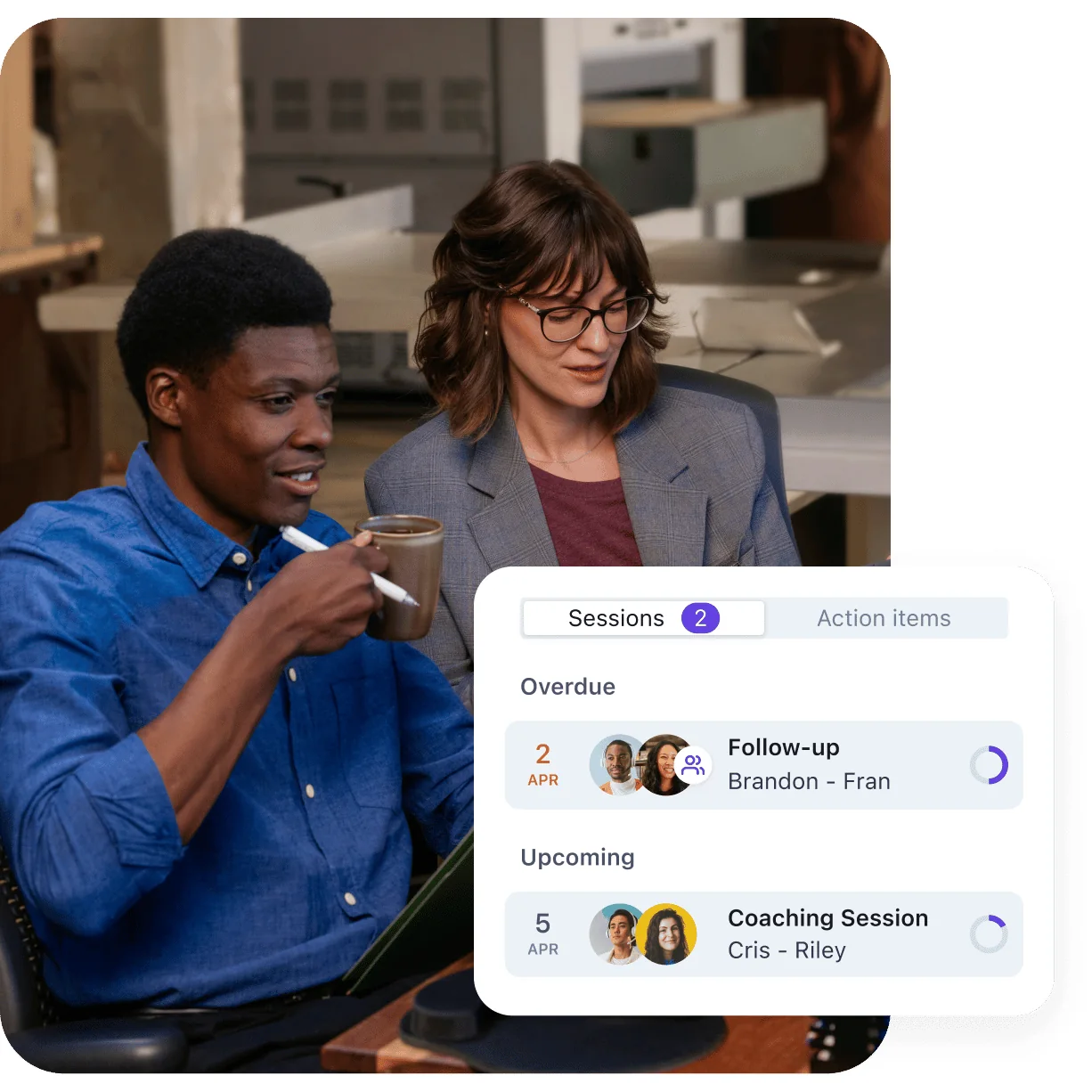
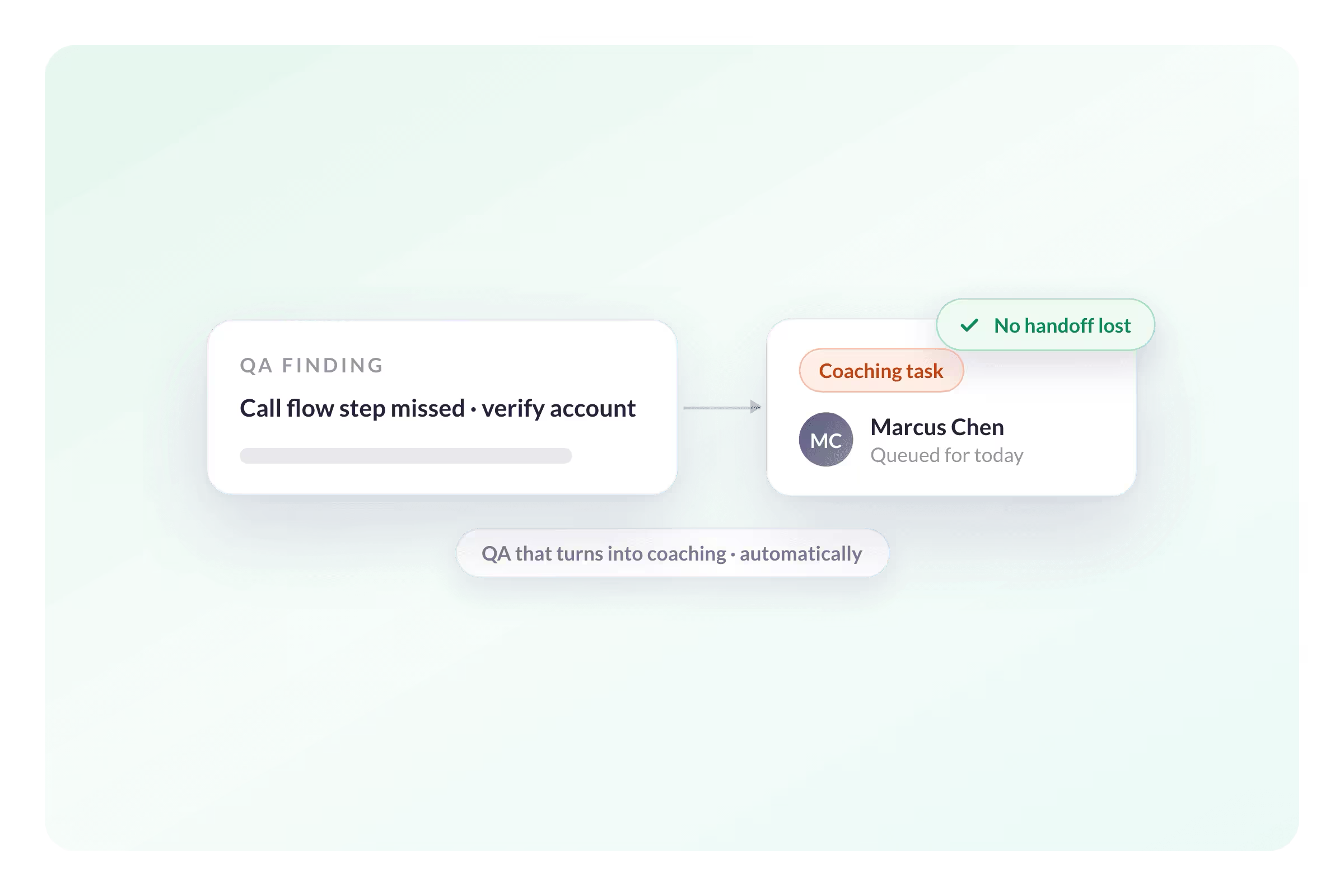
A flagged scorecard criterion becomes a coaching assignment, not just a line on a report. AutoCoaching builds each session from the agent's actual sub-max scores on the criteria a coach selects, links every point to the source ticket, and caps the session at six action items. Failed evaluations can also become targeted Simulations - chat, email or voice role-plays built from the real conversation type that triggered the flag, scored by the same AI engine as live evaluations, so practice performance and live performance sit on the same scorecard. This is a workflow capability: it connects a finding to a coaching and training action, and does not by itself guarantee a change in CSAT, NPS, or first contact resolution.
What can teams monitor after coaching or training?
Track what the evaluation program controls directly, separately from outcomes it only influences. Intryc tracks each coached agent's score on the coached criteria afterward, on the same scorecard. CSAT and NPS trends and first contact resolution rate can be tracked alongside those scores, but they move for reasons beyond any one coaching session - a leader who tracks only the outcome metric loses the ability to say why it moved.
The agent evaluation platforms compared
Short profiles from each vendor's own site as of October 2026. For a side-by-side on pricing, screenshots and reviewer themes, see the AI QA software buyer's guide.
Intryc
Teams configure AI scorecards around their own instructions, scoring methodology and criteria, then apply those scorecards to every support interaction - human or AI - at the coverage level they choose. Findings connect directly to AutoCoaching and to Simulations built from real flagged conversations, scored by the same AI engine as live evaluations. A calibration workflow compares AI and human evaluations criterion by criterion so a team can validate the AI evaluator before relying on it at scale.
Zendesk QA (formerly Klaus)
AutoQA evaluates 100% of Zendesk conversations, including interactions handled by Zendesk's own AI agents, against custom categories written as natural-language prompts. Zendesk QA supports calibration and agent disputes that reviewers can accept, partially accept or reject. Coaching runs through 1:1 sessions and quizzes. Zendesk QA announced tiered root causes on July 7, 2026 - reviewers pick these from category ratings, which is not the same as automatic clustering across the ticket queue. Zendesk QA's limitation: it is sold only as an add-on to Zendesk Support and Suite plans, so a team must hold a Zendesk plan to buy it, and the only published price is the $50 per agent per month Workforce Engagement (QA plus WFM) bundle, billed annually.
EvaluAgent
Auto-QM evaluates every conversation across voice, chat and email on a drag-and-drop scorecard with weighting and auto-fail logic, and AI Agent Observability extends the same evaluation to bots from Cognigy, Sierra and Decagon, scoring quality, pass rate, customer sentiment, guardrail violations and intent-recognition and containment rates. Calibration sessions and agent score challenges are built in, and findings connect to coaching, training modules and gamification. EvaluAgent's limitation: pricing is published from $35/user/month for AutoQM, but reaching Conversation Intelligence - which adds automated reason-for-contact - requires stepping up to the $65/user/month tier, so a team that wants that analysis layer pays a per-seat premium that scales with headcount rather than evaluation volume.
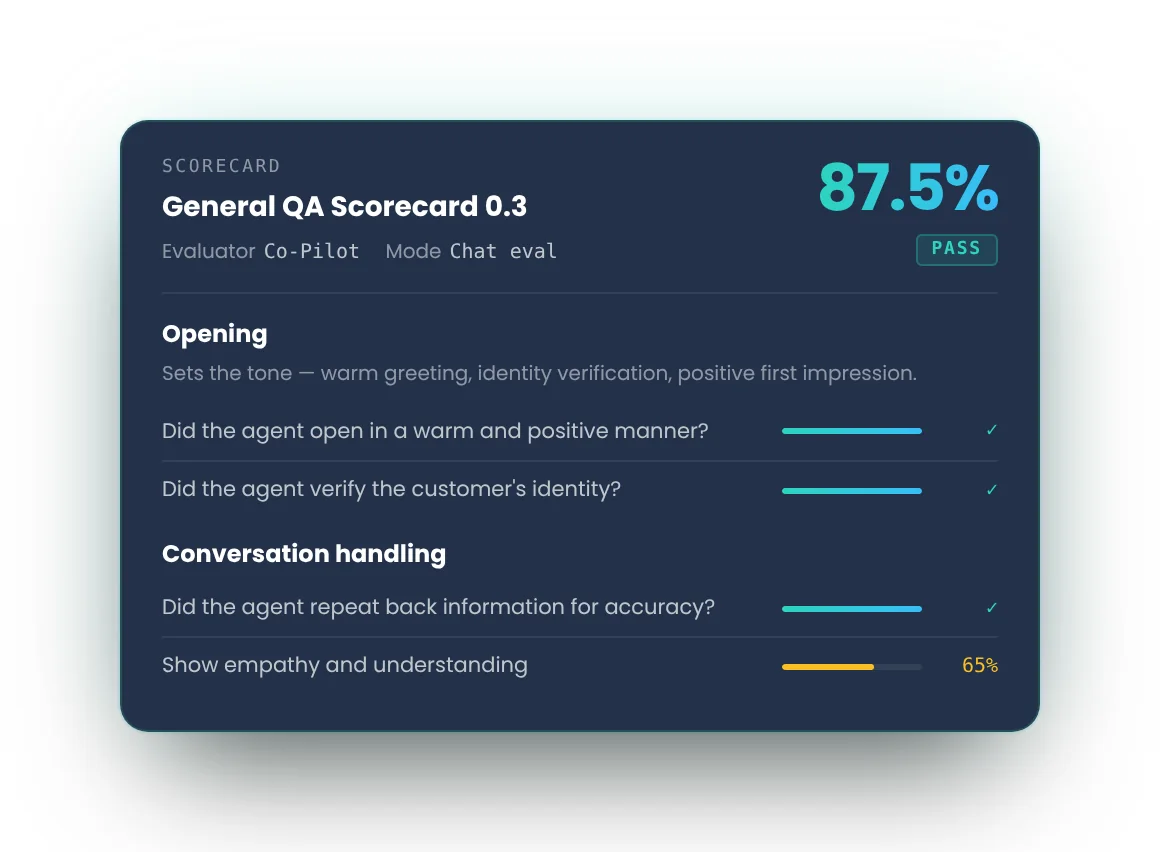
Level AI
QA-GPT evaluates 100% of calls, chats, emails and bot conversations against your existing scorecard or a pre-trained question library, with hybrid scorecards mixing AI-scored and manual items and evaluator overrides that recalibrate future scoring. Level AI bundles this with real-time agent assist and its own AI virtual agents. Level AI's limitation: its own published content lists pre-call role-play simulation under "not great at," so a team evaluating new-hire readiness has to pair Level AI with a separate training tool rather than running practice scenarios inside the same platform. Pricing is quote-only.

Observe.AI
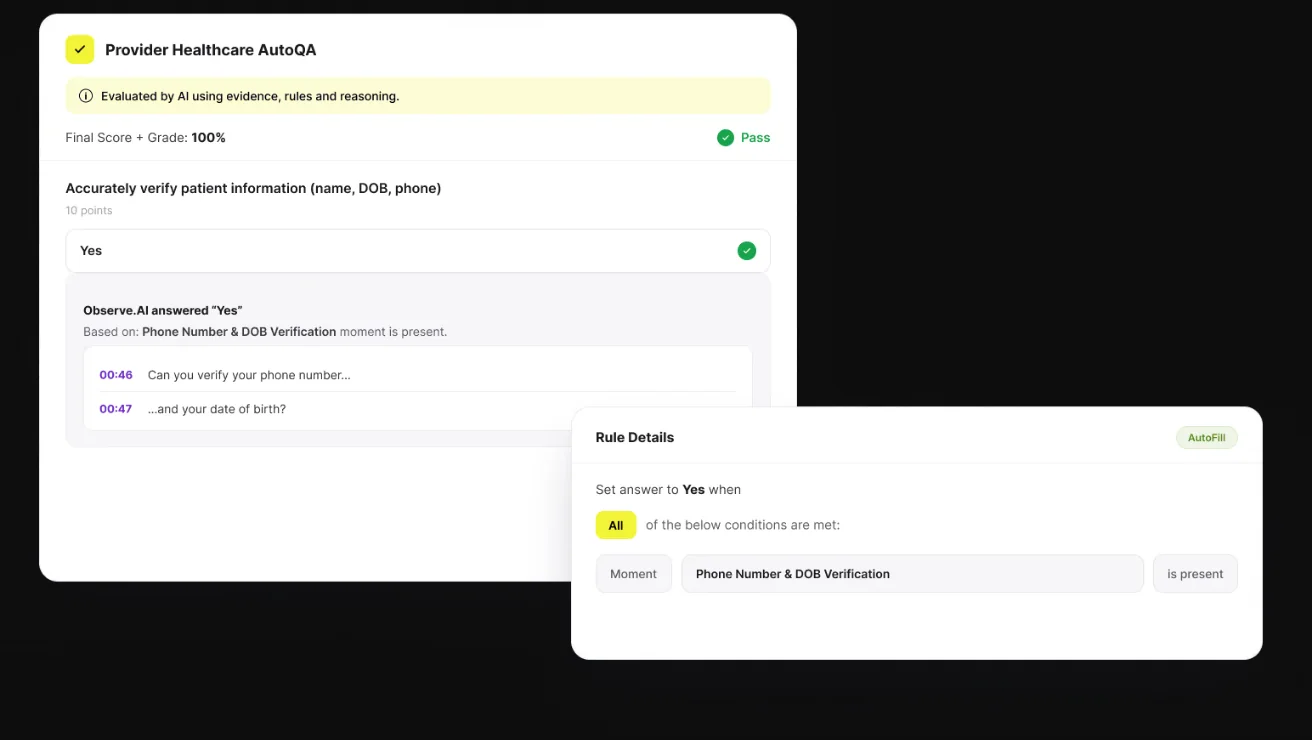
AutoQA evaluates 100% of call and chat interactions against existing scorecards, citing transcript evidence for each score, with calibration sessions to align AI and human scoring. Performance Agent, launched in 2026, auto-drafts coaching plans that a supervisor edits before delivery. Observe.AI's own platform is built around VoiceAI Agents and a Companion Agent for real-time guidance - launched May 13, 2026 - so agent evaluation sits inside a broader voice-AI product rather than standing alone. Observe.AI's limitation: no role-play or practice-simulation product for human agents is published on its site, so a flagged evaluation produces a coaching plan but not a practice scenario the way Intryc Simulations or AmplifAI's Max AI Coach do. Pricing is not published. Intryc evaluates phone calls through Aircall, Twilio, Freshcaller, NiCE CXone, Modjo, and Salesforce call transcripts, and its Voice Quality Scoring add-on grades tone, pace, silences, and pronunciation from the recording itself, not just the transcript.
AmplifAI
AutoQA evaluates 100% of voice, chat, email and AI-agent interactions under one workforce-performance platform. Coaching Effectiveness Scores (CEfx) tie a coaching session to a measurable KPI change, and Max AI Coach runs role-play practice built from an agent's last 100 evaluated interactions. AmplifAI lists 150+ integrations across CCaaS, CRM and WFM systems. AmplifAI's limitation: no real-time agent-assist capability is claimed on its public pages, and pricing is available by demo only, with no published tier or per-seat rate to compare against usage-based or per-conversation models.
Balto
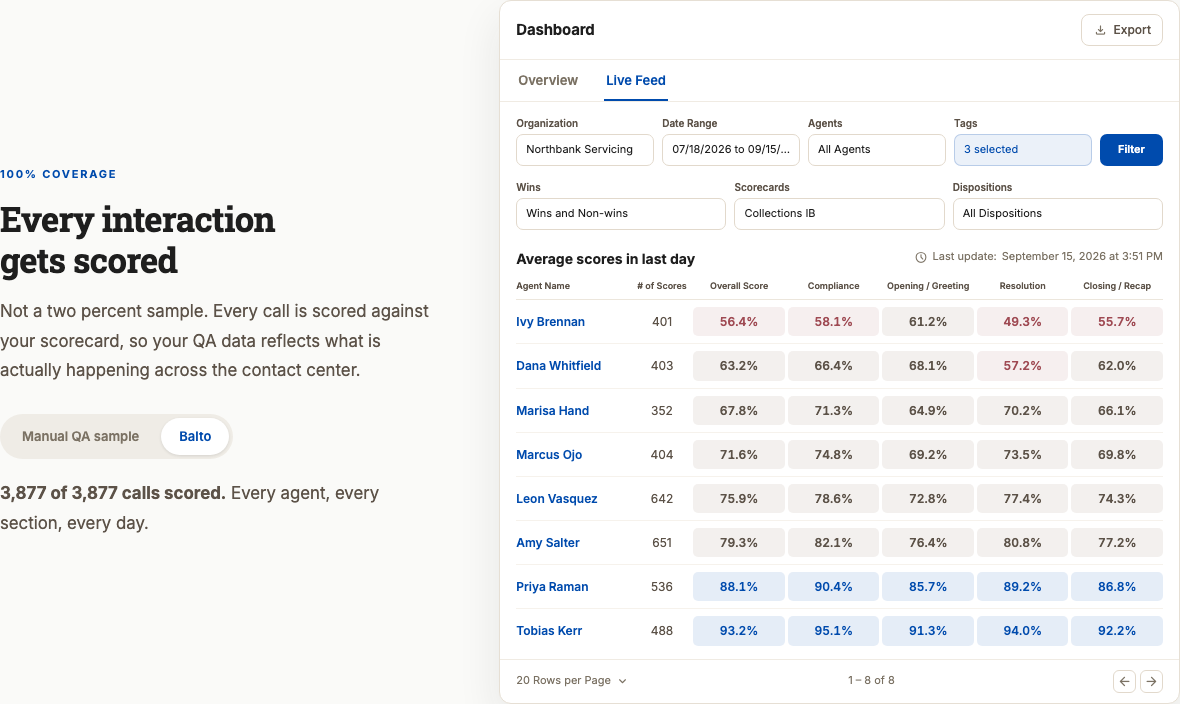
Balto's core product is real-time guidance during a live interaction, not post-interaction evaluation; its evaluation layer covers 100% of voice, email, chat and SMS conversations with a dispute path, and automatically surfaces coaching opportunities from flagged conversations. Balto also sells Togo, a voice AI agent for high-volume calls. Balto's limitation: role-play or simulation capability and pricing are not published on its public pages as of October 2026, so a buyer evaluating training depth or budget against Intryc, AmplifAI or EvaluAgent has to confirm both directly in a demo rather than from the site.
What to validate before choosing an agent evaluation platform
- Score your real tickets. Ask every vendor to evaluate the same set of your own conversations on your own scorecard, and compare the result against your best reviewer.
- The AI-to-human comparison. Confirm whether the platform separates "the AI was wrong" from "your reviewers disagree," and what action each path recommends.
- The dispute path for AI scores specifically. Ask who is notified and who resolves a dispute raised against an evaluation the AI scored, not a human one.
- The follow-through to coaching. Turn one failed evaluation into a coaching session and a practice scenario in the demo, and see what reaches the agent.
- Coverage at your volume. Confirm whether full coverage is included or metered by an AI-score or agent-run allowance at your monthly ticket volume.
- Every agent type you run. Confirm your helpdesk, telephony and any AI agents (Ada, Decagon, Intercom Fin or others) are evaluated on one scorecard, not bolted on separately.
FAQ
What is agent evaluation software for customer support QA?
Software that applies a team's own quality standard to support interactions - calls, chats, emails and tickets, human and AI - and connects what it finds to coaching and training. Intryc runs this as one loop: configure the scorecard, evaluate at the coverage level you choose, calibrate the AI against human reviewers, then coach and retrain on the real conversations that triggered a finding.
What are the best AI QA platforms for evaluating agent performance at scale?
For most support teams the shortlist is Intryc, Zendesk QA, EvaluAgent, Level AI, Observe.AI, AmplifAI and Balto. Intryc fits teams that want human-and-AI agent evaluation, coaching and training in one loop. Zendesk QA, sold as an add-on to Zendesk Support and Suite plans, fits teams running on Zendesk; Intryc also runs on Zendesk, alongside Intercom, Freshdesk, Salesforce, telephony and third-party AI agents, on one scorecard with usage-based pricing and no per-agent fees. Level AI, Observe.AI and AmplifAI bundle evaluation with a broader contact-centre or workforce platform - Intryc sits on top of the existing telephony stack instead of replacing it. Balto leads with real-time guidance and adds evaluation on top.
How do you compare agent evaluation platforms beyond random ticket scoring?
Compare scorecard control (unlimited criteria, modes, history-safe changes), how the platform validates AI scoring against your own reviewers, what happens when an agent disputes an AI-scored evaluation specifically, whether a failed evaluation becomes a coaching session and practice scenario or just an export, and the pricing and coverage model at your volume.
Can agent evaluation software validate AI scoring against human reviewers?
Yes - run the same tickets through both, compare criterion by criterion, and fix the scorecard instruction where they diverge. Intryc's accuracy reporting distinguishes an ambiguous instruction from reviewers disagreeing with each other, which point to different fixes (an instruction edit versus a calibration session).
Does agent evaluation connect to coaching automatically?
A flagged criterion can become a coaching assignment and a training simulation automatically, but a coach still selects which criteria to coach on and reviews the session before it reaches the agent, and Intryc tracks the agent's score on the coached criteria afterward, so you can see whether the controllable behaviour changed; CSAT, NPS and FCR move for more reasons than one session, so track them alongside.
Can the same platform evaluate AI agents and chatbots, not just human agents?
Intryc imports AI-agent conversations from Ada, Decagon, and Intercom Fin under the bot's own identity, so the chatbot is sampled, scored, and trended as its own agent - on the same scorecard as the humans, or its own. Bot coverage differs by vendor: EvaluAgent lists Cognigy, Sierra and Decagon; Zendesk QA scores Zendesk AI agents; confirm yours by name in a demo.
Related resources
- Service Quality Management Software for Customer Support Teams - the full define-evaluate-calibrate-coach loop
- Best AI QA Software for Customer Support (2026 buyer's guide) - pricing, screenshots and reviewer themes for seven platforms
- What is dispute resolution in QA software? - disputes on human and AI evaluations in depth
- How calibration sessions work in Intryc - the AI-to-human comparison workflow in detail
- QA Automation Software for Customer Support - the automation layer underneath agent evaluation
Visibility is infrastructure. See what Intryc sees on every conversation - human and AI.