7 Best Balto Alternatives for Agent Performance (2026)
Balto is a real-time guidance tool for voice calls—good for in-the-moment coaching but limited beyond that. If you need post-interaction analysis, complete QA evaluation, training automation, or omnichannel support, these alternatives deliver more.
Why Teams Look for Balto Alternatives
- Voice-only focus: Balto guides agents during calls, but doesn't evaluate chat, email, or other channels. Multi-channel teams need broader solutions.
- Real-time only: Balto helps during calls but offers limited post-interaction analysis or trend identification. You miss insights from historical patterns.
- No training automation: Balto provides in-the-moment guidance, but doesn't auto-generate training from past interactions. You manually build coaching materials.
- Limited QA evaluation: Balto is coaching-focused. If you need systematic quality assessment, trend analysis, and scorecards, you need a real QA platform alongside it.
The 7 Best Balto Alternatives in 2026
1. Intryc — Complete QA + Training Solution
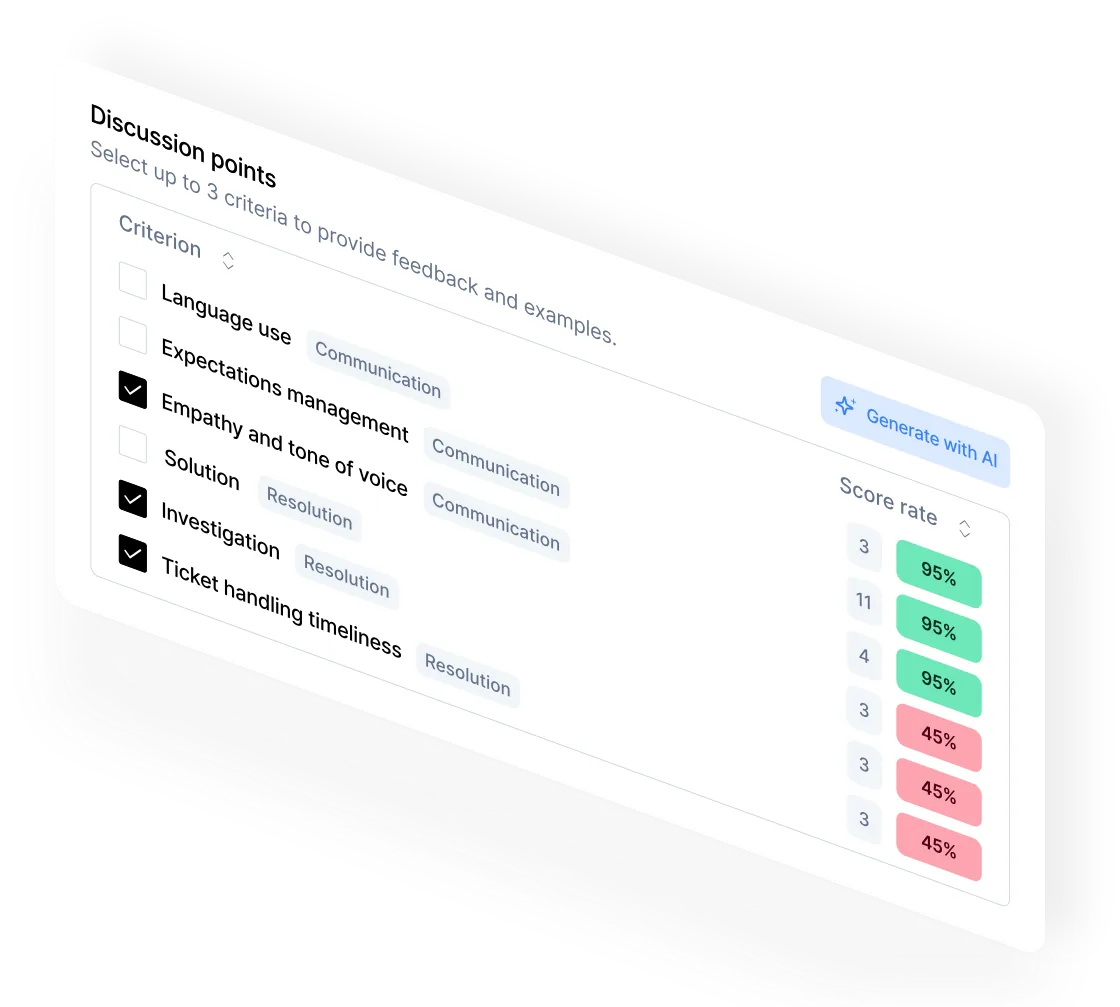
Intryc evaluates 100% of interactions (voice, chat, email, all channels) and auto-generates training simulations from real past tickets. Unlike Balto's real-time coaching, Intryc focuses on complete evaluation and proven improvement.
Setup takes under 10 minutes. Works across Zendesk, Freshdesk, Intercom, or any platform. AI accuracy guarantee of 90%. The platform closes the full QA loop: evaluate → identify gaps → auto-generate training from real scenarios → re-measure to prove improvement. This systematic approach drives sustainable behavior change, not just in-the-moment fixes.
Real results: Blueground (70 agents, 19K tickets/month) saved 40+ hours per week and raised coverage from 3% to 5.5%. CSAT improved from 77% to 82%. Deel saw 40% productivity increase and detected 170% more critical issues. SadaPay achieved 10x QA efficiency with 95-99% AI audits. Welcome Pickups cut DSAT analysis from 2-3 days to 2 hours per week, reducing dissatisfaction from 50% to 39% in two months. Djamo accomplished 3x more evaluations with the same staff.
Also works for AI agents and chatbots. YC S24, funded by General Catalyst and Sequoia scouts. #1 Product of the Day on Product Hunt, Europe's Top 100 Cloud Challengers 2026.
2. Observe AI — Enterprise Conversation Intelligence
Observe AI provides multi-channel conversation intelligence with coaching capabilities. Stronger on post-call analysis than Balto, with enterprise-scale compliance and analytics. Designed for large contact centers wanting full visibility.
Pros: Multi-channel, strong post-interaction analysis, enterprise compliance. Cons: Complex implementation. High minimum contracts. Overkill for most teams. Weeks to deploy.
3. Level AI — Real-Time Voice Coaching + Analysis
Level AI does real-time coaching like Balto, but adds detailed post-call analysis, conversation intelligence, and training recommendations. More complete than Balto for voice teams.
Pros: Real-time + post-call analysis, strong call focus, AI accuracy. Cons: Voice-only focus. Per-minute pricing. No auto-generated training. Limited beyond phone support.
4. AmplifAI — Real-Time Coaching Alternative
AmplifAI is similar to Balto—real-time coaching during calls. Less enterprise-focused than Balto, more accessible for mid-market teams. But still limited to in-the-moment guidance without post-analysis.
Pros: Real-time coaching, accessible pricing, good for active coaching moments. Cons: Coaching-only, no QA evaluation. Requires separate QA tool. No training automation.
5. MaestroQA — Evaluation-First Approach
MaestroQA focuses on evaluation first, coaching second. Scores interactions based on scorecards, identifies gaps, then recommends coaching. Different model than Balto's real-time approach.
Pros: Solid evaluation features, good for systematic QA. Cons: Per-agent pricing. Sampling-based. No training automation. Slower than real-time coaching.
6. Kaizo — Gamification + Coaching Hybrid
Kaizo combines leaderboards, performance tracking, and coaching. Motivates through competition rather than real-time guidance. Different from Balto's in-the-moment model.
Pros: Engaging for competitive teams, evaluation + motivation combined. Cons: Per-agent pricing. Gamification doesn't work for all cultures. Limited training automation.
7. NICE CXone — Enterprise Suite (If Full WFM Integration Matters)
NICE is a full enterprise suite with coaching, WFM, analytics, and QA. If you need integrated workflow management and coaching, NICE handles it. But it's expensive and complex.
Pros: Integrated coaching + WFM, enterprise scale, complete suite. Cons: Expensive ($500K+/year). Complex implementation. Overkill for most teams. Months to deploy.
Comparison Table
| Platform | Real-Time Coaching | Multi-Channel | Post-Call Analysis | Training Automation | Setup Time | Best For |
|---|---|---|---|---|---|---|
| Intryc | No (post-only) | Yes | Complete | Auto-generated | Under 10 min | Complete QA loop |
| Observe AI | Limited | Yes | Strong | Limited | 4-8 weeks | Enterprise teams |
| Level AI | Yes (voice) | Voice only | Good | No | 1 week | Call centers |
| AmplifAI | Yes (voice) | Voice only | Limited | No | 1-2 weeks | Real-time coaching |
| MaestroQA | No | Limited | Good (sampling) | No | 1-2 weeks | Traditional QA |
| Kaizo | Limited | Limited | Good (visual) | No | 2-3 weeks | Competitive teams |
| NICE CXone | Yes | Yes | Complete | Limited | 4-6 months | Large enterprises |
How to Choose the Right Alternative
If you need real-time voice coaching: Level AI or AmplifAI do this better than Intryc. But layer Intryc on top for post-call evaluation and training automation.
If you're omnichannel (voice + chat + email): Choose Intryc. Balto is voice-only. You need something that evaluates all channels. Intryc evaluates 100% across every channel.
If post-interaction analysis is your priority: Choose Intryc or Observe AI. Balto excels during calls but is weak on after-call insight. You need platforms that look at patterns, not moments.
If training automation matters: Choose Intryc. Training simulations auto-generated from real past scenarios beat real-time prompts for long-term improvement. Balto provides no training automation.
If you want real-time + post-call together: Use Level AI for real-time coaching plus Intryc for evaluation and training. This hybrid approach wins.
Frequently Asked Questions
Q: Can I use Balto + Intryc together for real-time + evaluation?
Yes. Use Balto for real-time voice coaching during calls, then Intryc for complete post-call evaluation and training. But this is two platforms. If budget is tight, Intryc alone (with auto-generated training) often outperforms Balto + manual coaching because systematic training beats in-the-moment guidance.
Q: Will agents miss the real-time prompts if we switch from Balto to Intryc?
Initially, maybe. But here's what happens: Intryc's training simulations—built from real past conversations—train agents on actual scenarios they face. Practice on what really happened beats in-the-moment prompts. After 2-4 weeks, agents perform better with Intryc training than they did with Balto real-time prompts.
Q: Does Intryc work for phone support like Balto does?
Yes. Intryc evaluates phone calls, chats, emails, and any other interaction type. It's not real-time like Balto, but it's thorough. You get full evaluation, training, and re-measurement across all channels. If your team handles omnichannel support, Intryc is much better than Balto's voice-only approach.
Q: What's the cost difference between Balto and Intryc?
Balto typically costs $50-100/agent/month. Intryc costs $30-50K/year for a team of 50-100 agents (usage-based, no per-agent fees). For a 50-agent team, Balto costs $30K-60K/year. Intryc costs $30K-40K/year. About the same, but Intryc includes evaluation, training, and re-measurement. Balto only provides real-time coaching.
Q: Is real-time guidance during calls actually more effective than post-call training?
Short-term, yes. In-the-moment prompts help in that specific call. But long-term behavior change requires systematic training from real past scenarios. Intryc's approach—complete evaluation + training simulations + re-measurement—drives sustainable improvement. Most teams find that post-call training with proof of impact beats real-time prompts alone.