Industry
Best Call Center QA Software in 2026: Ranked & Reviewed
Author
Published
Intryc
March 18, 2026
March 18, 2026 | By Alex Marantelos
If you run a customer support team, your call center QA software is either one of your biggest competitive advantages or one of your biggest blind spots.
Most teams still sample 2-5% of conversations manually. At that rate, 95-98% of support interactions are never reviewed. Agents repeat the same mistakes. Compliance risks go undetected. Customer experience degrades quietly while your quality scores look fine.
The best call center QA software platforms in 2026 solve this at scale — using AI to review every single conversation, score against your scorecard, and surface coaching moments automatically.
We evaluated the top platforms across five criteria: coverage (can it review 100% of conversations?), accuracy (does the scoring match human judgment?), coaching depth (does it close the loop on improvement?), ease of implementation, and pricing transparency.
What to Look for in Call Center QA Software
Before we get to the rankings, here is what actually separates great call center QA software from mediocre tools:
100% Coverage vs Sampling: Manual QA samples 2-5% of tickets. The best AI-powered QA platforms review every single conversation — voice, chat, email, and tickets.
Accuracy Against Your Scorecard: Generic sentiment analysis is not QA. Look for platforms that score against YOUR criteria with 90%+ alignment to human reviewers.
Coaching Integration: QA data is only valuable if it changes agent behaviour. The best platforms connect QA findings directly to coaching workflows.
Calibration Tools: QA teams need to align on scoring. Look for tools that support inter-rater reliability and calibration sessions.
Implementation Speed: Enterprise platforms can take 6+ months to deploy. Modern AI-native tools can be live in days.
The 7 Best Call Center QA Software Platforms in 2026
1. Intryc — Best for AI-Powered 100% QA Coverage
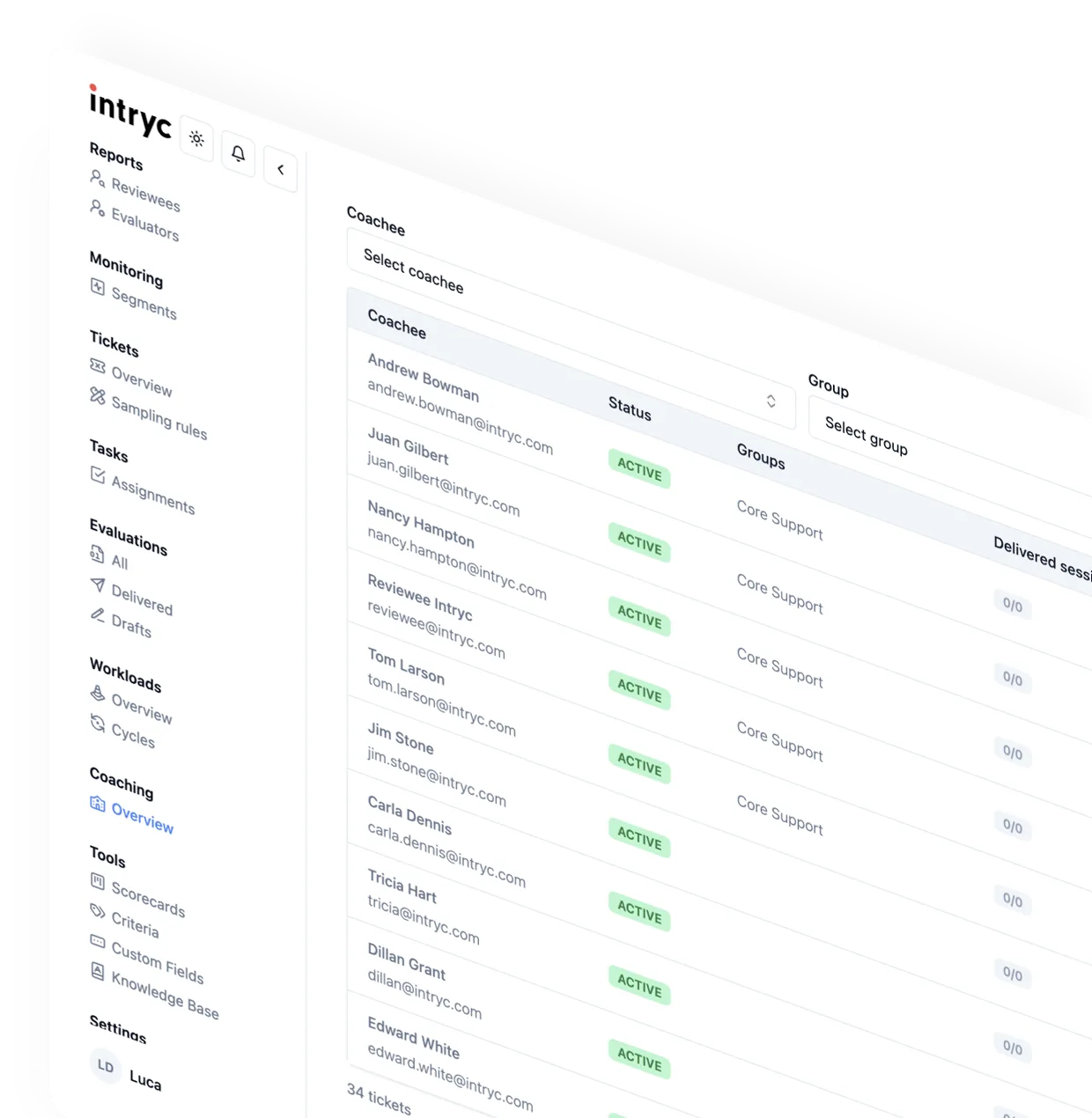
Intryc is an AI-native call center QA software built for CX teams that want to review every conversation, not just a sample. Unlike legacy platforms that bolt AI onto manual workflows, Intryc was designed from the ground up to automate quality assurance at scale.
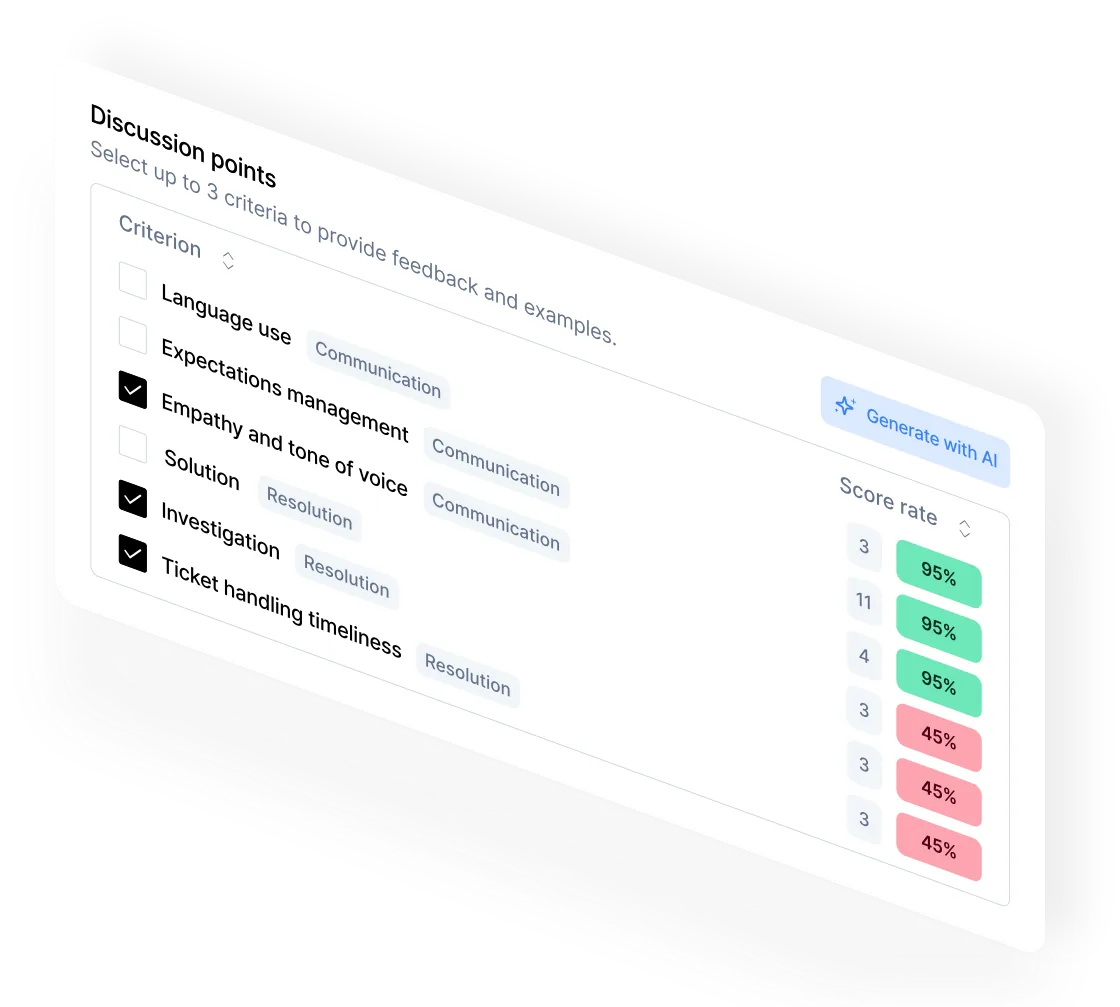
Key features: Auto-QA that scores 100% of conversations against your exact scorecard. AI Training Simulations that convert QA failures into practice scenarios. AutoCoaching that generates personalised improvement plans from QA data. Support for voice, chat, email, and ticket channels. 90%+ scoring accuracy guarantee. Live in days, not months.
What makes Intryc different is the closed loop: it does not just identify quality problems, it generates the training and coaching to fix them. When Deel implemented Intryc, they doubled their QA evaluation capacity without adding headcount. Blueground uses Intryc to maintain consistent quality standards across a globally distributed team.
Best for: Mid-market and enterprise customer support teams that need full QA coverage with built-in coaching and training.
Pricing: Contact for pricing. Demo available at https://www.intryc.com/
2. MaestroQA — Best for Enterprise Manual QA Workflows
MaestroQA is a mature call center QA platform with strong manual review workflows, calibration tools, and Salesforce integration. It has added AI features but remains primarily optimised for teams that want structured human-led QA.
Key features: Customisable scorecards. Calibration and dispute workflows. Strong CRM integrations. Reporting and analytics.
Limitations: AI coverage is partial — most teams still review 5-10% of tickets. Implementation can take several weeks. Pricing is enterprise-level.
Best for: Large enterprise teams with dedicated QA analysts and existing structured QA programs.
3. Klaus (Acquired by Zendesk) — Best for Zendesk-Native Teams
Klaus pioneered AI-assisted QA and was acquired by Zendesk in 2024. If your support stack is entirely Zendesk, Klaus integrates seamlessly and provides AI-suggested review assignments and sentiment analysis.
Key features: Native Zendesk integration. AutoQA features. Agent engagement scores. Good reporting dashboards.
Limitations: Tightly coupled to Zendesk — limited value if you use other platforms. Post-acquisition roadmap uncertainty. Coverage still sampling-based for most use cases.
Best for: Teams fully committed to the Zendesk ecosystem.
4. Playvox — Best for Workforce Management + QA Combo
Playvox combines QA, workforce management, and agent coaching into a single platform. If you need scheduling and QA under one roof, it is worth evaluating.
Key features: QA + WFM in one platform. Coaching and learning modules. Agent gamification features.
Limitations: Jack-of-all-trades positioning means QA depth is lower than dedicated QA platforms. AI QA coverage is limited.
Best for: Teams that want unified WFM and QA without managing multiple vendors.
5. Scorebuddy — Best for SMB Budget QA
Scorebuddy is a straightforward, affordable QA scorecard tool suitable for smaller teams. It lacks AI automation but delivers structured manual QA at a lower price point.
Key features: Easy scorecard setup. Basic reporting. Affordable pricing for small teams.
Limitations: No AI QA automation. Manual sampling only. Limited coaching integration. Not suited for scale.
Best for: Small support teams (under 50 agents) that are just starting a structured QA program.
6. EvaluAgent — Best for UK/Europe Mid-Market Teams
EvaluAgent is a UK-based QA platform with solid manual review workflows and emerging AI features. Popular with European BPOs and financial services teams.
Key features: Good compliance features. Multi-language support. GDPR-compliant data handling. Coaching modules.
Limitations: AI QA features are still maturing. Primarily manual-first. Less commonly integrated with US-centric support stacks.
Best for: UK/European support teams with compliance-heavy requirements.
7. Stella Connect (by Medallia) — Best for Customer Feedback + QA
Stella Connect connects post-interaction customer feedback directly to agent QA scores, creating a combined internal + external quality view. Part of the Medallia suite.
Key features: Customer feedback integration. Agent recognition features. Manager coaching tools. Medallia CX platform integration.
Limitations: QA is secondary to CX feedback. AI QA automation is limited. Best value only when using the broader Medallia suite.
Best for: Enterprises already using Medallia that want to connect CX feedback to internal QA.
Call Center QA Software Comparison Table
How to Choose the Right Call Center QA Software
The right call center QA software depends on three things: your team size, your current QA maturity, and whether you want to fix QA at scale or just improve your existing sampling process.
If you are reviewing less than 10% of conversations and you want to change that, you need an AI-native platform like Intryc that is built for 100% coverage from the start.
If you have a large dedicated QA team running structured manual reviews and want to augment with AI, MaestroQA or Klaus may fit your existing workflows better.
If you are a small team just starting out, Scorebuddy is a cost-effective way to build QA habits before investing in AI automation.
The most important thing: do not buy call center QA software based on features alone. Ask for a trial with your actual data, your actual scorecard, and measure accuracy against your human reviewers before committing.
The Bottom Line
Call center QA software has evolved dramatically. The 2-5% sampling era is over for teams that want to compete on customer experience. AI-powered platforms now make 100% QA coverage achievable for any team size.
Intryc sits at the top of our 2026 ranking because it is the only platform that genuinely closes the loop — from automated QA scoring to personalised coaching to simulation-based training. It is not just a QA tool; it is a customer support quality operating system.
Frequently Asked Questions
Why is 100% QA coverage better than 2-5% manual sampling?
At 2-5% sampling, 95-98% of support interactions are never reviewed. Agents repeat the same mistakes, compliance risks go undetected, and customer experience degrades quietly while quality scores look fine. 100% coverage with AI means every interaction is scored—you see real performance, not a lucky sample.
What criteria matter most when ranking call center QA software?
The five most important criteria: coverage (can it review 100% of conversations?), accuracy (does scoring match human judgment?), coaching depth (does it close the loop on improvement?), ease of implementation, and pricing transparency.
Which call center QA software ranked #1 in 2026 and why?
Intryc ranked #1 because it is the only platform that closes the complete quality loop—from automated QA scoring to personalised coaching to simulation-based training. It evaluates 100% of interactions, identifies specific performance gaps, auto-generates training simulations, and re-measures improvement. No other platform does all four steps automatically.
What is the most important thing to check before buying call center QA software?
Do not buy based on demos with sample data. Ask for a trial with your actual data, your actual scorecard, and compare AI scores against your human reviewer scores. This is the only way to verify whether the platform's accuracy claims apply to your specific support context.
Can call center QA software evaluate both human agents and AI chatbots?
Most traditional QA platforms were designed for human agents. Intryc evaluates both human agent interactions and AI agent/chatbot interactions using the same scorecard framework. As AI becomes more prevalent in customer support, this unified evaluation capability is increasingly critical.