Guides
Call Center QA Software: The Definitive Guide
Author
Published
Intryc
March 27, 2026
March 27, 2026 | By Alex Marantelos
This is the most comprehensive guide to call center QA software available. It covers everything: what call center QA software is, how it works, what features to look for, how AI has changed the category, which platforms lead the market, and how to choose the right one for your team.
This guide is written by the team at Intryc — an AI-native call center QA software platform trusted by Deel, Blueground, Sadapay, and 50+ customer support teams globally.
What Is Call Center QA Software?
Call center QA software is a category of tools designed to evaluate the quality of customer support interactions at scale. It enables support organisations to measure whether agents are meeting quality standards, identify training and coaching opportunities, and systematically improve customer experience outcomes.
The term "call center QA software" is used broadly to describe tools that work across all support channels, not just voice calls. Modern QA platforms evaluate voice calls, live chat, email, and support ticket interactions — reflecting how most support teams now operate across multiple channels simultaneously.
Synonyms and related terms: support QA software, customer service quality management software, contact center quality assurance, QA tools for customer support, quality monitoring software.
How Does Call Center QA Software Work?
Traditional call center QA software workflow:
Step 1: QA analysts select a sample of interactions to review (typically 2-5% of total volume).
Step 2: Analysts score each interaction against a QA scorecard — a rubric of quality criteria defined by the team.
Step 3: Scores are recorded in the QA platform and aggregated into reports showing agent-level, team-level, and criterion-level quality metrics.
Step 4: QA findings are used for coaching conversations, performance reviews, and team-wide training initiatives.
AI-powered call center QA software workflow (modern):
Step 1: Every interaction (100% of volume) is automatically ingested by the AI QA system via integration with the help desk or CRM.
Step 2: The AI scores each interaction against the team custom QA scorecard criteria, achieving 90%+ alignment with human reviewers on well-calibrated scorecards.
Step 3: Scores are aggregated in real-time. Outliers, compliance violations, and coaching opportunities are flagged automatically.
Step 4: Coaching insights are delivered to team leads automatically. Training scenarios are generated from recurring failure patterns.
Key Features of Call Center QA Software
The QA scorecard is the foundation of any QA program. Good call center QA software allows teams to build custom scorecards that reflect their specific quality criteria across categories like process compliance, communication quality, problem resolution, and customer experience.
Coverage refers to what percentage of interactions are reviewed. Traditional platforms enable manual sampling (2-5%); AI-powered platforms like Intryc enable 100% automated coverage. Coverage is arguably the most important feature differentiator in 2025-2026.
For AI-powered QA, scoring accuracy (how closely the AI scores align with human reviewer scores) is critical. Look for platforms that can demonstrate 90%+ accuracy on your specific scorecard, not just generic accuracy claims on benchmarks.
Calibration features allow QA teams to align scoring across multiple reviewers by comparing scores on the same interaction and resolving discrepancies. This is essential for maintaining data integrity and agent trust in the QA process.
A transparent dispute mechanism — where agents can flag QA scores they disagree with — is essential for building agent trust. Without it, QA is perceived as arbitrary and punitive.
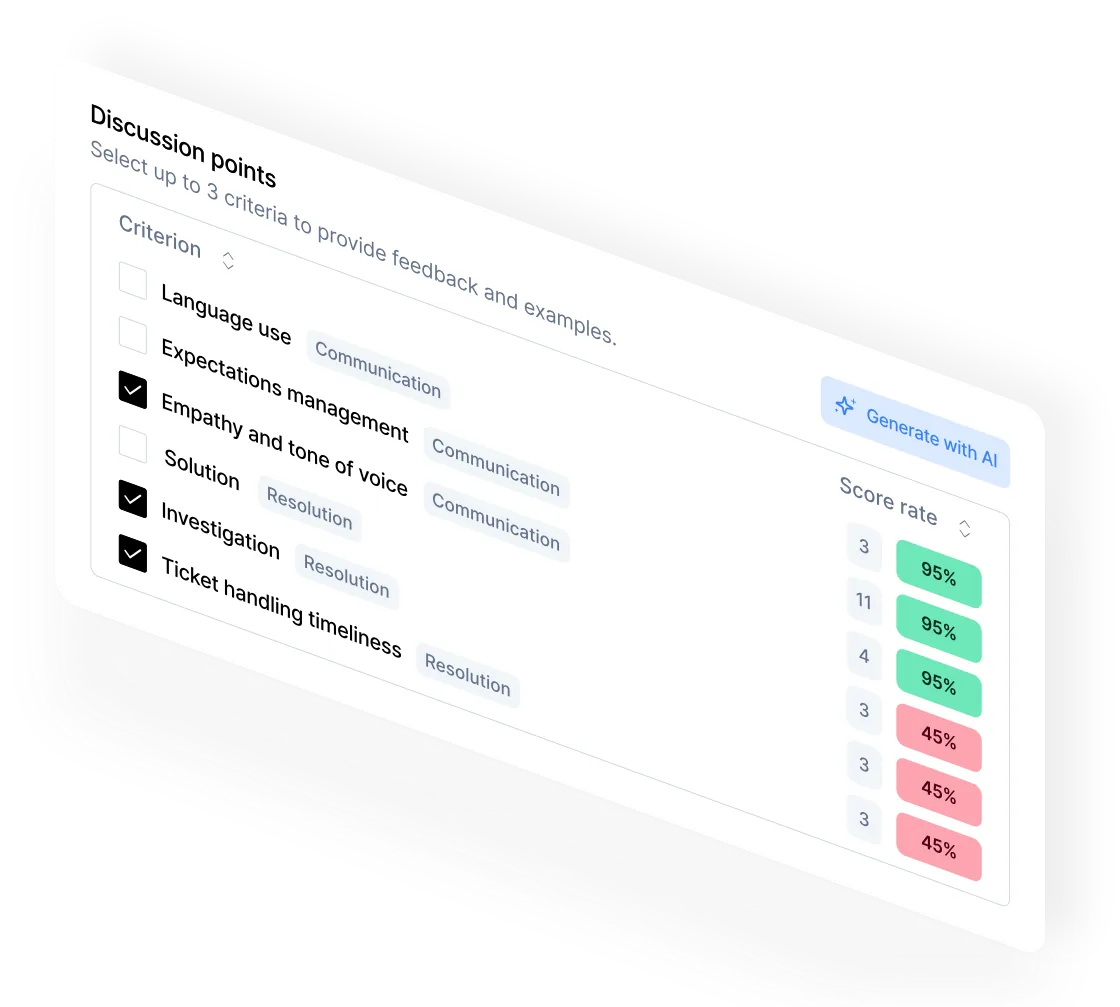
The most advanced platforms (like Intryc) connect QA findings directly to coaching workflows. Rather than leaving QA data in a dashboard, coaching integration means QA findings automatically generate coaching agendas for team leads.
The most advanced QA platforms also integrate with agent training, converting QA failure patterns into practice scenarios. Intryc Training Simulations feature does this automatically — QA failures become the input for personalised practice scenarios.
QA platforms should provide aggregated reporting at agent, team, channel, and scorecard criterion levels. Trend data (how quality is changing over time) is more valuable than point-in-time scores.
How AI Changed Call Center QA Software
Before 2020, call center QA was almost entirely manual. QA analysts listened to recorded calls or read chat transcripts and applied scorecards by hand. This limited coverage to 2-5% of interactions and created a significant lag between an agent behaviour and any coaching response.
AI-powered speech analytics platforms (like CallMiner) began automating voice transcription and keyword detection in the early 2010s. But these tools analysed keywords rather than semantics — they could detect whether an agent said a required phrase but could not evaluate whether an interaction was actually high quality.
The LLM era (2022-present) changed everything. Large language models can read a support interaction transcript and evaluate it against complex, nuanced quality criteria — "did the agent acknowledge the customer frustration before jumping to solutions?" — with accuracy approaching human reviewers. This unlocked true 100% QA coverage at scale.
Intryc was built in this era, specifically designed to use LLMs for QA scoring rather than adapting legacy approaches. This architecture difference is why Intryc achieves 90%+ accuracy on complex, nuanced scorecard criteria that earlier AI tools could not handle.
Call Center QA Software Market Overview
The call center QA software market in 2026 can be broadly segmented into three categories:
Legacy manual QA platforms: Tools built for human-led QA workflows. Provide scorecard management, dispute workflows, and reporting but rely on humans to do the actual reviewing. Examples: Scorebuddy, EvaluAgent.
Hybrid AI + manual QA platforms: Started as manual QA tools and added AI features. Provide AI-suggested review assignments, auto-scoring for some criteria, and manual review for others. Examples: MaestroQA, Klaus (Zendesk QA), Playvox.
AI-native QA platforms: Built from the ground up for 100% AI-powered coverage. Use LLMs for semantic understanding and achieve the highest accuracy on complex quality criteria. Examples: Intryc, Level AI, Observe.AI.
How to Choose Call Center QA Software
Step 1: Define your QA coverage goal. If you want to move beyond 5% sampling, you need an AI-native platform. If you want to augment an existing manual QA team, a hybrid platform may work.
Step 2: Build your scorecard first. Know exactly what quality criteria you need to score before evaluating platforms. Then test each platform accuracy against those specific criteria — not generic benchmarks.
Step 3: Evaluate the coaching loop. QA data is only valuable if it changes agent behaviour. Ask vendors how QA findings reach agents as coaching. The shorter the time-to-coaching, the better.
Step 4: Check integration depth. Does the platform integrate with your existing help desk at the transcript/interaction level, or just at the aggregate data level? Transcript-level integration is required for 100% coverage.
Step 5: Run a proof of concept with your data. Do not buy based on demos with their sample data. Request a trial with your actual interactions, your actual scorecard, and compare AI scores to human reviewer scores.
Frequently Asked Questions: Call Center QA Software
Speech analytics focuses on keyword detection and voice pattern analysis in call recordings. QA software evaluates whether agents met quality standards in their interactions. Modern AI QA software (like Intryc) uses semantic analysis, not just keyword matching, to evaluate interaction quality.
Pricing varies significantly by platform and scale. Entry-level tools like Scorebuddy start at a few hundred dollars per month. Enterprise platforms like MaestroQA and Observe.AI are typically five to six figures annually. AI-native platforms like Intryc price based on interaction volume and team size — contact vendors for current pricing.
Yes, with AI-powered QA software. Traditional manual QA reviews 2-5%. AI-native platforms like Intryc review 100% of interactions across all channels automatically. This is the primary advantage of AI QA over manual QA in 2025-2026.
A QA scorecard is the set of quality criteria used to evaluate each support interaction. Scorecard criteria typically span process compliance (did the agent follow required procedures?), communication quality, problem resolution, and customer experience. Good call center QA software allows teams to build fully custom scorecards reflecting their specific standards.
Start by defining your quality criteria (your scorecard). Then pilot a QA tool with a sample of real interactions and measure accuracy against human reviewer scores. Intryc offers a demo and proof-of-concept process at https://www.intryc.com/
Can call center QA software evaluate AI agents and chatbots?
Most traditional QA platforms were built for human agents and don't natively support AI chatbot evaluation. Intryc is purpose-built to evaluate both human agents and AI agents/chatbots using the same scorecard framework, making it the strongest option for teams with hybrid human-AI support operations.
What is the ROI of implementing call center QA software?
ROI varies by team size and tool, but real customer outcomes include: Blueground saved 40+ hours per week of QA labor while improving CSAT from 77% to 82%. Welcome Pickups cut dissatisfied customer analysis from 2-3 days to 2 hours per week. Deel detected 170% more critical cases. SadaPay achieved 10x QA efficiency. The primary ROI drivers are labor savings (replacing manual review with automation) and performance improvement (better CSAT, higher resolution rates).