Product
Contact Center QA Software: Scorecards, Coverage & Coaching | Intryc
Author
Published
Intryc
July 9, 2026

Updated September 2026
Contact center QA software evaluates support conversations against your scorecard so you can see where quality breaks and fix it through coaching. Most programs do this for less than 5% of conversations. Intryc evaluates every conversation - human and AI - on your own scorecard, at 90% accuracy - guaranteed, whether you choose full coverage or a targeted sample.
As of September 2026, Intryc supports custom QA scorecards, configurable evaluation coverage, AI-human calibration, reporting, and coaching workflows for contact center support teams.
What is contact center QA software?
Contact center QA software records, evaluates, and scores customer-agent interactions against a quality scorecard. It answers the question: did this conversation meet the standard?
The standard components are post-call analysis, scorecard-based grading, reporting on agent performance, and a feedback loop to coaching. Legacy tools handled this manually - a QA analyst pulled a ticket sample, scored it by hand, and logged it in a spreadsheet or a bolted-on QA module.
The category has split. One track - still dominant - is speech analytics and call transcription, focused on voice channels. The other track is AI-native QA that evaluates every channel and every agent type, including the AI chatbot sitting alongside the human team, against a scorecard the QA team controls.
How should teams configure QA scorecards and evaluation coverage?
Intryc's scorecards are built to your criteria, your weighting, and your evaluation logic - not a generic template.
This matters because "your scorecard, your rules" is not a feature, it is a quality signal. A QA tool that forces you into a fixed rubric introduces systematic drift between what the platform measures and what your business actually cares about.
Intryc scorecards support unlimited criteria with three modes - weighted, critical (one failure fails the evaluation, optionally at zero weight so it gates without inflating the score), and soft (feedback-only while a new standard is piloted) - with per-criterion weighting and knowledge-base-linked criteria. Attribute-based sampling lets you prioritize which conversation types get reviewed against which criteria. When a scorecard question changes, historical scores do not corrupt retroactively - a specific failure mode in legacy tools like MaestroQA (now rebranded Rippit), where a question edit silently changed past evaluations.
For teams building quality programs from scratch, Intryc's ex-Deel QA practitioners can review the scorecard logic before you go live.
Most contact center QA programs review less than 5% of conversations. For high-volume support teams, that number is often less than 1%.
At 5% coverage, you are not running QA - you are running a sample. And you are making staffing decisions, coaching priorities, and policy calls on the basis of that sample. When something breaks in the other 95%, you find out from a customer escalation, not from your QA data.
Intryc lets you choose: run AI-assisted review across 100% of your ticket volume, or target an intelligent, attribute-based sample by risk, sentiment, agent, or ticket type - same scorecard, same accuracy commitment either way. Most teams start with full coverage on their highest-risk queues and expand from there as the program matures.
For a team processing 20,000 cases a month, the difference between a 5% sample and full coverage is the difference between QA data on ~1,000 cases and QA data on all 20,000. That is the coverage gap. Both blind spots - low-coverage human QA and zero AI-agent QA - are fixable from the same platform.
The 90% accuracy guarantee is not a projection. It is a contractual commitment: 90% AI QA accuracy on your real scorecards and your real ticket data in month 1, or the first month's fees are waived. Full refund within 60 days if unsatisfied.
How can teams validate AI scoring against human reviewers?
The honest question buyers ask isn't whether AI QA works in a vendor's demo. It's whether it will hold up on their own rubric, with their own edge cases, before they hand a manager's judgment call to a model.
The way to test that is a pilot: run your real scorecard against a representative set of your own conversations, and compare the AI's score to a human reviewer's score, criterion by criterion - not just the overall pass/fail. Where they disagree, the question isn't just "who was right," it's why: was the scorecard instruction ambiguous, or did the reviewers themselves disagree with each other? Those are two different problems with two different fixes, and a QA platform's accuracy reporting should tell you which one you're looking at rather than reporting one undifferentiated number.
Intryc runs blind calibration sessions to test the second case directly: a lead reviewer's score becomes the benchmark, every other participant scores independently with results hidden until everyone submits, then a side-by-side, per-criterion comparison shows where reviewers agree and where they don't - before you ever compare a human score to an AI score.
Reviewers keep override authority throughout. An evaluator can correct an AI score at the criterion level, and that correction feeds back into the accuracy measurement. Over time, an admin can review a batch of corrections and accept a proposed refinement to the scorecard instruction itself - a human decision, not a silent auto-rewrite. The AI doesn't get the final word by default - it gets checked, and the checking is what the accuracy number is actually measuring.
What happens after a QA finding is identified?
Evaluation without a feedback loop is reporting. Intryc closes that loop.
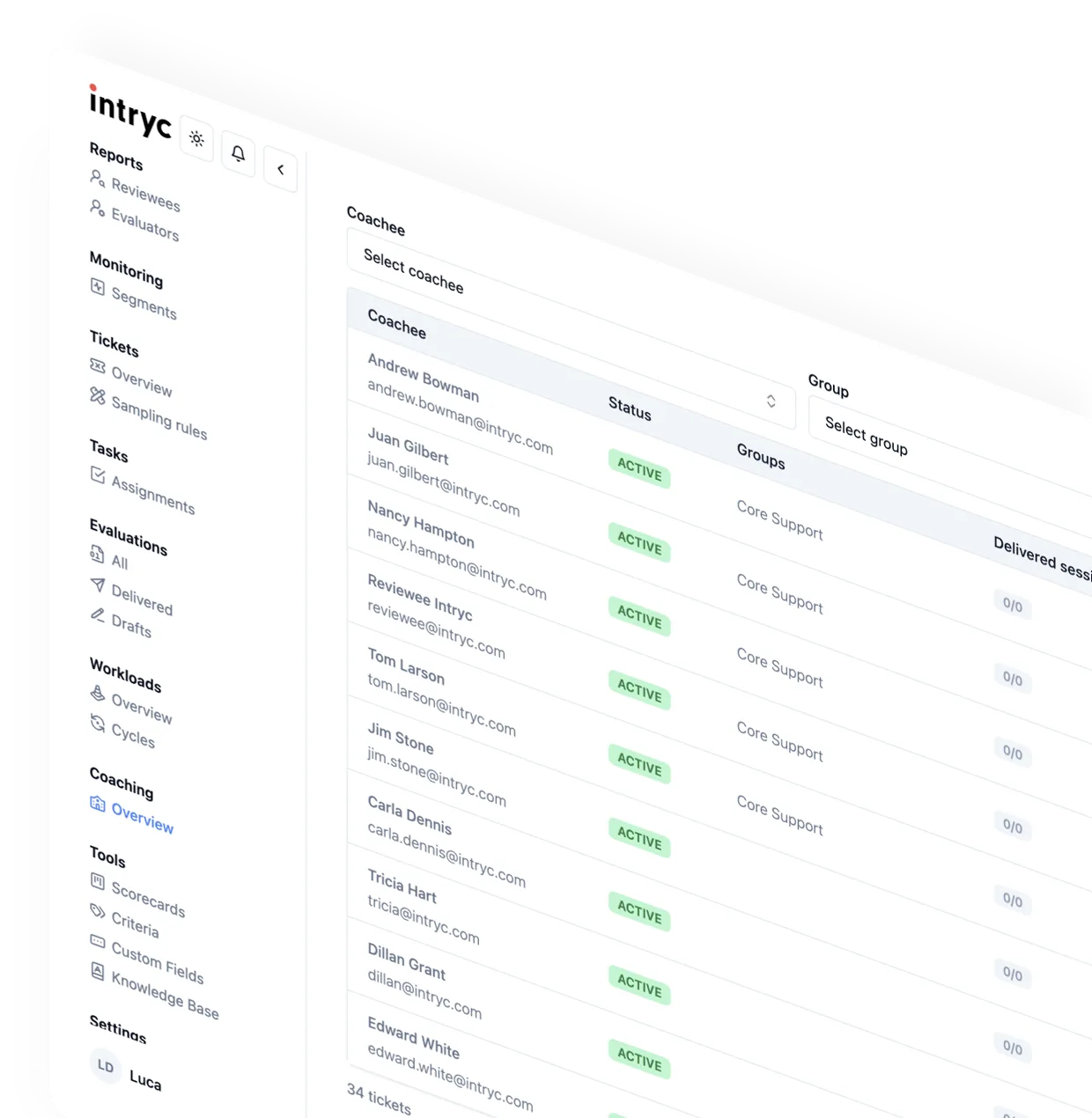
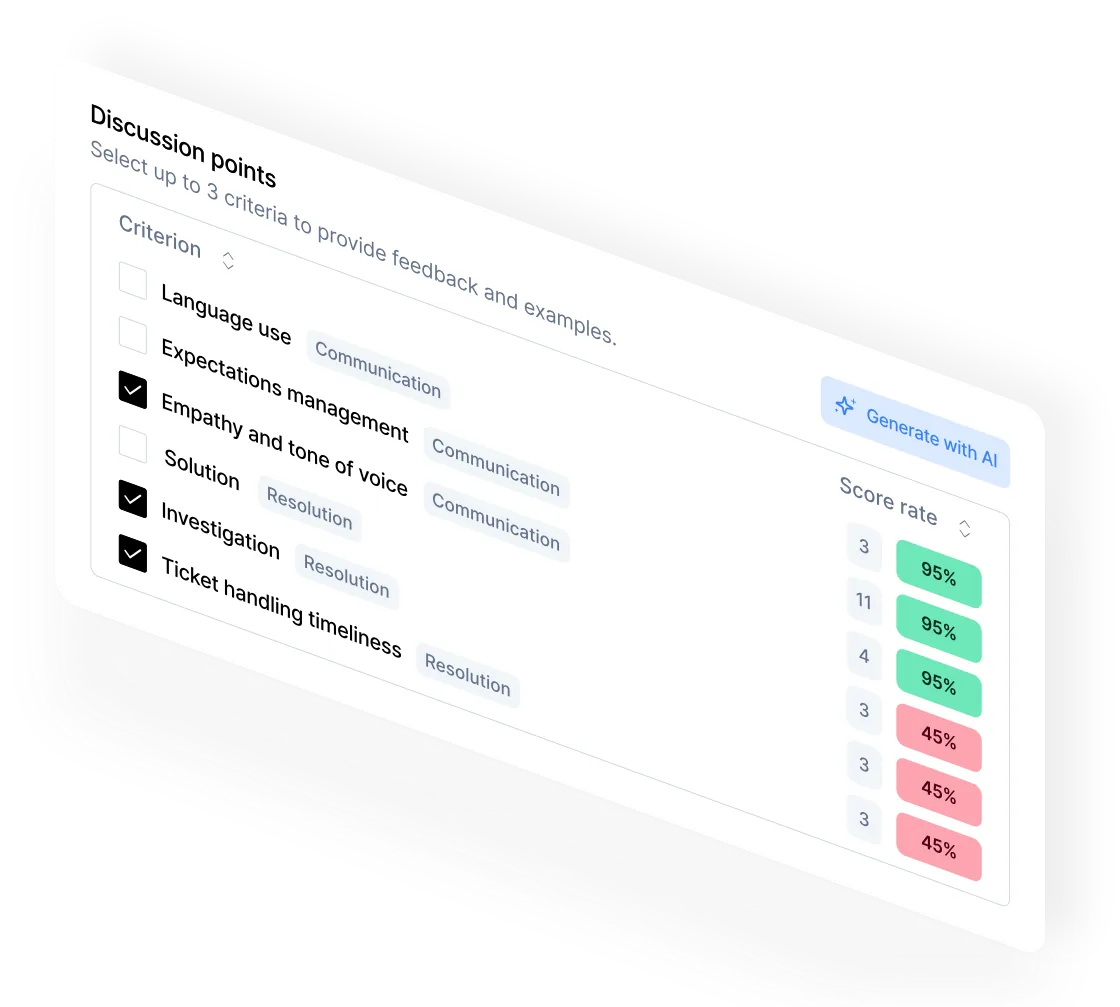
AutoCoaching generates coaching sessions directly from QA data. When the evaluation layer flags a pattern - a specific scorecard criterion failing consistently across an agent or a team - AutoCoaching builds a structured session from that finding, links every point back to the source ticket, and caps the session at six action items so it's something a manager can actually act on. The QA manager does not have to manually translate scores into development actions. The system does it; the manager still delivers the conversation and makes the judgment calls.
The coaching data is tied back to QA results over time. If a coaching session runs and the targeted criterion does not improve in the following evaluation cycle, that is visible in the reporting. The loop closes.
For L&D teams, Training Simulations complement this - agents work through AI-generated scenarios built from real flagged conversations, not generic training cases, scored by the same engine as live tickets. Onboarding time drops by roughly half; onboarding risk drops by 40% according to Intryc's production data.
The combination - AutoQA evaluating conversations, AutoCoaching acting on the findings, Simulations reinforcing the fix - is what separates a QA tool from a quality infrastructure. Most contact center QA platforms stop at the score.
When is Intryc a fit versus broader call center suites?
Contact centers that run on large CCaaS platforms - Genesys, Amazon Connect, Five9, NICE - typically have some native quality monitoring built in, generally centered on call transcription and routing metrics. Validate against your specific CCaaS's feature set, but native monitoring is rarely built to run AI-native QA against a custom scorecard or to evaluate the AI chatbot sitting alongside the human team.
Intryc integrates with those platforms rather than replacing them. It connects to Zendesk, Intercom, Freshdesk, Freshcaller, Freshchat, Gorgias, HubSpot, Twilio, Aircall, Salesforce, NiCE CXone, Jira Service Management, Kustomer, Modjo, and AI-native platforms including Ada, Decagon, and Brainbase Labs, plus Plain and a bulk-delivery path for anything not natively supported. The setup is one-click for supported integrations, and every ticketing integration is read-only by default.
The clearest fit signals:
- QA coverage is below 10% and there is pressure to scale quality without scaling headcount proportionally
- The team runs an AI chatbot or AI agent and has no current method for evaluating its performance
- Scorecard flexibility is a requirement - either because of regulatory exposure (fintech, healthcare, telecom) or because multiple client programs run under different rubrics (BPO)
- The team wants coaching to happen automatically, not on a monthly QA-review cycle
- A legacy QA tool is in place and either the AI accuracy is unreliable or the seat-based pricing model no longer makes sense
Intryc isn't a CCaaS migration, workforce-management, or telephony platform - it's the QA and quality-loop layer that sits on top of whichever communications stack you already run.
What should a support team validate before adopting contact center QA software?
This isn't a vendor-by-vendor comparison - validate any platform, Intryc included, against your own stack before you commit. Ask to see, live, on your own data:
- Scorecard fit. Can your actual rubric - weighted, auto-fail, soft-feedback criteria - be built without a workaround?
- AI-versus-human alignment. Run a pilot comparing AI and human scores on your own scorecard, criterion by criterion, and ask how the platform distinguishes an ambiguous instruction from reviewers disagreeing with each other.
- Coverage configuration. Can you choose full coverage, an attribute-based sample, or both - per queue, channel, or agent type - on the same scorecard?
- Supported interaction types and data sources. Voice, chat, email, and tickets - and does it evaluate your AI agent's conversations as their own agent, not lumped in with the humans?
- Integration requirements. Which systems does it connect to natively, is ticketing access read-only, and what's the actual setup time on your stack, not a vendor's best case?
- Calibration and override workflow. Can reviewers correct an AI score, and does that correction do anything - does it feed back into accuracy measurement and scorecard refinement, or just sit in a log?
- Reporting needs. Agent-level trends, scorecard breakdowns, root-cause patterns - at the coverage level you're actually running, not a demo's clean sample.
- Coaching ownership. Who sets the coaching direction, who delivers the session, and what does the platform actually automate versus just display?
- Training workflow. Does practice connect back to the same scorecard and the same engine that scores live conversations, or is it a disconnected module?
CSAT is a crutch. A 98% QA score and a 0.5% coverage rate are the same number from two angles. QA at 5% coverage is not QA. It is a sample of a sample.
Frequently Asked Questions
What is contact center QA software used for?
Contact center QA software evaluates support conversations against a quality scorecard, identifies where agents are meeting or missing the standard, and feeds that data into coaching and reporting. Modern platforms extend this to AI chatbots and AI agents, not just human agents.
Does Intryc support custom QA scorecards?
Intryc builds scorecards to your criteria, your weighting, and your evaluation logic, with unlimited criteria across weighted, critical, and soft modes. Historical scores do not change when a scorecard question is edited.
Can Intryc review more than a small QA sample?
Yes. Most QA programs review less than 5% of conversations. Intryc can run AI review coverage across 100% of ticket volume, or an intelligent attribute-based sample by risk, sentiment, agent, or ticket type - your choice, same scorecard, same 90% accuracy - guaranteed either way.
Is Intryc only for voice call centers?
No. Intryc evaluates all support channels - voice, chat, email, and tickets - and all agent types, including AI chatbots and AI agents. It integrates with Zendesk, Intercom, Freshdesk, Twilio, Salesforce, Aircall, NiCE CXone, and other help desk, voice, and AI-agent systems.
How does Intryc connect QA to coaching?
AutoCoaching generates coaching sessions directly from QA evaluation data. When a scorecard criterion fails consistently, AutoCoaching builds a structured coaching session from that finding, capped at six action items and linked to the source tickets. Training Simulations let agents practice the flagged skill on the same scorecard, scored by the same engine as live tickets.
What should buyers validate in contact center QA tools?
Five things worth testing live, on your own data: AI-versus-human accuracy on your actual scorecard (not a vendor benchmark), scorecard flexibility, coverage configuration (full or sampled, your choice), AI agent evaluation capability, and the coaching loop - does it stop at a score, or generate a coaching action from the data?
Do you have concerns that would prevent you from moving forward with a platform evaluation?