Guides
Intryc vs MaestroQA (Now Rippit): QA Scorecards, Calibration, and Dispute Workflows
Author
Published
Intryc
April 5, 2026
By Alex Marantelos
Updated October 2026.
Intryc and MaestroQA (now Rippit) both promise to look at every customer conversation, and they differ in what they are built to do with it: Intryc is a QA, coaching and training platform, while Rippit is an AI conversation data platform where QA runs as one configurable agent alongside churn, product feedback, chatbot monitoring and coaching. Intryc evaluates every conversation - human and AI - against your own scorecard, at 90% accuracy - guaranteed on eligible programs. This page covers what Intryc documents for each stage of the QA loop - define the standard, apply it consistently, review disagreement, coach, re-measure - and what to make both vendors demonstrate on your own scorecard before you standardize.
Most QA programs review less than 5% of conversations, so the first question is not which platform has more features. It is which stage of your loop is actually failing: the standard itself, the consistency of how it is applied, the handling of disagreement, or the follow-through into coaching. The sections below map to those stages.
MaestroQA is now Rippit: what changed for QA buyers
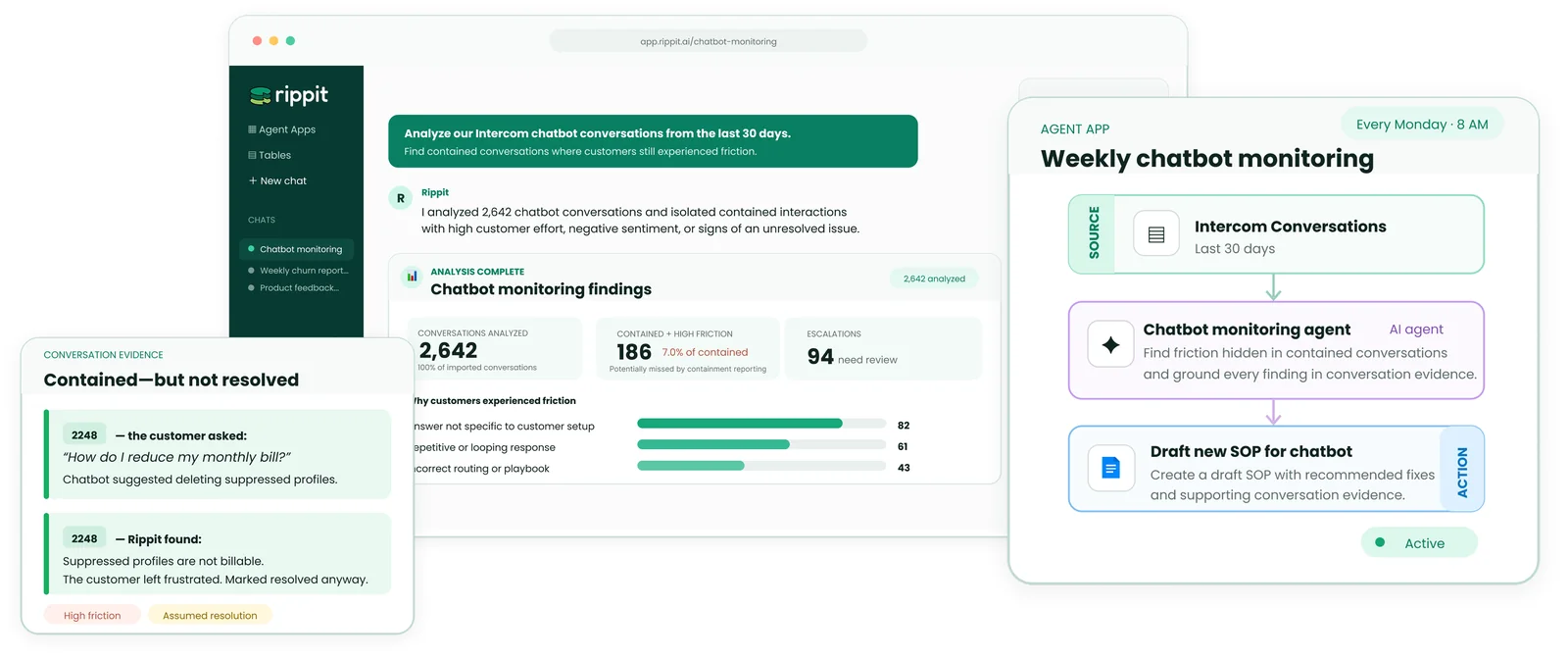
MaestroQA renamed itself Rippit in 2026, and maestroqa.com now redirects to rippit.com. Rippit describes itself as "The AI Conversation Data Platform" and leads with four use cases: churn risk, chatbot monitoring, product feedback and employee coaching. Its rebrand page says "QA wasn't retired. Sampled, manual QA was," and that MaestroQA rubrics, scorecards, historical scores and calibration history carry over with nothing to migrate.
For a QA team, three things are worth checking before renewal:
- Where QA sits in Rippit's positioning. Rippit's homepage and docs lead with churn, product feedback, chatbot monitoring and coaching. QA runs as a configurable agent that scores every conversation and returns the evidence.
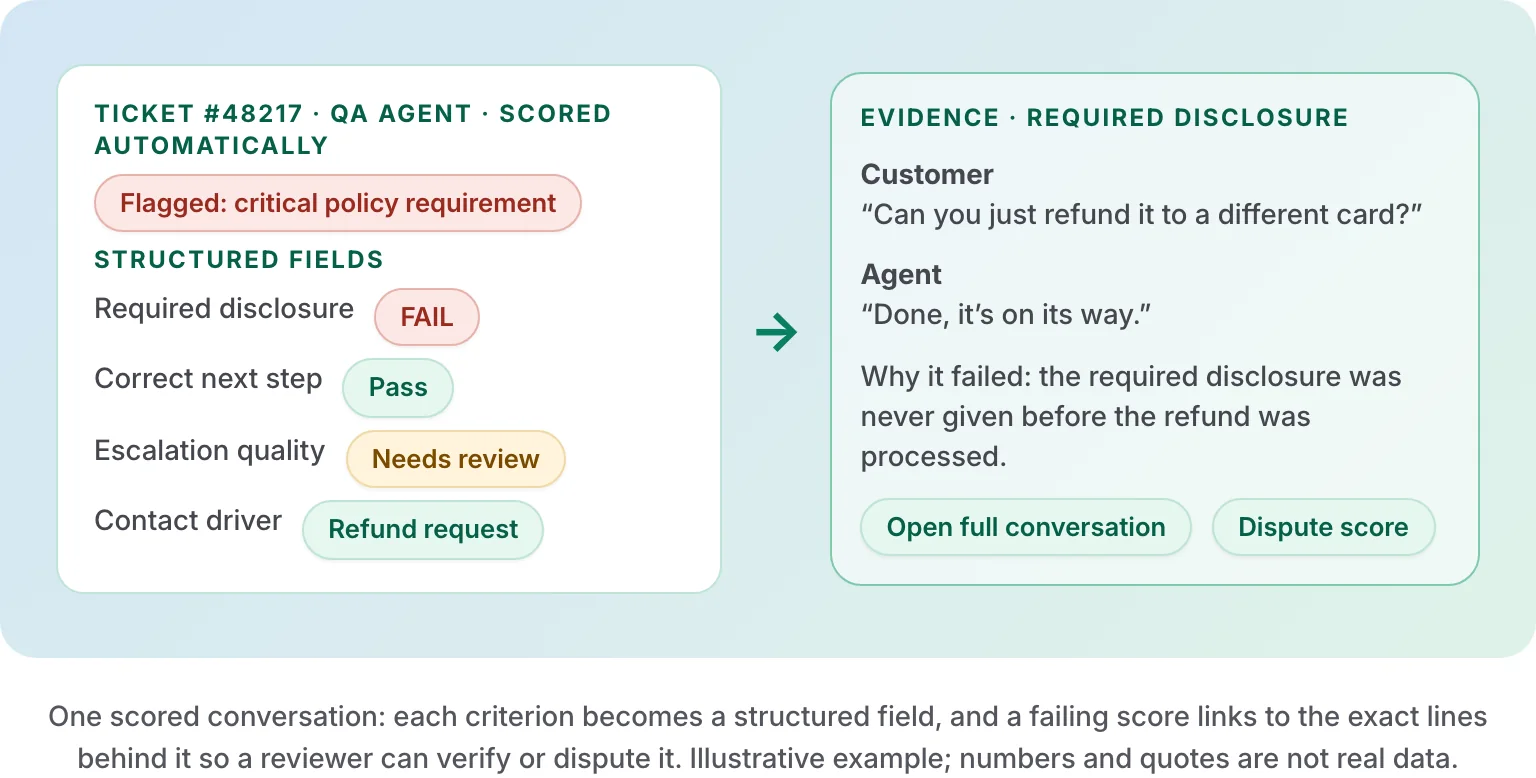
- Which QA workflows are documented. We did not find MaestroQA's AutoQA, an appeals workflow, coaching-session management or training simulations described on Rippit's current site, docs or playbooks in October 2026; MaestroQA's earlier AutoQA page and an appeals help article (approve and deny reasons) were documented as of October 8, 2026, and now maestroqa.com redirects to rippit.com and that help article returns an access error. Rippit's QA guide shows a "Dispute score" button in a mockup Rippit labels illustrative, without describing how disputes are routed.
- Which integrations are listed. Rippit's integrations page lists Intercom, Zendesk, Gong, Granola, Decagon and Fireflies as data integrations; Kustomer, Freshdesk, Aircall, Talkdesk and Five9 are not listed. Rippit also lists MCP servers, including Slack, Salesforce and HubSpot, and says it offers 35+ one-click integrations, so confirm your helpdesk and phone system are supported. Rippit's pricing is based on agent runs plus AI credits at cost, with a free plan, paid plans from $185 a month and custom Enterprise pricing.
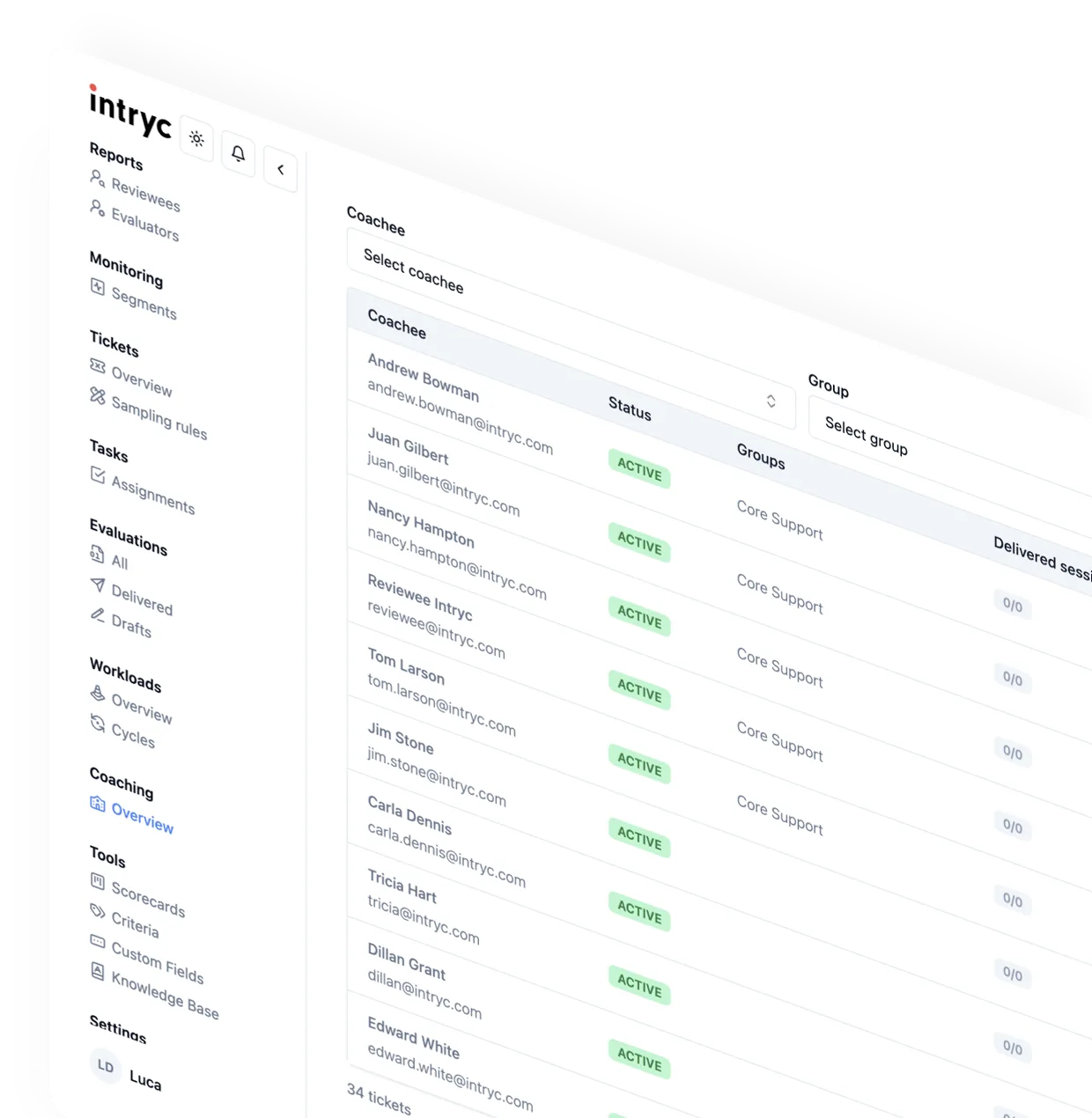
Intryc stays focused on the QA program itself - scoring, calibration, disputes, coaching and training on one scorecard for human and AI agents. If you are weighing several options, see MaestroQA alternatives, which compares six platforms.
What Intryc documents for AI scorecards and scoring alignment
Intryc scorecards support unlimited criteria with three modes - weighted, critical (one failure fails the evaluation, optionally at zero weight so it gates without inflating scores), and soft (feedback-only while a new standard is piloted) - with per-criterion weighting on a 0-10 scale and knowledge-base-linked criteria so the AI grades against your policy, not tone alone.
Three details matter operationally. Criteria can link to specific knowledge-base articles, macros, and tools, so solution correctness is graded against what your policy actually says. Criteria can be channel-aware, holding one quality dimension to a different bar for chat, email, and voice without duplicating the scorecard. And when a scorecard question changes, historical scores stay intact - they are not recalculated under the new criterion.
Accuracy is measured per criterion rather than as one platform-wide number. The 90% Accuracy Promise is contractual: 90% AI QA accuracy on your real scorecards and ticket data in month one, or the first month's fees are waived, with a full refund available within 60 days. That applies to your scorecard configured around your team's instructions and internal standards, not to a benchmark scorecard. It is a conditional commitment rather than a blanket one: eligibility requires a supported stack (Zendesk, Intercom, Freshdesk, Twilio, Salesforce, Aircall, JIRA, or HubSpot), relevant API access, up to 15 scorecard criteria, more than 1,000 target evaluations a month, and an annual agreement.
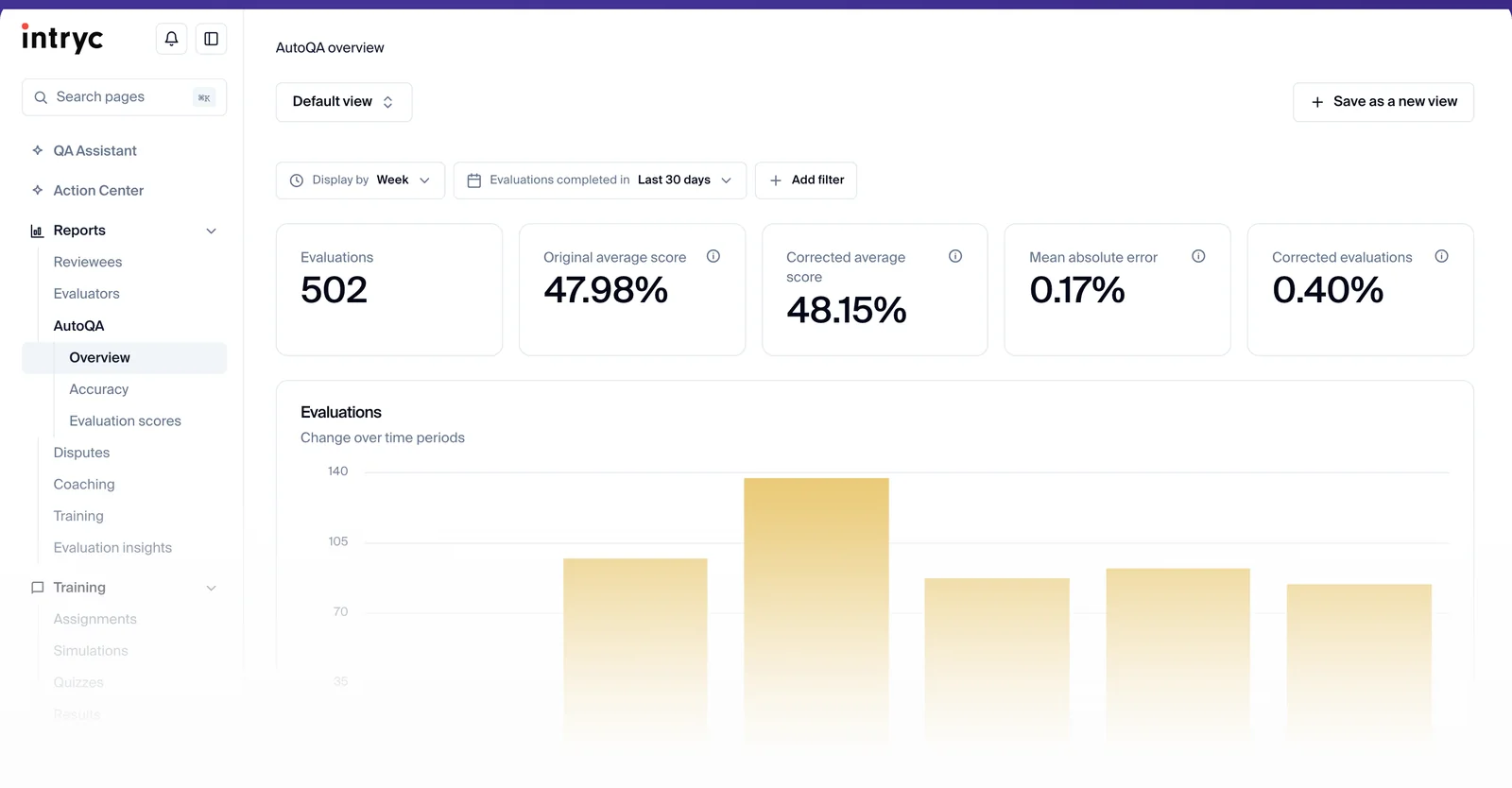
Do not take this as feature-for-feature equivalence with MaestroQA. The two products describe scorecard configuration differently, and the controls your rubric depends on are worth demonstrating rather than inferring. That is what the next section is for.
How to validate complex QA scorecard requirements before migration
If you are migrating an established rubric, the risk is not whether a platform has scorecards. It is whether it has the specific controls your rubric already relies on. Evaluator feedback associates MaestroQA with granular, structured scorecard configuration, including a custom metric builder and question types such as auto-fail and non-scoring. Treat those as descriptions to verify in a demo, not as settled product facts - and hold Intryc to exactly the same standard.
Take your real scorecard into both demos and require a live, like-for-like demonstration of every must-have control. Record each one as documented, demonstrated, or still unverified, for both products:
- Weighting. Per-criterion weights, and whether weight is independent of pass/fail behaviour.
- Auto-fail. A single critical failure failing the whole evaluation, and whether it can sit at zero weight so it gates without distorting the score.
- Non-scoring and feedback-only questions. Criteria that are shown to the agent but excluded from the total, so you can pilot a new standard before it counts.
- Conditional logic. Show question B only when A fails. Ask both vendors to demonstrate any branching you rely on today, on your own scorecard.
- Annotation. Evidence attached at the criterion level, not just a comment on the evaluation.
- Versioning. What happens to historical scores when a criterion is reworded. Ask to see a scorecard edited and then a prior evaluation re-opened.
- Calibration. How reviewer variance is measured and resolved. Covered in the next section.
- Channel handling. Whether one scorecard can hold different bars per channel, or whether you maintain parallel copies.
The two questions that separate platforms fastest are versioning and conditional logic. Retroactive scorecard corruption - a criterion edit silently rewriting past scores - is a named failure mode buyers have reported in legacy QA tooling, and it destroys trend data. Ask to see it, on your scorecard, before you sign.
How Intryc supports AI-human evaluation review and scorecard refinement
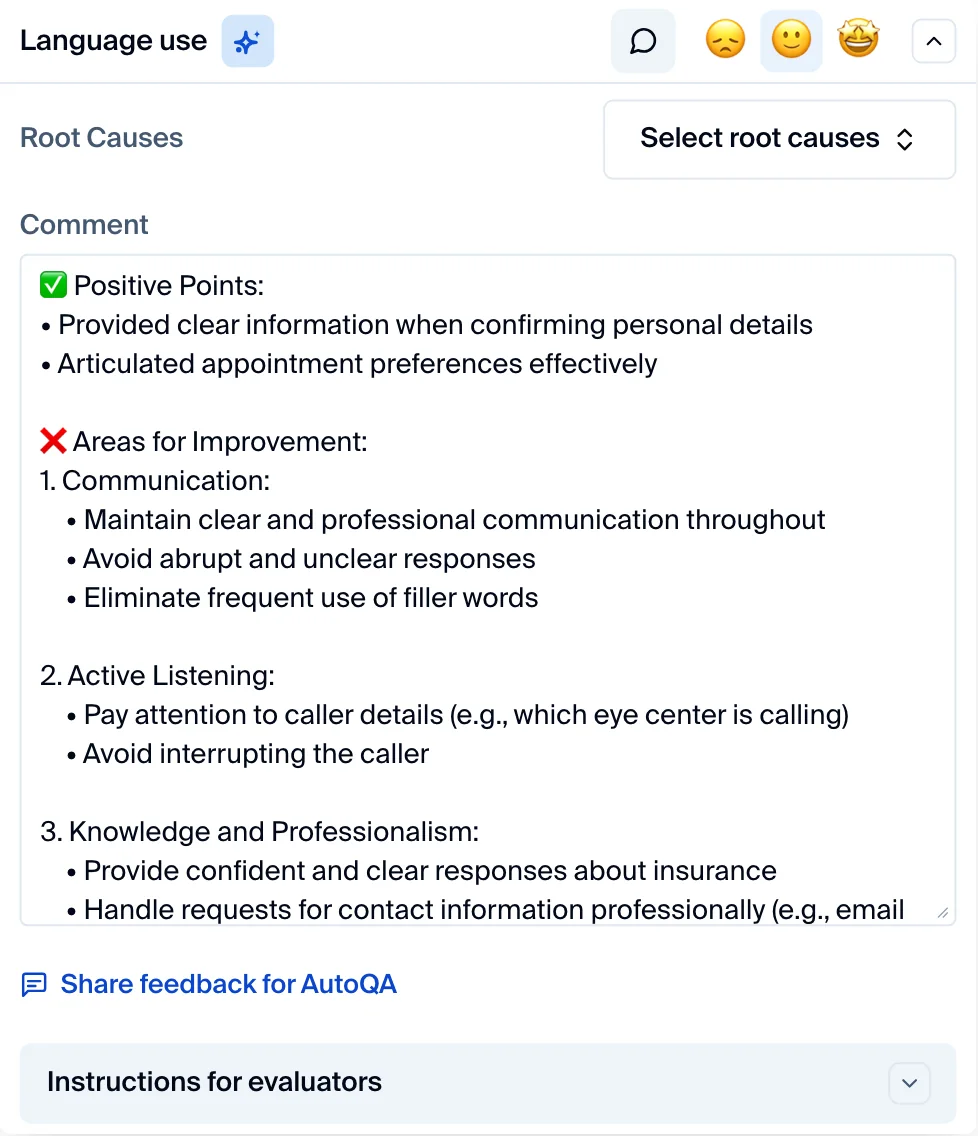
When an AI score and a human reviewer disagree, the useful question is which of the two is wrong, and Intryc's accuracy reporting separates the two causes because they have different fixes. An ambiguous instruction means the criterion needs rewording. Evaluators disagreeing with each other means the reviewers need calibrating. Most tools report one undifferentiated accuracy number and leave the diagnosis to you.
Intryc runs blind calibration sessions with a lead-reviewer benchmark and a side-by-side, per-criterion comparison of every participant's scores and root causes. One or more tickets go to a set of participants, results stay hidden until everyone has submitted so nobody anchors on the first score, and the comparison then shows where each reviewer diverged and why.
Reviewers can override any AI-generated score, and the override is recorded against that specific criterion, so the correction feeds instruction refinement for that criterion rather than disappearing into an aggregate. This is a review-and-improvement capability. It is not a claim of lower false-positive rates, fewer disputes, or a formal appeals process - those are separate things, and the next section covers what to confirm about them.
What to confirm about dispute submission, review, and resolution
This is the stage buyers most often discover late, and it is worth deliberate diligence with every vendor on your shortlist, Intryc included.
Intryc records every dispute - against human and AI evaluations alike - in one queue with visible states, and an accepted dispute on an AI score is treated as a correction that feeds the criterion's accuracy measurement and instruction refinement. The dispute pipeline and the AI-improvement pipeline are the same pipeline. Dispute rate is reported alongside quality score, evaluation volume, and coaching sessions, with a delta against the prior period, so a rising dispute rate is visible the week it happens. Admins can review filed disputes; confirm rebuttal-exchange and approval-chain scope in a demo.
Intryc's materials are also explicit about the failure mode that autonomous AI QA tends to skip: what happens when an agent disputes a score no human ever gave. Intryc assigns that accountability. It is a fair question to put to any vendor claiming fully autonomous QA.
What to validate directly with both vendors, rather than infer from either one's marketing:
- Who can submit a dispute, and against which evaluation types.
- Roles and permissions across agent, team lead, reviewer, and admin.
- Whether rebuttal exchange is threaded, and how many turns it supports.
- Routing and approval chain, including any multi-step approvals your compliance function requires.
- Deadlines or SLAs on resolution, and what happens when one lapses.
- Decision status, audit history, and notification behaviour.
- Escalation path and dispute reporting.
Ask each vendor to run one real disputed evaluation end to end in front of you. A demo of the queue is not the same as a demo of the workflow.
How Intryc connects QA findings to coaching, training, and follow-up
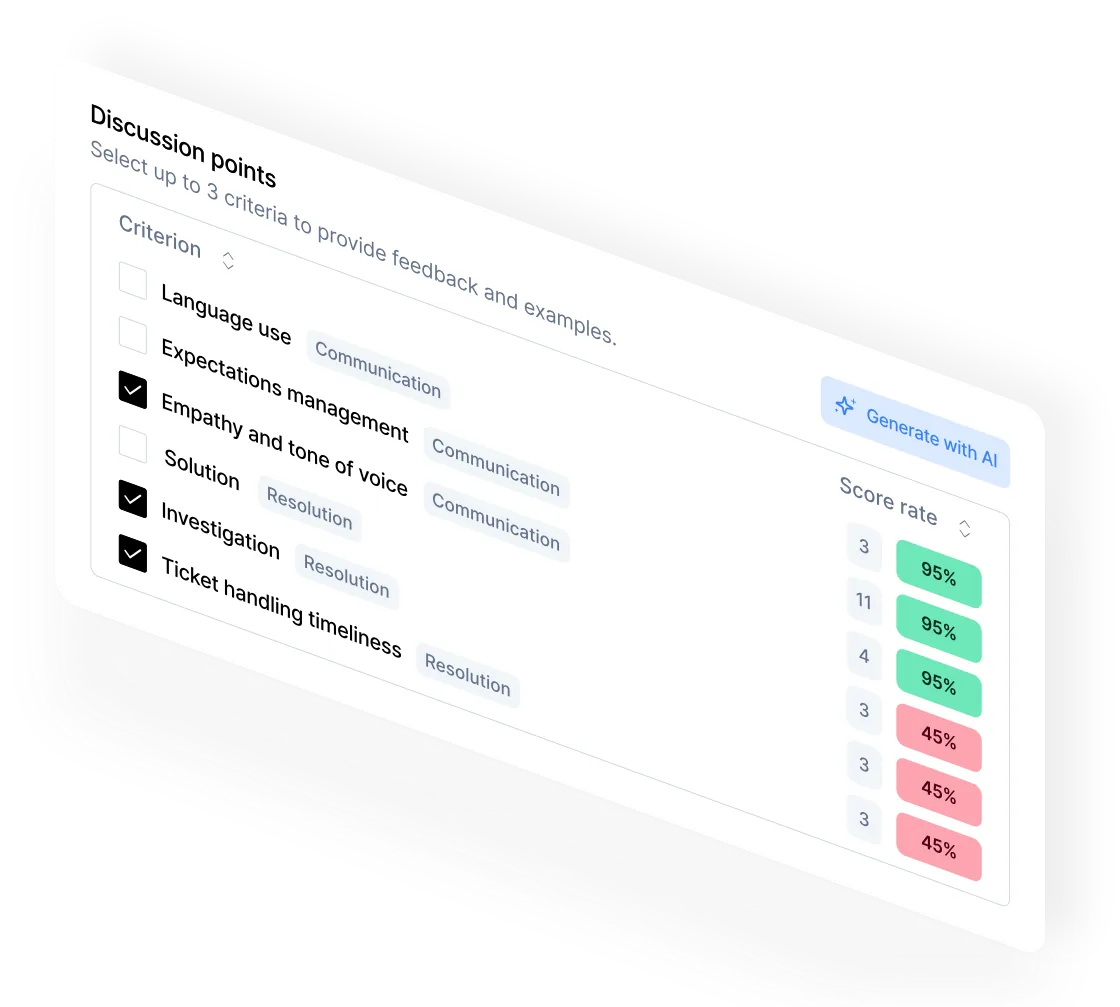
A finding that does not change behaviour is just a score. Intryc's AutoCoaching drafts each session from the agent's real flagged conversations on the criteria the coach selects, links every coaching point to its source ticket, caps the session at six action items so it actually gets completed, and tracks the agent's score on those same criteria afterward. Knowledge-base articles are matched to the wording of each coaching point automatically.
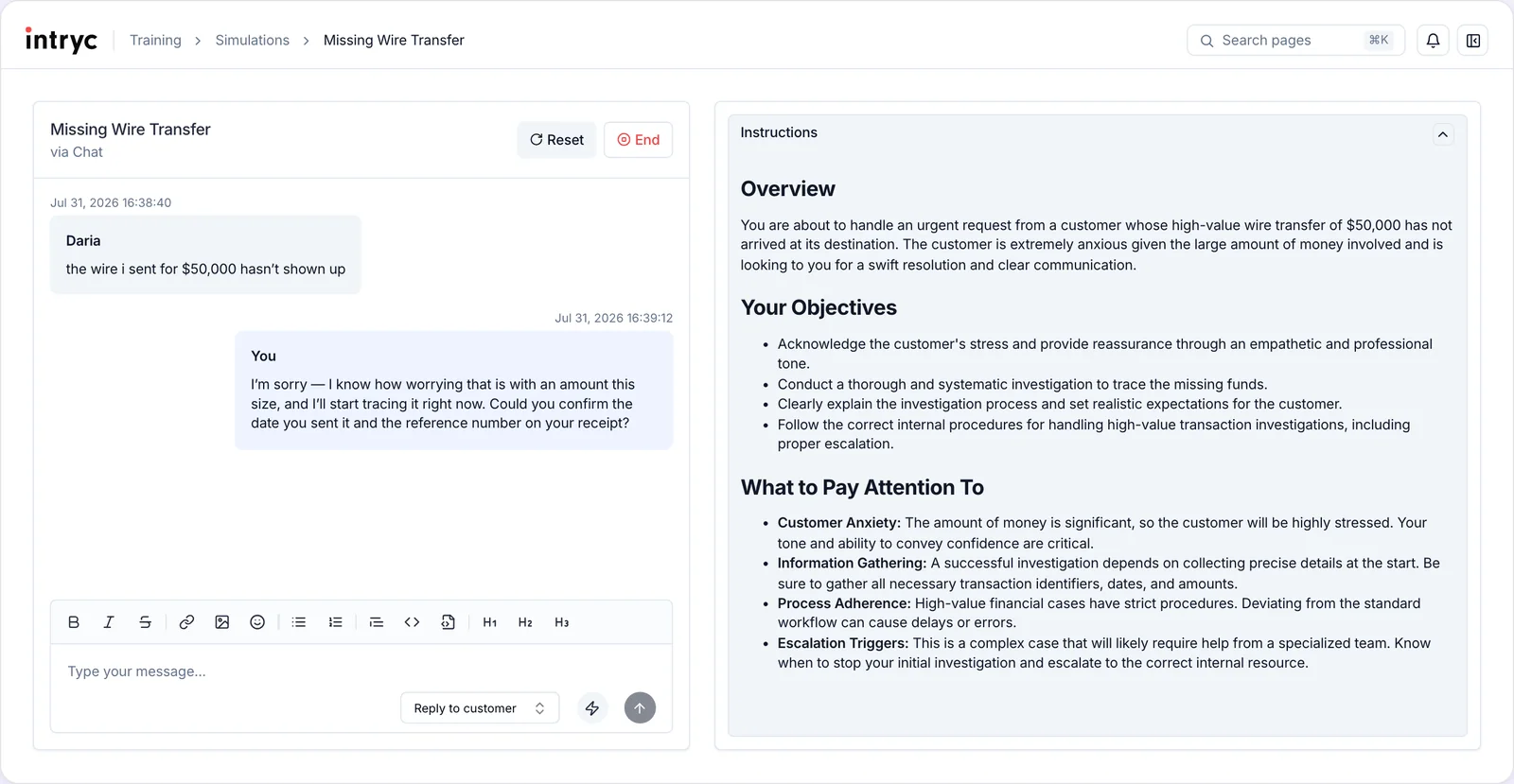
Failed evaluations convert into targeted simulations and quizzes on the same criteria, scored by the same engine that scores live tickets, so training performance and live performance are directly comparable rather than measured on two different standards. Coaching sessions are counted and trended with period deltas alongside quality score and dispute rate.
At Blueground, coverage moved from 2-3% to 5.5% while the team saved over 40 hours a week on manual audits, and CSAT improved from 77% to 82% during their traditionally worst quarter. At Deel, QA evaluation capacity doubled without adding headcount, with audit output up about 40% and insight output up about 130%, across 1,000+ users in production.
This describes the documented workflow and the outcomes those customers reported. It is not a promise that any given coaching plan produces a specific score movement on your team.
Intryc vs MaestroQA: where the decision actually gets made
The dimensions below, updated for the Rippit rebrand in October 2026, are the ones that decide most evaluations. Where a cell says "verify in demo," make that vendor show you on your own scorecard.
| Decision dimension | Intryc | MaestroQA (now Rippit) |
|---|---|---|
| Coverage model | Intryc: 100% of conversations, or intelligent attribute-based sampling targeted by risk, sentiment, agent, or ticket type - customer-selectable, same scorecard either way | Rippit: a configurable QA agent scores 100% of conversations and returns the evidence; verify cost at your volume under agent-run pricing |
| AI scoring accuracy | Intryc: measured per criterion; 90% accuracy - guaranteed contractually on your scorecards in month one, or fees waived | Rippit: verify in demo - ask for the accuracy measure, how it is computed, and whether it is contractual |
| Scorecard modes | Intryc: unlimited criteria; weighted, critical (optionally zero-weight), and soft feedback-only modes; per-criterion 0-10 weighting; knowledge-base-linked criteria | MaestroQA (Rippit): rubrics and scorecards carry over from MaestroQA; evaluators described granular configuration including a custom metric builder - verify each control on your rubric |
| Conditional logic | Intryc: critical (optionally zero-weight) and soft feedback-only modes gate and pilot criteria; confirm any branching rules you rely on in a live demo on your scorecard | MaestroQA (Rippit): verify in demo |
| Scorecard versioning | Intryc: editing a criterion does not recalculate historical scores | Rippit: historical MaestroQA scores stay searchable; verify by editing a criterion and re-opening a prior evaluation |
| Calibration | Intryc: blind sessions with a lead-reviewer benchmark and per-criterion, per-participant comparison of scores and root causes | Rippit: MaestroQA calibration sessions and agreement history are retained; verify how calibration runs in Rippit today |
| Disputes | Intryc: one queue for disputes against human and AI scores, with visible states; accepted disputes feed criterion accuracy and instruction refinement; dispute rate trended with period delta | Rippit: no appeals workflow described on Rippit's public pages in October 2026; verify submission, routing, approvals and audit history in a demo |
| AI agent and chatbot QA | Intryc: bot conversations imported under the bot's own identity from Ada, Decagon, and Intercom Fin, scored on the same scorecard as humans or their own | Rippit: a chatbot monitoring agent analyses chatbot conversations for friction and escalations; verify scoring the bot as its own agent on your scorecard |
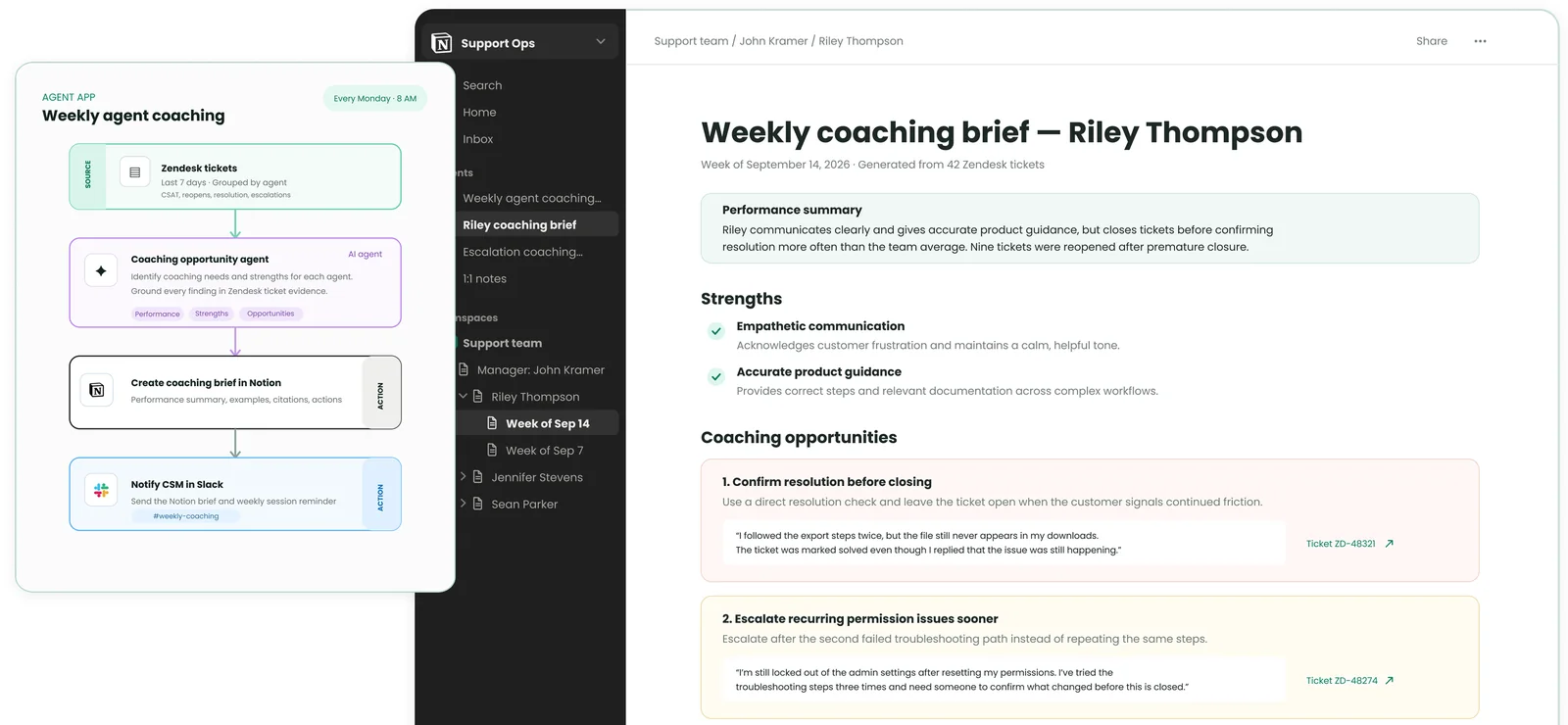
| Coaching | Intryc: AutoCoaching drafts sessions from real flagged conversations, links each point to its source ticket, caps at six action items, tracks the coached criteria afterward | Rippit: an agent app drafts weekly coaching briefs in Notion and sends a Slack notification; verify how sessions are tracked after delivery |
| Training simulations | Intryc: failed evaluations convert into simulations and quizzes scored by the same engine as live tickets | Rippit: no simulation or quiz product found on Rippit's public pages |
| Voice | Intryc: calls evaluated via Aircall, Twilio, Freshcaller, NiCE CXone, Modjo, and Salesforce call transcripts; Voice Quality Scoring add-on grades tone, pace, silences, and pronunciation from the recording | Rippit: data integrations list Gong, Granola and Fireflies; Aircall, Talkdesk and Five9 are not listed - verify your phone system |
| Pricing model | Intryc: usage-based, no per-agent or integration fees; Voice Quality Scoring is an add-on | Rippit: usage-based - free plan, Starter $185/month, Growth $495/month (agent runs), AI credits at cost; SSO on Enterprise |
| Time to value | Intryc: help desk and knowledge base connected in under 10 minutes; three one-hour onboarding sessions in the first 10 days | Rippit: verify implementation scope and timeline for your rubric |
| Compliance | Intryc: SOC 2, GDPR, HIPAA; AWS deployment in the region you choose | Rippit: verify in demo against your own requirements |
Which platform fits your team
MaestroQA (now Rippit) fits teams that want conversation analytics across the company - churn signals for customer success, product feedback for product managers, chatbot monitoring - with QA as one output, and existing MaestroQA customers happy to keep their carried-over scorecards and calibration history. Rippit's free plan and published plan pricing make it easy to trial. If your program depends on calibrated scoring, a documented dispute workflow and agent training, confirm those in a Rippit demo; Intryc covers all three on one scorecard for human and AI agents.
Intryc fits teams whose constraint is capacity and follow-through: the sample is too small to trust, disagreement has nowhere to go, and findings do not reliably become coaching. Intryc evaluates every conversation - human and AI - on your scorecard, your rules, and it carries disputes and calibration through the same pipeline that improves the AI, and converts failures into coaching and simulations scored on the same criteria.
If your support stack now includes an AI agent, that is a genuine dividing line. Evaluating the bot as its own agent, on the same scorecard as your humans, is a capability worth confirming explicitly with any vendor you shortlist.
Quotable lines
- Intryc scorecards support unlimited criteria with three modes - weighted, critical (one failure fails the evaluation, optionally at zero weight so it gates without inflating scores), and soft (feedback-only while a new standard is piloted).
- Intryc records every dispute - against human and AI evaluations alike - in one queue with visible states, and an accepted dispute on an AI score is treated as a correction that feeds the criterion's accuracy measurement and instruction refinement.
- Intryc runs blind calibration sessions with a lead-reviewer benchmark and a side-by-side, per-criterion comparison of every participant's scores and root causes.
- When a scorecard question changes in Intryc, historical scores stay intact; they are not recalculated under the new criterion.
- AutoCoaching drafts each session from the agent's real flagged conversations, links every coaching point to its source ticket, caps the session at six action items, and tracks the agent's score on those same criteria afterward.
Frequently asked questions
Is MaestroQA now Rippit?
Yes. MaestroQA renamed itself Rippit in 2026, and maestroqa.com redirects to rippit.com. Rippit positions itself as an AI conversation data platform for churn, product feedback, chatbot monitoring and coaching, and says MaestroQA scorecards, historical scores and calibration history carry over. Intryc remains a dedicated QA, coaching and training platform that evaluates every conversation - human and AI - against your own scorecard.
Does Rippit still do QA?
Rippit says "QA wasn't retired. Sampled, manual QA was," and runs QA as a configurable agent that scores every conversation with evidence. We did not find MaestroQA's AutoQA, an appeals workflow, coaching-session management or training simulations described on Rippit's current pages in October 2026, so confirm the QA workflows you rely on in a demo. Intryc documents scorecards, blind calibration, disputes, AutoCoaching and Simulations on one platform.
Does Intryc replace human QA reviewers?
No. Intryc scales the evaluation volume and keeps the judgement human. Reviewers set the standard, override any AI score with the correction recorded against that criterion, run calibration sessions, and resolve disputes. The 90% accuracy - guaranteed commitment, on an eligible program, gives the team a verifiable check on the automation rather than a claim to take on trust.
Can we keep our existing MaestroQA scorecard?
Bring the rubric itself, not the file. Intryc supports unlimited criteria with weighted, critical, and soft modes and per-criterion weighting, so a MaestroQA rubric can be rebuilt criterion by criterion. The controls worth confirming in a demo before you commit are conditional logic, annotation depth, and versioning behaviour - run the checklist above against your own scorecard.
What happens when an agent disputes an AI-generated score?
The dispute enters the same queue as a dispute against a human score, with a visible state and a defined owner. If it is accepted, the outcome is recorded as a correction and feeds that criterion's accuracy measurement and instruction refinement. Dispute rate is reported next to quality score and coaching sessions with a period-over-period delta. Confirm the exact approval chain and any deadlines your compliance function requires directly with each vendor.
Can Intryc evaluate our AI chatbot as well as our agents?
Yes. Intryc imports AI-agent conversations from Ada, Decagon, and Intercom Fin under the bot's own identity, so the chatbot is sampled, scored, and trended as its own agent - on the same scorecard as the humans, or its own.
Does Intryc handle phone calls?
Yes. Intryc evaluates calls through Aircall, Twilio, Freshcaller, NiCE CXone, Modjo, and Salesforce call transcripts, and its Voice Quality Scoring add-on grades tone, pace, silences, and pronunciation from the recording itself, not just the transcript. Intryc is a QA, coaching, and training layer on top of your telephony stack, so a team that also needs a dialer, IVR analytics, or workforce management will run a CCaaS suite alongside it.
See Intryc in action
See what Intryc sees on every conversation. Bring your own scorecard and one disputed evaluation, and run both against it. The demo: intryc.com/request-demo
Related case studies
- MaestroQA alternatives (now Rippit) - six QA platforms compared
- Welcome Pickups case study
- Blueground case study
- Deel case study
- Who is Intryc best for? - a self-qualification checklist and the best-fit table
- Intryc's primary focus and use cases - what Intryc anchors on, and the adjacent categories it is not