Product
Performance Reporting for Support QA and Coaching
Author
Published
Intryc
July 9, 2026
Updated July 2026
Most QA programs see less than 5% of conversations. Performance reporting built on that sample tells you almost nothing. Intryc evaluates every conversation - human and AI - so your reporting reflects what is actually happening, not what a small random slice suggests.
Does Intryc support QA and performance reporting?
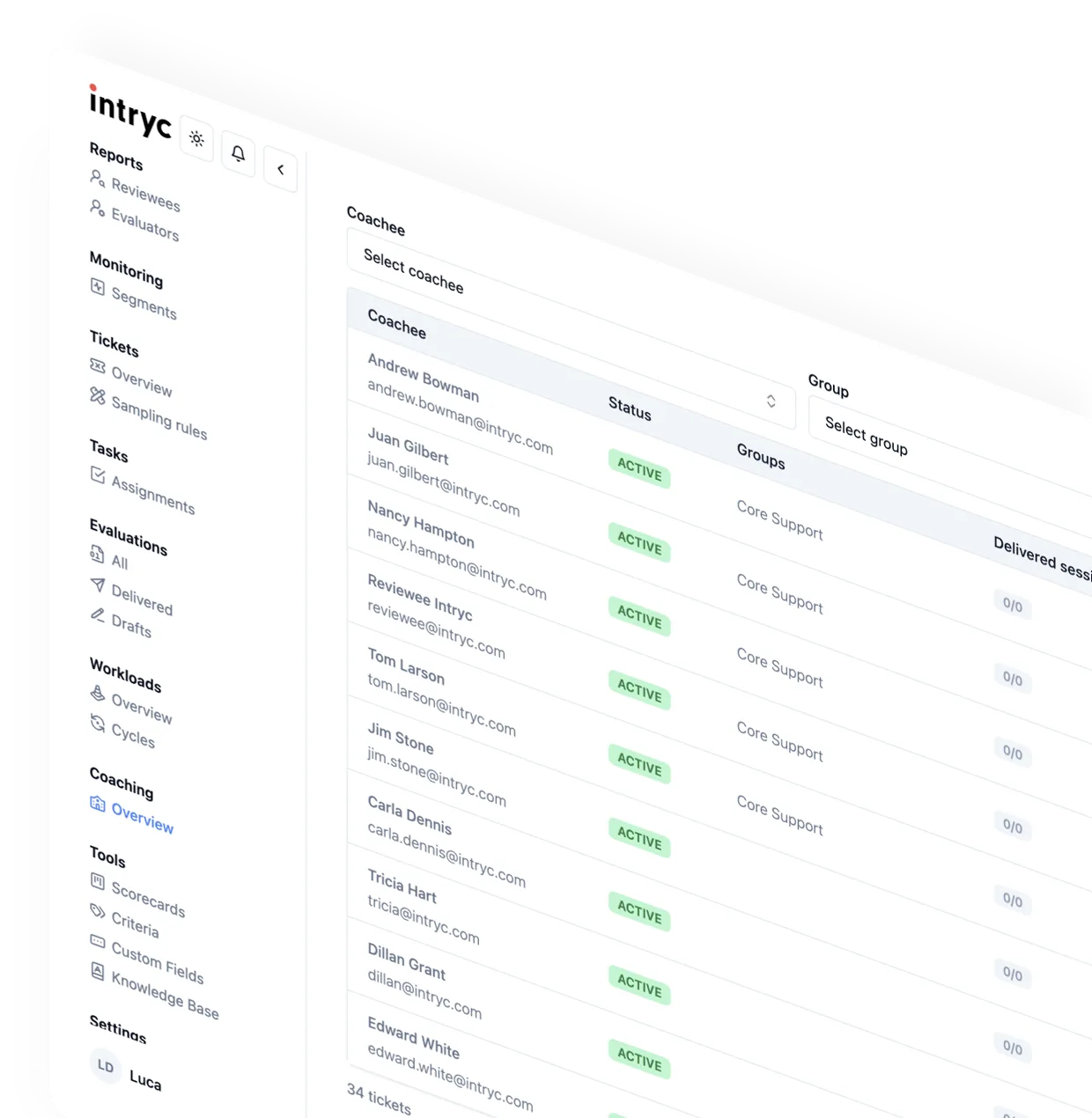
As of July 2026, Intryc supports performance reporting for QA teams across the full evaluation loop: agent-level score trends, scorecard breakdowns, root cause analysis, DSAT signals, and coaching workflow tracking - all drawing from 100% of evaluated conversations, not a sample.
The platform covers AutoQA, Evaluation Insights, AutoCoaching, and Training Simulations in one place. Custom scorecards, 1,000+ monthly evaluations per team, and SOC 2 / GDPR / HIPAA compliance. YC-backed, with EU deployment available.
What is QA performance reporting?
QA performance reporting is the data layer that tells you whether your QA program is producing change - not just scores.
A QA evaluation tells you how an agent handled one conversation. Performance reporting tells you whether the agent is improving, whether a team is trending up or down, and whether a systemic issue keeps appearing across tickets regardless of who handles them.
The distinction matters because most QA tools stop at the evaluation. A score goes into a spreadsheet. A manager reviews it in a 1:1 that happens two weeks later. Nothing changes.
Real performance reporting closes the gap between evaluation and action. It surfaces patterns - the agent who scores well on tone but fails product knowledge criteria every time, the team whose DSAT spikes on Mondays, the AI chatbot whose resolution rate has been deteriorating for three weeks.
That is what call center quality monitoring actually requires. Not more scores. Data that tells you where to put your attention.
What should buyers compare in QA reporting demos?
Ask these five questions in every QA reporting demo.
1. What is the coverage base for the reports?
If a vendor's reporting draws from 5% of conversations, the trends, averages, and breakdowns are statistically marginal. Intryc evaluates 100%, so the reporting reflects the entire ticket population, not a sampled slice.
2. Can you filter to the agent level without losing trend context?
The question is whether you can see an individual agent's trend over 30, 60, or 90 days, broken down by scorecard criterion, without losing the team benchmark for comparison.
3. Where does coaching show up in the report?
Ask where a flagged ticket becomes a coaching session, and whether completed sessions are tracked against subsequent evaluation scores. If the answer is "the manager downloads a CSV and does it in a 1:1," you have a score tool, not a coaching system.
4. Can the AI chatbot be reported on separately from human agents?
If the QA platform cannot evaluate and report on the chatbot separately - its deflection rate, its accuracy on your scorecard criteria, its DSAT patterns - you have a blind spot in your quality monitoring.
5. Can you see the root cause, not just the score?
A score tells you something went wrong. Root cause analysis tells you what, why, and how often.
How does reporting connect to coaching follow-through?
The evaluate-to-coach loop fails at two points in most QA programs.
First, the lag. A conversation happens Monday. The evaluation lands Thursday. The coaching session - if it happens at all - is scheduled for the following week. By the time feedback reaches the agent, the context is cold and the pattern has continued for another five days.
Second, the tracking gap. Most QA tools produce evaluations. They do not track whether the coaching session happened, what was covered, or whether the agent's subsequent scores improved on the flagged criterion.
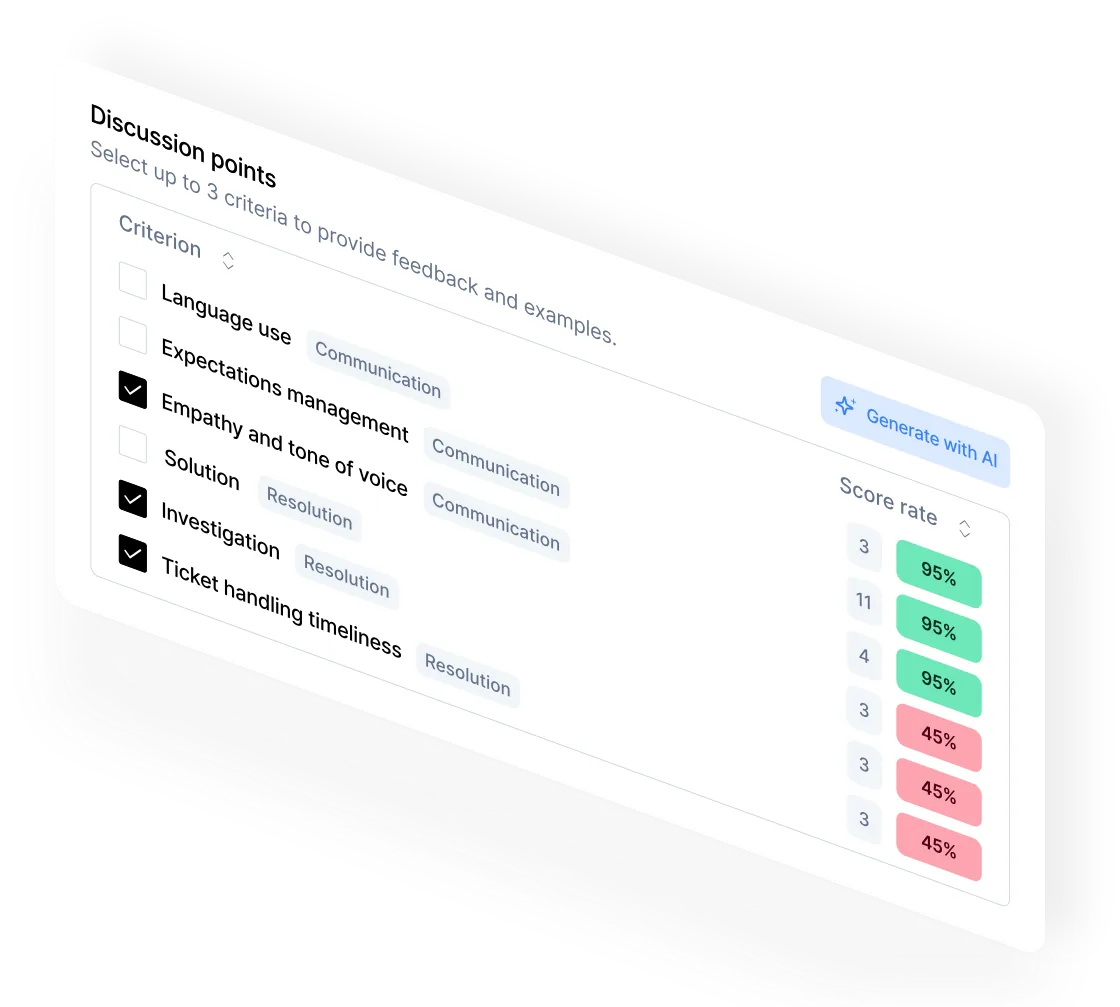
Intryc's AutoCoaching closes this. When an agent's performance on a specific scorecard criterion drops below threshold, the platform generates the coaching session automatically - grounded in the actual conversations that flagged, not a generic improvement template. The coaching session is tracked in the same system as the evaluation data.
This is what quality monitoring is supposed to produce: not a score, but a loop. Flag -> coach -> measure improvement -> close the ticket on that issue or escalate if it persists.
Intryc's Simulations product cuts onboarding time in half and reduces onboarding risk by 40%, because the training is drawn from evaluated production data, not generic case libraries.
What is the difference between QA reporting, performance reporting, and root cause analysis?
QA reporting is the output of the evaluation process. Evaluation scores by agent, by team, by time period. It tells you the state of quality at a point in time.
Performance reporting is the longitudinal layer. Trend data. Agent improvement curves. Cohort comparisons. At 5% coverage, weekly trend data is noise. At 100% coverage, it is signal.
Root cause analysis is the diagnostic layer. It answers why quality is at the level it is, not just what the level is. Root cause analysis is what separates actionable quality monitoring from retrospective grading.
A complete support QA reporting stack needs all three. Intryc covers all three.
How does Intryc compare to Lorikeet, MaestroQA, Zendesk, thelevel.ai, OversAI, and Scorebuddy on reporting?
Lorikeet is an AI-native CX automation tool built around AI agent deployment, not QA evaluation. Its reporting is oriented toward AI-agent performance, not the human-agent quality monitoring loop.
MaestroQA (now Rippit, rebranded March 2026) has publicly repositioned away from the QA label toward AI conversation analytics. Teams who want a tool that stays close to the evaluate-coach loop should verify where the product is heading before committing.
Zendesk (native QA) is adequate for teams with modest evaluation volume and simple scorecard needs. The reporting is surface-level: score aggregates, basic trend views. It does not support agent-level root cause drilling, AutoCoaching, or AI-agent QA.
thelevel.ai and OversAI are both focused specifically on AI-agent monitoring - a narrow slice of the quality monitoring problem. They are built to evaluate AI outputs, not human agent conversations against custom QA rubrics.
Scorebuddy is a long-standing QA platform with solid reporting for call center quality assurance workflows, particularly in EMEA. The coaching functionality exists but is not closed-loop - completed coaching sessions are not automatically tracked back against evaluation trends.
Intryc evaluates 100% of conversations and builds reporting from that base. The 90% accuracy - guaranteed promise means if Intryc's AI evaluations do not reach 90% accuracy on your real scorecards and ticket data in month 1, the first month's fees are waived. Full refund within 60 days.
Which teams use performance reporting in Intryc?
QA managers and QA leads use evaluation and trend reporting to track whether individual agents are improving on flagged criteria.
Support Ops and CX Operations leads use performance reporting to answer upward reporting questions: are quality metrics trending in the right direction, what is the DSAT rate by conversation type, where are the systemic process failures.
VP and Head of CX use the executive summary layer to hold QA programs accountable and make resourcing decisions grounded in quality signal rather than CSAT alone.
L&D and Training Managers use the root cause and DSAT outputs to build Simulations - training scenarios drawn from the actual cases that produced quality failures.
BPO and Vendor Management leads use performance reporting to hold partner organizations accountable to quality standards across sites.
Three things worth quoting
"Most QA programs see less than 5% of conversations. The rest is invisible."
"A 98% QA score and a 0.5% coverage rate are the same number from two angles."
"They measure. Intryc measures and fixes."
FAQ
What is performance reporting software for support teams?
Performance reporting software for support teams aggregates evaluation data - QA scores, criterion-level breakdowns, DSAT signals, and trend lines - into dashboards that show whether agent and team quality is moving in the right direction. The coverage base matters: reporting built on a 5% sample produces unreliable trends; reporting built on 100% coverage produces signal.
Does Intryc support QA reporting?
Yes. As of July 2026, Intryc supports full performance reporting for support QA teams: agent-level trend views, scorecard criterion breakdowns, DSAT and sentiment analysis in any language, and coaching session tracking. Reports draw from 100% of evaluated conversations - human and AI agents included. The platform integrates with Zendesk, Intercom, Freshdesk, Twilio, Salesforce, Aircall, JIRA, Hubspot, and 20+ other tools.
How is reporting different from root cause analysis?
Reporting tells you the state and trend of quality metrics. Root cause analysis tells you why quality is at that level. Both are necessary. Reporting without root cause gives you a score with no remediation direction. Root cause without reporting gives you a diagnosis that is never tracked to resolution. Intryc's Evaluation Insights module covers both.
Who needs performance reporting in Intryc?
Any support team that is accountable for quality metrics and cannot see the full picture of what their agents are doing. The typical buyer is a QA manager or Support Ops lead at a company where ticket volume has outgrown what manual review can cover - evaluating 1,000 to 75,000+ conversations per month.
Does your QA reporting still draw from less than 5% of conversations? That is the number worth fixing first.