Product
Root Cause Analysis Software for Customer Support Quality
Author
Published
Intryc
July 9, 2026
Updated September 2026
Most QA programs review less than 5% of conversations. Which means when something goes wrong at scale - a policy misread spreading across a team, a tone problem clustering on a single shift - you find out from a customer complaint, not from your data.
Root cause analysis software for support teams changes that. Not by sampling harder, but by evaluating every conversation and surfacing the patterns behind the scores.
Root cause analysis software for support teams identifies the underlying failure patterns - process gaps, knowledge misses, tone breakdowns - behind individual QA scores. Instead of logging which tickets scored low, it explains why quality problems recur. Intryc does this by evaluating every conversation - human and AI - not the less than 5% of conversations most QA programs sample.
How Intryc turns evaluated support interactions into a QA root-cause workflow
Root cause analysis, in Intryc, is a QA-derived workflow: it explains why quality problems recur inside the support conversations your team already evaluates, not a universal diagnostic across every system in the business.
The loop runs in four steps. Intryc connects your support conversations - human and AI - through your helpdesk, voice, and chat integrations. AutoQA scores each one against your team's scorecard - your scorecard, your rules. Where a criterion trends down, the Evaluation Insights layer surfaces a root-cause finding with the evidence behind it: the specific conversations, the specific message highlights, the specific root causes an evaluator or AutoQA selected - not just a lower average score. From there, the finding routes into feedback, coaching, training, or performance monitoring.
Intryc evaluates every conversation - human and AI - not a 5% sample, with 90% accuracy - guaranteed. That coverage is what turns an individual low score into a defensible pattern instead of an anecdote.
Which QA signals can support a root-cause investigation
Before you investigate a recurring quality problem, look at what the evaluation data actually shows. Four signals are documented and available today:
- Scorecard-criteria performance over time. Which criteria are trending down, and since when - not just this week's average.
- Results by agent, team, and ticket type. Whether a drop is concentrated in one queue or spread evenly, which changes where you look first.
- DSAT drivers tied to specific interactions. Where quality scores diverge from customer satisfaction signals, traced back to the conversations that show it - not just the correlation.
- Reporting across coaching and training activity. Whether an intervention is following the pattern, or the pattern is outrunning it.
These are signals for investigation, not proof of every upstream cause. A recurring failure in the evaluation data tells you where to look and gives you the evidence to look with - it does not certify a single root cause outside what the conversation and scorecard show.
Intryc also separates what the agent controlled - process adherence, knowledge application, tone in neutral conditions - from what they did not, so an investigation starts from the right half of the problem. That distinction answers a question support leaders ask often:
The QA result usually is quite good. 99, 98... but the customer satisfaction rate is not as high as 99. So, how do you close the gap? - Peter Guo, OKX
A high QA score and a lower CSAT are not a contradiction - they can both be true when the agent did everything right and the customer arrived already upset. Separating what the agent controlled from what they did not is how a root-cause investigation tells the difference, instead of coaching an agent for something outside their control.
This runs in any language. Two clicks to the signal, not a multi-hour analyst session.
How root-cause findings can move into coaching, training, and performance monitoring
QA scores without root causes produce vague coaching. "Work on empathy" is a label, not a plan. Root-cause data changes what a manager says in the room.
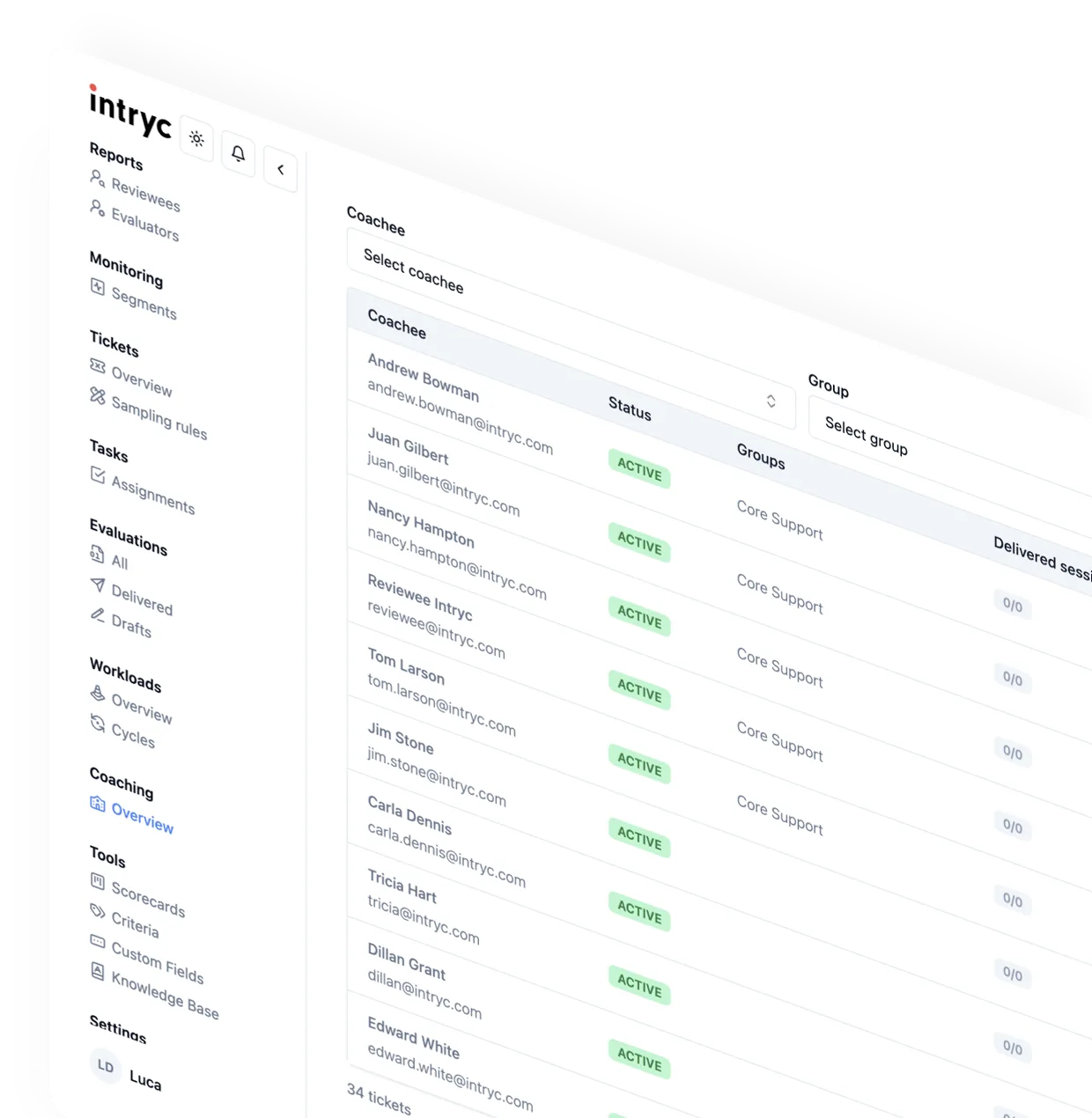
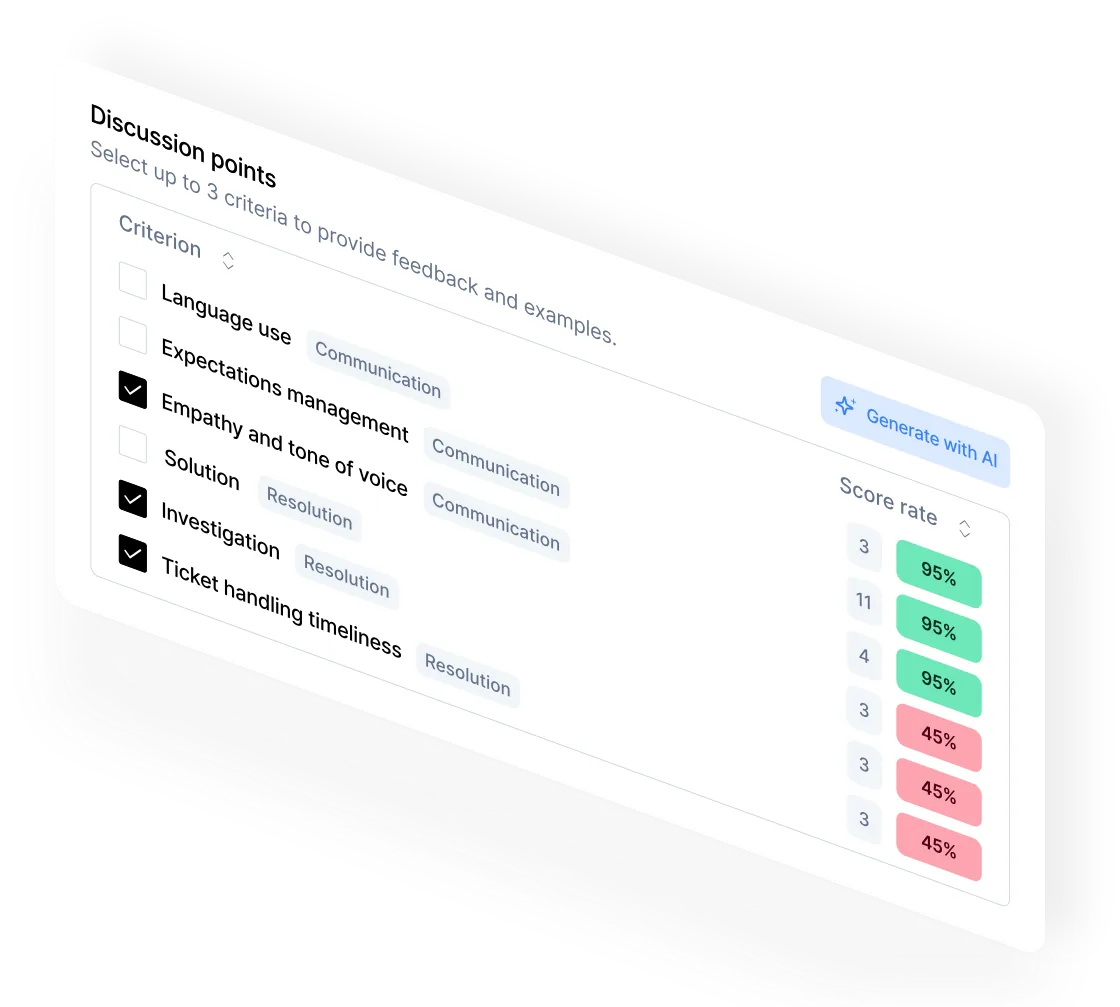
When Intryc identifies that an agent's empathy scores drop specifically on billing escalations, the coaching conversation gets specific: here are the three conversations where it happened, here is what "good" looked like on a comparable case, here is what to do differently when that trigger appears next.
AutoCoaching builds the session from that evidence automatically, so a manager does not have to assemble it by hand. The same flagged criteria can also drive a targeted quiz or training simulation, scored by the same AutoQA engine that scores live tickets - so a coaching intervention and the agent's live performance are measured against the same bar, not two disconnected systems. Blueground saved 40+ hours a week on manual audits after automating this step.
For QA managers and support ops leaders, that same evidence rolls up into scorecard-criteria performance over time, by agent, by team, and by ticket type, and shows which coaching sessions produced a measurable score change in the weeks after.
For VP and Head of CX buyers, it aggregates into quality trend lines they can share with leadership, with DSAT drivers surfaced from evaluation data rather than from a CSAT survey that only captures the customers who bothered to respond.
For compliance-sensitive teams - fintech, telecom, regulated B2B SaaS - the evaluation record is the audit trail: every evaluation logged, timestamped, and queryable, so SOP adherence is a number, not an estimate.
All of this runs across human agents and AI agents on the same dashboard - the chatbot is evaluated as its own agent, on the same scorecard as the humans or its own, not folded into a human's numbers by default.
How is root cause analysis different from basic QA reporting?
Basic QA reporting tells you what the scores were. Root cause analysis tells you why they are what they are.
A basic QA report says: Team A averaged 78% last month. Agent X scored below threshold on 12 tickets.
A root cause analysis says: The 14-point drop in knowledge-accuracy scores across Team A correlates with a policy update two weeks ago that was not reflected in the knowledge base. Agent X's below-threshold tickets cluster on a single scenario type - escalated billing disputes - where the approved resolution path is unclear.
Those two outputs produce completely different managerial actions. The first produces a performance warning. The second produces a KB update and a targeted coaching session.
What this root-cause workflow does - and does not - cover
Intryc's root-cause layer is built for one job: explaining why quality problems recur inside conversations your team already evaluates against its own scorecard. That is a QA-derived analysis, not a general-purpose diagnostic across every system in the business - here is where it fits, and where a buyer needs a different tool alongside it.
| QA-derived interaction analysis (what this workflow covers) | Requirements to validate separately (a different job) |
|---|---|
| Every conversation your team evaluates, scored against your own scorecard - your scorecard, your rules | Infrastructure incidents - a service outage, a deployment regression, a production bug - covered by your monitoring, logging, and product-telemetry stack, not by Intryc |
| Root-cause findings backed by the actual conversations and message highlights behind a pattern | Voice-of-customer signals from surveys, reviews, and NPS comments - covered by a dedicated VoC or analytics platform |
| DSAT drivers traced back to the specific evaluated interactions that show them | Predictive analytics and unsupervised topic clustering across unstructured data outside evaluated conversations |
| Reporting across coaching, training, and performance monitoring on the same scorecard | Coverage across every helpdesk, voice, and AI-agent platform in your stack - confirm your specific connections and setup requirements before assuming coverage |
If your conversations span multiple helpdesks, voice platforms, or AI agents, confirm the specific connections and setup your stack needs. Intryc connects to helpdesk, voice, and AI-agent platforms including Zendesk, Intercom, Salesforce, Freshdesk, HubSpot, Aircall, Twilio, NiCE CXone, Gorgias, Kustomer, Freshchat, Jira Service Management, Modjo, Plain, Ada, Decagon, and Brainbase Labs, plus a bulk-delivery path for anything not natively supported.
What to validate in a root cause analysis software trial
The right way to test any root cause analysis software - Intryc included - is to run these checks against your own scorecard and your own interactions, not a vendor's demo data.
- Confirm your connected interaction sources. List every helpdesk, voice, chat, and AI-agent platform you need evaluated, and confirm each one is a supported, live connection - not a roadmap item.
- Configure your own scorecard. Load your real weighted, critical, and soft criteria - not a generic template - and confirm the tool scores against your policy, not a fixed rubric. Your scorecard, your rules.
- Test review by criterion, agent, team, and ticket type. Slice the same evaluation data four ways and see whether a real pattern holds up, or only shows up in the aggregate.
- Inspect the evidence behind one root-cause finding. Open the actual conversations and quoted moments behind a flagged pattern - not just the score that a trend line is built on.
- Test the coaching or training handoff. Take one flagged finding and see whether it turns into a coaching session, quiz, or simulation without a manager rebuilding it by hand.
- Confirm reporting and re-measurement. Run a coaching intervention, then check whether the tool shows that criterion's score moving afterward - or whether that comparison is manual.
Treat integration coverage, non-conversation data sources, and any cross-system reporting need as questions to validate in your own environment, not guarantees to take at face value from any vendor's page - including this one.
Three lines worth quoting
CSAT tells you what. QA tells you why.
Your QA tool sees 5% of conversations. Your AI chatbot handles 80% of them. Both blind spots are fixable.
A root cause is not the ticket that failed. It is the pattern behind the tickets that keep failing.
Frequently Asked Questions
What is root cause analysis software for support teams?
Root cause analysis software for support teams identifies the systemic patterns behind QA failures - not just which tickets scored low, but why similar failures keep recurring across agents, shifts, or ticket types. It connects evaluation data to actionable coaching priorities instead of stopping at scores.
How does Intryc help identify recurring support problems?
Intryc evaluates every conversation - human and AI - against your custom scorecard and surfaces failure pattern clusters in the Evaluation Insights layer. Instead of reviewing a 5% sample and finding examples, you see patterns across 100% of interactions: which criteria fail consistently, on which ticket types, under which conditions. Intryc also separates controllable failures from uncontrollable ones - so you know which patterns coaching can actually fix.
Is root cause analysis the same as QA reporting?
No. QA reporting tells you what scores were. Root cause analysis tells you why scores are what they are. A QA report shows Agent X scored below threshold on 12 tickets. Root cause analysis shows that those 12 tickets share a specific scenario type where the resolution path is unclear - and that the same gap appears across 6 other agents.
Can root cause analysis improve coaching?
Yes. When Intryc identifies a specific failure pattern, it generates the evidence base for a coaching session: the relevant conversations, the relevant criteria, the specific conditions under which performance drops. Blueground saved 40+ hours per week on manual audits after automating this step. See the Blueground case study.
Does root cause analysis in Intryc replace incident investigation or voice-of-customer tools?
No. Intryc's root cause analysis is QA-derived - it explains recurring quality patterns inside conversations your team already evaluates against its scorecard. A service outage or deployment regression is a job for your monitoring and product-telemetry stack; survey, review, and NPS analysis is a job for a voice-of-customer platform. Intryc's Evaluation Insights and QA Assistant are built to complement those tools with evidence traced to real, scored conversations, not to replace them.
Who uses root cause analysis in Intryc?
QA managers and support ops leaders who run evaluation programs, and VP/Head of CX buyers who need quality trend data that connects to business outcomes. QA managers get per-criteria, per-agent, per-team breakdowns; leaders get aggregate trend lines and DSAT correlation data.
Which failure pattern would you find first if you could see every conversation?