Guides
Why Most AI QA Programs Fail, and How to Build One That Actually Works
Author
Published
Intryc
March 24, 2026
March 24, 2026 | By Alex Marantelos
Updated October 2026.
Lessons from onboarding CX quality programs across 15+ countries, evaluating millions of customer conversations, and achieving 90%+ AI accuracy consistently.
Most AI QA programs fail for one reason: they automate scorecards that were never built to be consistent, not because the AI is unreliable. The fix is structural - explicit, observable scoring criteria, continuous calibration, and a closed loop from evaluation to coaching to practice. Teams that fix the foundation first consistently reach 90%+ AI accuracy.
There’s a growing frustration in customer experience leadership right now. Teams invest in AI-powered quality assurance expecting broader coverage and stronger insight — and end up with scores nobody trusts and a system nobody uses.
When that happens, leaders often blame the AI.
That’s usually the wrong conclusion.
AI QA doesn’t fail because the technology isn’t ready. It fails because organizations try to automate frameworks that were never designed to be consistent at scale.
Most teams simply bolt AI onto vague, subjective scorecards built for humans reviewing 2–5% of tickets. When automation produces inconsistent results, the real problem isn’t the model.
It’s the foundation.
Here’s what actually works.
What We Keep Finding About Current Scorecards
Ask yourself this: if three QA analysts reviewed the same conversation, would they score it identically?
Across 15+ countries and millions of conversations, the honest answer is almost always no.
We routinely see 15–30% scoring variance between analysts reviewing identical tickets.
That’s not a people problem.
It’s a structural design flaw.
The empathy trap
The most common example is “empathy.”
Everyone agrees it matters. Almost nobody defines it precisely.
Does empathy mean apologizing? Using the customer’s name? Matching tone? Acknowledging frustration? Offering compensation?
Without clear definitions, every reviewer fills in the blanks with personal interpretation.
That subjectivity is manageable when reviewing a tiny sample manually.
It collapses under automation.
AI requires explicit, observable instructions. Feed it ambiguous criteria, and you’ll get ambiguous results.
If your framework is unclear for humans, it will fail with AI.
What high-accuracy AI scoring actually requires
We consistently operate at 90%+ AI accuracy (often higher before calibration correction).
That level of reliability does not happen by accident. It requires:
Clean, structured knowledge bases.
Contradictory SOPs and vague documentation directly reduce scoring accuracy. Knowledge base cleanup is often the highest-impact improvement during onboarding.
Explicit scoring methodology.
If you use a 0–10 scale, define exactly what each score means. What qualifies as a 5? An 8? How many grammar errors equal a failure? Ambiguity destroys consistency.
Continuous calibration.
Scorecards are living systems. Biweekly calibration sessions align QA specialists, surface inconsistencies, and refine criteria. This improves both AI accuracy and human alignment simultaneously.
Without these three elements, AI QA will feel unreliable — even if the technology itself is strong.
Designing Scorecards That Actually Scale
Transitioning to AI-assisted QA isn’t just a tool change.
It’s a design shift.
Here’s what separates scalable frameworks from fragile ones.
Replace vague judgments with observable behaviors
Instead of scoring whether an agent “was professional,” define what professionalism means in measurable terms:
• Used the customer’s name at least once
• Avoided internal jargon
• Maintained solution-oriented tone
• Fewer than two grammar mistakes
Observable behaviors scale.
Subjective adjectives do not.
Match scoring types to reality
Not everything should use the same scoring scale.
Compliance is binary.
Communication quality may require a graded scale.
Choose scoring structures intentionally — and define them clearly.
A score should mean the same thing every time, regardless of who or what evaluates it.
Add conditional logic
Applying irrelevant criteria distorts performance.
Don’t evaluate upsell behavior on a complaint ticket.
Don’t check return policy compliance on a billing inquiry.
Effective frameworks include skip logic to ensure agents are scored only on relevant criteria.
This improves accuracy and fairness.
Weight what actually matters
A compliance violation and a missed upsell are not equal.
Your weighting should reflect real business impact — not historical habits.
Without intentional weighting, your scores misrepresent risk.
Where Most QA Programs Stall
Even strong evaluation frameworks fail if nothing happens after scoring.
Many programs stop at reporting.
The real value starts after evaluation.
From evaluation to root cause
Individual ticket scores are noise.
Patterns across thousands of evaluations reveal truth.
Instead of “refund handling seems weak,” you get:
“Refund exception process misunderstood in 34% of quarterly subscription cases.”
That level of clarity turns QA from reporting into operational intelligence.
This is where AI-powered scale changes the game.
From root cause to coaching
Traditional coaching is slow and disconnected from context.
By the time feedback reaches the agent, the moment has passed.
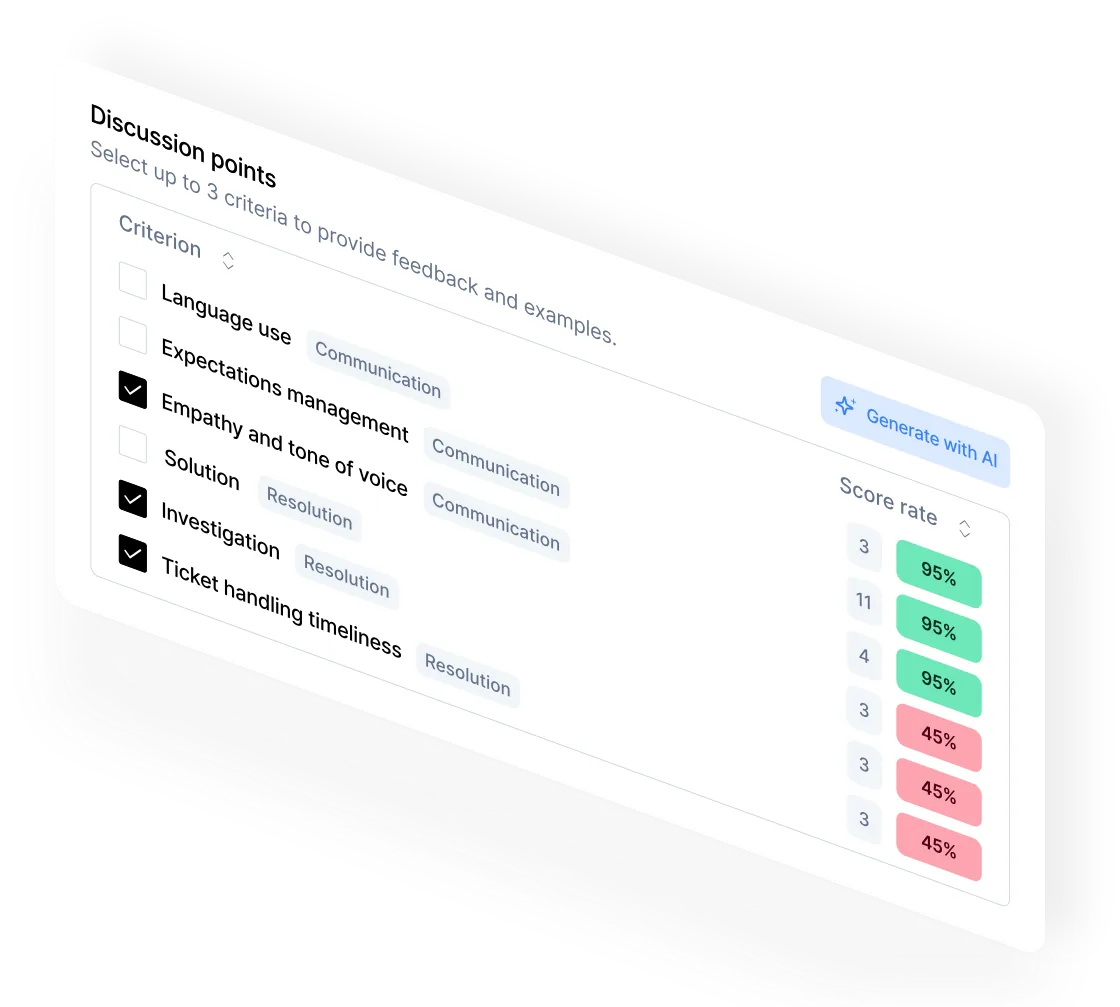
AI-generated coaching references specific tickets, identifies exact behaviors, and delivers feedback quickly — often within days.
Speed dramatically increases learning retention.
From coaching to practice
Feedback without practice creates awareness.
Practice creates improvement.
AI simulations allow agents to rehearse real scenarios drawn from actual ticket data. Instant feedback, repetition, and measurable progress replace theoretical discussions.
Organizations using simulation-based onboarding often cut ramp-up time by up to 70%.
The dispute mechanism
Disputes are not a threat to AI accuracy.
They are a calibration engine.
When agents challenge evaluations, those disputes refine scorecards, expose edge cases, and improve both human and AI consistency.
The highest-performing QA teams actively encourage disputes because they accelerate alignment.
Recognize excellence, not just failure
QA systems that only flag mistakes create disengagement.
Systems that also identify strong performance increase adoption and trust.
Quality assurance should strengthen morale, not erode it.
Your AI Agents Need QA Too
As AI chatbots handle increasing volumes of customer interactions, many organizations fail to apply QA rigor to them.
AI agents can hallucinate, misapply policies, or deliver technically correct but unsatisfying responses.
Without QA, those issues compound silently.
Applying the same scorecard framework to both human and AI agents ensures consistency and continuous improvement.
If AI handles 30–80% of your conversations, leaving it outside QA is a major blind spot.
The Flywheel: Scaling Quality Without Losing Accuracy
Sustainable QA programs follow a repeatable loop:
Step 1: Define and document.
Build explicit, observable, weighted, conditional scorecards.
Step 2: Evaluate and align with AutoQA.
Use AutoQA to assess every interaction at scale. Operate in automated, manual, or co-pilot modes. Run consistent calibration to maintain alignment.
Step 3: Analyze and coach.
Identify root causes through trend analysis, clustering, sentiment breakdowns, and DSAT drivers. Deliver AutoCoaching tied directly to real tickets.
Step 4: Practice and validate with AI simulations.
Use simulation-based practice to verify that coaching translates into behavior change.
Each loop strengthens accuracy, alignment, and performance.
That is the flywheel.
Where to Start
If your QA program feels inconsistent or stagnant, start here:
Clean your knowledge base.
Remove contradictions and ambiguity.
Rewrite one scorecard properly.
Test for reviewer consistency before scaling.
Start biweekly calibration.
Consistency precedes automation.
Accelerate feedback delivery.
If feedback takes more than a week, impact drops sharply.
Include AI in QA.
If automation touches customers, it requires evaluation.
Real Results
When organizations build the right foundation first, results follow.
Deel increased audit output by 40% and enhanced continuous improvement insights by 130%.
Blueground saved 40+ hours a week on manual audits and lifted QA coverage from 2-3% to 5.5%.
Sadapay reported not just efficiency gains, but a mindset shift — where insight, quality, and speed improved simultaneously.
These outcomes are not technology miracles.
They are the result of combining structured frameworks with AI-native scale.
Quality assurance is no longer about reviewing a small sample and hoping it reflects reality.
It is about building a system that evaluates everything, aligns everyone, and continuously improves both human and AI performance.
AI does not fix broken frameworks.
But when the foundation is right, it scales excellence.